Trump Renews Pressure on Canada as ‘51st State’ Rhetoric Deepens U.S.-Canada Rift
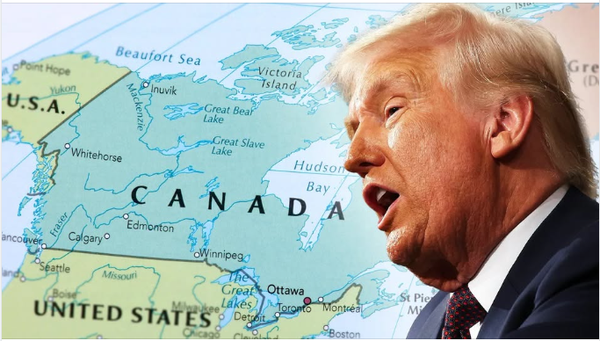


President Donald Trump has reignited tensions with Canada after sharing provocative maps and repeating his vision of Canada becoming part of the United States, intensifying an already bitter dispute.
Trump’s latest imagery depicted Canada alongside other territories within an expanded United States, according to the Associated Press, reviving questions about his ambitions toward America’s northern neighbor.
The posts followed months of Trump rhetoric about making Canada the 51st U.S. state, language that Canadian officials have repeatedly rejected as incompatible with the country’s sovereignty.
Canadian Prime Minister Mark Carney has responded by emphasizing national independence while pursuing stronger economic relationships with Europe and other international partners as tensions with Washington deepen.
Trump’s campaign against Canada is closely connected to trade. His administration has imposed increasingly aggressive tariffs, while Ottawa has responded with retaliatory measures targeting selected American products.
Reuters reported that Canada’s counter-tariffs on roughly $20 billion of U.S. goods took effect in September, escalating an eighteen-month trade conflict between the neighboring countries.
The dispute has extended beyond tariffs into symbolic gestures. Trump recently ordered U.S. federal agencies to use the name “Lake America” for Lake Ontario, a move Canada rejected.
Trump has also directed the General Services Administration to begin removing Canadian-origin products from certain federal purchasing schedules, citing what he described as unfair treatment of American businesses.
Canadian officials argue that such measures threaten one of the world’s most integrated bilateral economic relationships, while Ottawa increasingly seeks alternatives that could reduce dependence on the American market.
Carney is now promoting deeper ties with the European Union, describing the effort as a potential “unique alliance” rather than seeking full Canadian membership in the bloc.
Reuters reported that Canada and the European Union are exploring cooperation involving energy, artificial intelligence, critical minerals, defense, infrastructure, and other strategic sectors.
The shift reflects Canada’s concern that its traditional economic relationship with the United States has become more vulnerable to tariffs, political pressure, and unpredictable policy changes from Washington.
Trump, meanwhile, continues to argue that Canada would benefit economically and strategically from becoming part of the United States, despite strong Canadian political resistance to the proposal.
Canadian nationalism has strengthened in response to Trump’s rhetoric, with the 51st-state idea becoming a powerful political symbol for defending the country’s independence and national identity.
The controversy has also affected communities along the border, where businesses on both sides have reported weaker cross-border activity as tariffs, boycotts, and political tensions influence consumer behavior.
At the national level, the dispute is increasingly becoming a broader geopolitical issue as Canada attempts to diversify trade while maintaining its longstanding security and economic relationship with Washington.
The United States and Canada remain deeply connected through commerce, energy, manufacturing, agriculture, tourism, and supply chains, making prolonged confrontation potentially costly for businesses and consumers in both countries.
Trump’s rhetoric has therefore created a difficult balancing act for Canadian leaders, who must protect national interests while avoiding unnecessary damage to one of the country’s most important markets.
With trade negotiations stalled and Canada strengthening ties with Europe, the confrontation appears unlikely to disappear soon, particularly as both governments prepare for further economic and political pressure.
For Trump, the Canada dispute has become a defining example of his transactional approach to foreign policy, while for Canada, resistance to his demands has become increasingly tied to sovereignty.
Image note: The uploaded photograph is used only as an illustrative political visual. The article does not treat the image itself as evidence of the specific statements, map, or events described above.
Comments (0)
Loading comments...
May You Like

gfnhgmnghnmfgnbvvvvvvvvv

Barack Obama Draws Attention With New Literary Podcast