Trump Said Canada Is “Tougher to Deal With” Than China — But the Viral Graphic Changes the Meaning
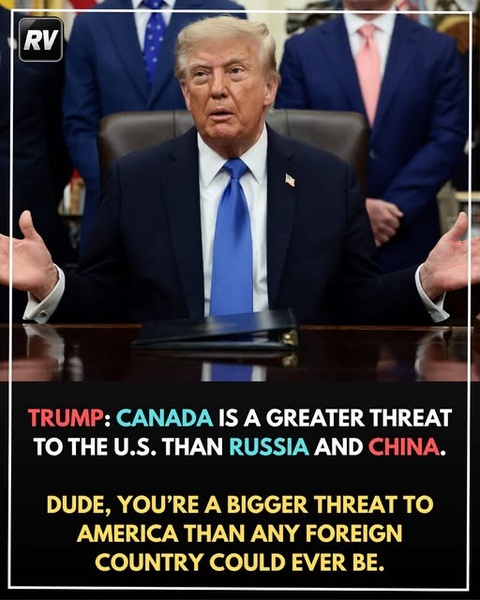
A viral graphic circulating online claims President Donald Trump said:
“Canada is a greater threat to the U.S. than Russia and China.”
It then adds a second line accusing Trump of being “a bigger threat to America than any foreign country.”
That graphic is misleading. Trump did make a striking statement about Canada on September 2, 2026 — but he did not say that Canada was a greater threat to the United States than Russia and China.
The image takes a real Trump remark about trade negotiations and transforms it into a much broader claim about national security threats.
What Trump actually said
During an Oval Office exchange with reporters on September 2, Trump was discussing negotiations with Canada and the difficulty of dealing with the Canadian government.
A reporter asked, in effect, which country was the toughest to negotiate with — China or Vietnam.
Trump answered:
“No, actually, it’s Canada.”
He continued by saying Canada had “felt emboldened” and accused successive Canadian governments of taking advantage of the United States.
Reuters also obtained video of the exchange, confirming that Trump was talking about which country was hardest to deal with, not which country represented the greatest military or national-security threat to America.
That distinction is crucial.
“Toughest to deal with” ≠ “greatest threat”
Trump's actual statement can reasonably be summarized as:
Canada is, in his view, harder to negotiate with than China or Vietnam on the issues he was discussing.
The viral graphic turns that into:
Canada is a greater threat to the United States than Russia and China.
Those are two very different propositions.
There is no evidence in the transcript that Trump made the second statement.
The real dispute is about trade
Trump's comments came amid an increasingly bitter U.S.-Canada trade confrontation.
The Trump administration imposed additional 50% duties on certain Canadian products in July, including measures involving dairy, automobiles and alcoholic beverages. The White House justified those measures by alleging discriminatory treatment of U.S. commerce.
The conflict escalated again this week.
On September 8, the White House announced that certain Canadian products, including specified automobiles and auto parts, would be excluded from U.S. imports beginning September 29.
Reuters reported that the United States also announced further restrictions involving Canadian dairy, alcohol and other products as the trade dispute intensified.
So there is a real and serious deterioration in U.S.-Canada economic relations behind the viral post.
But that still isn't the same thing as Trump declaring Canada a greater national-security threat than Russia or China.
What about Russia and China?
This is where the graphic becomes especially misleading.
The U.S. intelligence community's 2026 Annual Threat Assessment describes China and Russia as persistent and active threats to U.S. interests. It specifically describes China's military modernization and potential ability to challenge the United States in the Indo-Pacific, while Russia retains capabilities that can threaten U.S. interests through military and nonmilitary means.
There is no equivalent assessment in that report saying Canada is a greater threat than either country.
In fact, the U.S. and Canada continue to operate a deeply integrated continental-defense system.
NORAD is a binational U.S.-Canadian command responsible for detecting and responding to threats to North America.
Just days before Trump's September comments, American and Canadian military forces completed Exercise AMALGAM DART 2026, a joint air-defense exercise designed to strengthen the two countries' ability to defend North America. NORAD described it as reinforcing the “enduring United States-Canada defense partnership.”
That doesn't mean the two governments have no disagreements. They plainly do. But it puts Trump's trade rhetoric into its proper context.
The second sentence isn't a Trump quote either
The graphic's bottom line —
“DUDE, YOU'RE A BIGGER THREAT TO AMERICA THAN ANY FOREIGN COUNTRY COULD EVER BE.”
— is clearly presented as a response from the graphic's creator, not as part of Trump's statement.
It is political commentary.
Likewise, the headline claim that Canada is a greater threat than Russia and China is not an accurate transcription of Trump's September 2 remarks.
Why the distinction matters
There is plenty to criticize or debate about Trump's handling of Canada.
He has repeatedly threatened tariffs, advocated — sometimes provocatively — for Canada becoming the 51st U.S. state, and used increasingly hostile economic rhetoric toward America's northern neighbor.
And the current trade confrontation is very real. On September 3, Canadian Prime Minister Mark Carney said Canada remained prepared to reach a trade agreement with Washington, while Trump continued criticizing Canada's approach.
But fact-checking the viral image requires separating what Trump actually said from what political commentators think his statement means.
He said Canada was tougher to deal with.
He did not say Canada posed a greater threat to the United States than Russia and China.
Verdict: MISLEADING
The graphic is built around a real Trump statement, but it substantially changes its meaning.
Real: Trump said on September 2 that Canada was tougher to deal with than China or Vietnam in the context of negotiations.
False attribution: There is no evidence he said Canada was a greater threat to the U.S. than Russia and China.
Opinion: The claim that Trump himself is a greater threat to America than any foreign country is political commentary, not a factual quotation.
The viral post therefore takes a genuine Trump remark from the escalating U.S.-Canada trade dispute and repackages it as a much more extreme national-security statement.
Comments (0)
Loading comments...
May You Like
Russian Drone Strikes Kyiv Bridge as German Chancellor Arrives in Ukraine
South Korea–Ukraine Rift Deepens Over North Korean POW Transfer as PURL Draws New Scrutiny