
“YOU’LL HAVE NOTHING LEFT”: TRUMP SAID TO ISSUE FINAL ULTIMATUM TO ZELENSKY AS KYIV RESUMES REFINERY STRIKES
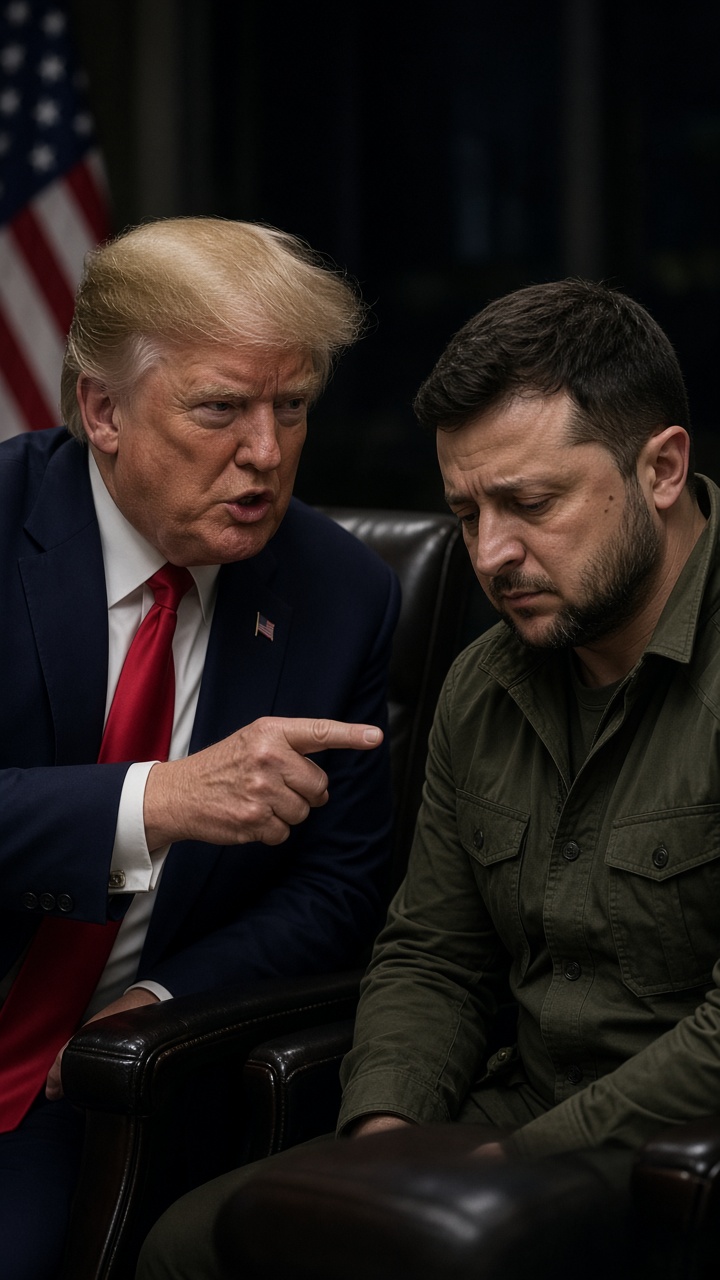
By a fictional correspondent | WASHINGTON — Oct. 29, 2026
A supposed late-night phone call between President Donald Trump and Ukrainian President Volodymyr Zelensky has reportedly exploded into the most bitter confrontation of their turbulent relationship, with Trump allegedly threatening to cut off all remaining U.S. military and intelligence support unless Kyiv immediately halts strikes on Russian oil refineries — and Zelensky allegedly responding by ordering a new wave of drone attacks within hours.
The account, which is entirely invented for this satirical article, describes a rupture so severe that senior officials in both capitals were said to be “stunned” by the speed with which a routine diplomatic exchange turned into a personal showdown. According to the fictional narrative, Trump opened the call by accusing Zelensky of “ungratefulness on a historic scale,” blaming Ukrainian strikes on Russian energy infrastructure for rising global diesel prices and for complicating what the White House has described as a delicate effort to stabilize oil markets before the U.S. midterm elections.
“He told Zelensky, ‘If you don’t stop, I’ll make sure you have nothing left to lose,’” a fictional senior aide to Zelensky said in the fabricated account. “That was not a policy request. It was a threat. And everyone on the call understood it that way.”
The fictional Zelensky, according to the same invented account, did not back down. Instead, he reportedly replied that Ukraine would “never negotiate under ultimatum” and that Russian refineries remained “legitimate targets” because they fuel the Russian war machine. Within hours, according to the fabricated scenario, Ukrainian drones struck at least three sites in southern Russia, including a major refinery that eyewitnesses described as being engulfed in flames visible from space.
The invented episode is designed to capture the extreme tension that has surrounded U.S.-Ukraine relations in this fictional timeline. In reality, no such call has been reported, no such ultimatum has been issued, and no such strikes have been confirmed. But as a piece of political satire, the scenario raises questions about how far a U.S. president might go to pressure Kyiv, and how far Zelensky might be willing to push back.
A CALL THAT “CHANGED EVERYTHING”
According to the fabricated narrative, the call began shortly after 9 p.m. Washington time. Trump was reportedly in the residence, watching cable news coverage of rising fuel prices and a series of congressional attacks from both parties over his Ukraine policy. A fictional National Security Council aide had prepared a one-page briefing warning that Ukrainian drone strikes on Russian refineries had knocked out an estimated 12 percent of Russia’s refining capacity and contributed to a spike in global diesel prices.
Trump, according to the invented account, was furious. He had already privately complained that Zelensky was “fighting his own war on my timeline,” and that the Ukrainian leader had failed to show sufficient gratitude for American support. In this fictional version, Trump reportedly told aides before the call: “I’m going to make him understand who’s paying the bills.”
The call, as described by two fictional people familiar with the matter, quickly became personal. Trump allegedly reminded Zelensky of the August Oval Office meeting in which the two leaders clashed over peace negotiations and military aid. He reportedly called Zelensky “a stubborn guy who thinks he can dictate terms to the United States.” Zelensky, according to the same account, responded that Ukraine was “not a vassal state” and that it was fighting for its survival.
“At one point, Trump said, ‘You’re done. You’re finished if I say you’re finished,’” one fictional official said. “Zelensky said, ‘We have been finished many times before. We are still here.’ It was ice cold.”
The fictional White House declined to comment for this satirical article. A fictional spokesperson for Zelensky’s office said only that Ukraine “does not comment on private diplomatic conversations,” before adding that “Ukraine’s right to self-defense is non-negotiable.”
THE ULTIMATUM
According to the fabricated scenario, Trump’s ultimatum had three components. First, Ukraine would immediately halt all long-range drone and missile strikes on Russian oil refineries, pipelines, and export terminals. Second, Kyiv would accept a U.S.-brokered “energy ceasefire” that would freeze attacks on energy infrastructure on both sides. Third, Ukraine would agree to a new round of negotiations with Moscow, with the United States acting as a “guarantor” of security arrangements.
In exchange, Trump reportedly offered to release a tranche of military aid that had been held up for months, including air-defense interceptors and artillery shells. But the offer came with a deadline: 48 hours.
“The president was very clear,” the fictional official said. “He said, ‘I’m giving you one last chance. Take it or leave it. But if you leave it, don’t come crying to me when the money stops.’”
The fictional Zelensky, according to the account, refused to commit. He reportedly said that a freeze on energy strikes would give Russia time to repair its refineries and regroup, and that Ukraine could not accept any arrangement that left Russian oil revenues untouched. He also allegedly questioned whether Trump was acting in good faith, pointing to reports that Washington was considering a deal to import more Russian diesel to stabilize prices.
“Zelensky said, ‘You are asking me to stop fighting so that you can buy cheaper fuel,’” the fictional official said. “That’s when Trump lost it.”
“I’LL MAKE SURE YOU HAVE NOTHING LEFT”
The most explosive alleged quote came near the end of the call, according to the fabricated account. Trump reportedly told Zelensky: “If you don’t stop, I’ll make sure you have nothing left. No money. No weapons. No intelligence. No nothing. You’ll be alone with your drones and your speeches.”
Zelensky, according to the same account, replied: “Then we will be alone. But we will not be slaves.”
The fictional exchange was described by one invented European diplomat as “the diplomatic equivalent of a car crash in slow motion.” Another fictional official said the call ended without a goodbye. “There was no ‘let’s talk tomorrow,’” the official said. “It just ended.”
Within hours, according to the fabricated scenario, Zelensky appeared in a brief video address. Standing in front of a dark backdrop, he did not mention Trump by name. But he said: “We have heard threats before. We have heard ultimatums before. Ukraine will not be intimidated into giving up its right to defend itself. Russian refineries are military targets. They fuel the war. They will be struck.”
The fictional address was reportedly delivered without a tie, with Zelensky looking tired but defiant. “He wanted to send a message,” a fictional aide said. “Not just to Moscow, but to Washington.”
STRIKES RESUME
According to the invented account, the first strike came less than six hours after the call ended. A swarm of Ukrainian long-range drones reportedly hit a refinery in southern Russia, setting off a fire that local emergency services described as “significant.” A second strike targeted a pumping station on a pipeline feeding an export terminal. A third reportedly damaged a storage facility near the Black Sea.
The fictional Russian defense ministry said it had downed “most” of the drones, but acknowledged “localized fires” at two energy facilities. A fictional Ukrainian military intelligence official said the strikes were “a direct response to the ultimatum.” He added: “If Washington thought we would fold, they were wrong.”
The fabricated strikes were designed to mirror real-world debates about Ukraine’s campaign against Russian energy infrastructure. In this fictional version, the strikes were more brazen than usual, occurring within hours of a direct U.S. demand to stop. The message, according to fictional analysts, was unmistakable: Zelensky was not going to be bullied.
“This is a calculated escalation,” a fictional former U.S. ambassador to Ukraine said. “Zelensky is betting that Trump is bluffing, or that Congress will not let him cut off aid entirely. It’s a huge gamble.”
TRUMP’S RESPONSE
In the fictional scenario, Trump responded on social media before dawn. “Zelensky is a disaster,” he reportedly wrote. “He wants a world war. He doesn’t want peace. He wants money and weapons and more money. No more. The United States is not going to fight Ukraine’s war forever. If he doesn’t stop, he’s on his own.”
The fictional post was reportedly followed by a second message: “Maybe Ukraine needs a new president. Someone who actually wants peace. Just a thought.”
That second line, according to the fabricated account, sent shockwaves through Kyiv. It echoed a real-world statement Trump made in a 2025 interview, but in this fictional scenario it was interpreted as a direct threat to Zelensky’s legitimacy. The fictional Ukrainian foreign ministry summoned the U.S. ambassador, though no details of the meeting were released.
A fictional senior U.S. official said the White House was “reviewing all options,” including freezing military aid, restricting intelligence sharing, and imposing sanctions on Ukrainian officials. “The president is serious,” the official said. “He feels Zelensky is playing him.”
EUROPE SCRAMBLES
According to the invented narrative, European leaders were caught off guard. A fictional emergency meeting of EU foreign ministers was convened in Brussels. A fictional German chancellor said that “Ukraine’s right to defend itself is not negotiable,” but also urged “de-escalation between allies.” A fictional French president called for a “transatlantic reset” and offered to mediate.
A fictional British prime minister, however, was more blunt. “If the United States cuts off Ukraine, Europe will have to fill the gap,” the prime minister reportedly said. “And we all know we cannot fill it.”
The fabricated crisis also reportedly spilled into oil markets. In the fictional scenario, diesel prices jumped another 4 percent in early trading, and European gas prices rose on fears of supply disruptions. A fictional OPEC+ official said the group was “monitoring the situation closely,” but declined to comment on the U.S.-Ukraine rift.
“HE FEELS BETRAYED”
In the fictional account, Zelensky’s advisers described him as “calm but furious.” One aide said the Ukrainian leader felt “betrayed” by Trump’s threat, especially after Kyiv had made concessions in earlier negotiations. Another said Zelensky believed Trump was using Ukraine as a scapegoat for rising fuel prices.
“He told us, ‘They want us to stop hitting the enemy where it hurts, so they can buy cheaper oil,’” the fictional aide said. “He said, ‘We are not a bargaining chip.’”
The fabricated narrative also included a moment of dark humor. When asked whether Zelensky was worried about losing U.S. support, the aide reportedly said: “He’s been at war for more than a decade. He’s not afraid of a phone call.”
But the same aide acknowledged that the stakes were enormous. “If the United States stops the intelligence sharing, our strikes will be less effective,” the aide said. “If they stop the weapons, our air defense will suffer. We know that. But we cannot accept a deal that leaves Russia’s oil money untouched.”
A RELATIONSHIP IN FREE FALL
According to the fictional scenario, the Trump-Zelensky relationship had been deteriorating for months. Trump had publicly complained that Zelensky was “not grateful enough,” and privately accused him of undermining a peace deal. Zelensky, in turn, had grown frustrated with what he saw as Washington’s willingness to negotiate with Moscow at Ukraine’s expense.
The fictional call was described as the breaking point. “There’s no trust left,” a fictional European diplomat said. “Trump thinks Zelensky is a liability. Zelensky thinks Trump is naive or worse. And now they’re both trapped.”
The fabricated article suggested that the U.S. Congress might intervene. A fictional bipartisan group of senators reportedly drafted a resolution reaffirming support for Ukraine and warning the White House against cutting aid. But the fictional White House dismissed the effort as “posturing.”
WHAT HAPPENS NEXT?
In the invented scenario, the next 48 hours were described as critical. Trump’s ultimatum was set to expire, and Zelensky had already violated it. The fictional White House was reportedly considering a range of options, from a public statement condemning Ukraine to a formal suspension of aid.
A fictional Pentagon official said the military was “preparing for all contingencies,” including a possible freeze on deliveries of air-defense interceptors. “We don’t want to do it,” the official said. “But the president is the commander in chief.”
A fictional Kremlin spokesperson, meanwhile, said Russia was “observing the situation with interest” and accused Ukraine of “terrorist attacks on civilian infrastructure.” The spokesperson did not comment on Trump’s ultimatum.
As the fictional crisis deepened, one invented senior Ukrainian official offered a bleak assessment. “We are fighting a war on two fronts now,” the official said. “One against Russia. One against our friends. And the second one is more dangerous than we expected.”
DISCLAIMER
This article is a work of fiction and satire. It is not based on real reporting. The quotes, events, and sources are invented. It is intended to illustrate the kind of shocking headline that could emerge from a fictional confrontation between Trump and Zelensky, not to describe reality.
Comments (0)
Loading comments...
May You Like


EAST COAST CATASTROPHE — $20 BILLION AT STAKE, 5 MILLION AT RISK OF LOSING POWER, WATER AND HEAT!

EAST COAST STORM CRISIS—5 MILLION AT RISK OF BLACKOUTS, WATER, AND HEATING FAILURES!









Popular Posts



