Trump Says a Canada Deal Could Come “Fairly Soon” — But Ottawa Is Already Building a Future Beyond the U.S.
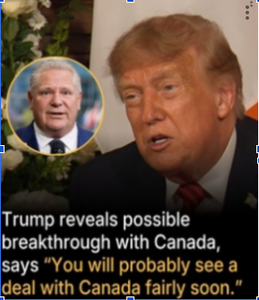
President Donald Trump has suggested Washington and Ottawa could still reach an agreement, while Prime Minister Mark Carney accelerates a historic shift toward Europe after trade negotiations with the United States collapsed.
WASHINGTON/OTTAWA — President Donald Trump has raised hopes of a possible breakthrough in the increasingly bitter U.S.-Canada trade dispute, saying he believes a new agreement with Ottawa could arrive “fairly soon.”
The statement offered a notably more optimistic tone after months of tariffs, diplomatic confrontation and unsuccessful negotiations between two countries whose economies have been deeply interconnected for generations.
Trump said Canada wants an agreement and suggested remaining disputes could ultimately be resolved, particularly if Ottawa addresses American complaints involving agricultural trade and access to Canadian markets.
But days after those remarks, no new comprehensive U.S.-Canada agreement has been announced, and the two governments remain separated by significant disagreements over tariffs, procurement, agriculture and industrial policy.
Formal negotiations have remained suspended since August, when Carney walked away from the negotiating table rather than accept terms his government concluded Canada could not live with.
Carney has since repeatedly defended that decision, arguing that returning immediately to negotiations would make little sense unless Washington presents terms that better protect Canadian economic and sovereignty interests.
That makes Trump’s “fairly soon” language an expression of optimism about future negotiations rather than confirmation that negotiators have already reached a new agreement.
The disagreement represents a dramatic change in one of the world’s largest trading relationships. For nearly four decades, Canada deliberately increased its economic integration with the United States.
The 1989 Canada-U.S. Free Trade Agreement and subsequent NAFTA framework encouraged increasingly integrated supply chains involving automobiles, manufacturing, agriculture, energy and numerous other industries.
Today, approximately 70% of Canadian exports still go to the United States, illustrating both the extraordinary scale of the relationship and the difficulty Canada faces in reducing that dependence.
Trump has used that dependence as leverage, imposing tariffs and demanding changes that his administration argues are necessary to create a fairer commercial relationship for American businesses and workers.
Canada disputes important elements of that characterization and has responded with countermeasures while insisting any future agreement must preserve its ability to make independent decisions about domestic economic policy.
Carney is now pursuing a much broader response than retaliatory tariffs. His government is attempting to fundamentally diversify Canada’s international economic relationships rather than simply wait for another American agreement.
Europe has become central to that strategy. Carney recently addressed the European Parliament and called for a substantially deeper alliance spanning energy, defense, artificial intelligence, critical minerals, research and investment.
European Commission President Ursula von der Leyen went further, publicly proposing that Canada could become the European Union’s first “associate member,” although no such formal membership category currently exists.
Carney welcomed the possibility of closer integration but emphasized that Canada is not seeking conventional EU membership or surrendering its sovereign decision-making authority to European institutions.
French President Emmanuel Macron subsequently endorsed the push for closer Canada-EU ties during a meeting with Carney in Saint-Pierre-et-Miquelon, the French territory located just off Canada’s Atlantic coast.
Their discussions covered defense, energy, telecommunications, space and emerging technologies, demonstrating that Canada’s European pivot extends well beyond ordinary tariff negotiations.
Carney has framed that diversification as economic insurance, arguing Canada should never again depend so heavily on a single trading partner that another government can effectively dictate its economic choices.
His government aims to double Canadian trade outside the United States over the next decade, while also pursuing additional commercial relationships with major economies including India.
Canada is simultaneously attempting to attract international capital by portraying itself as a comparatively predictable investment destination built around political stability, rule of law and access to numerous global markets.
The government recently announced nearly half a trillion dollars in investment commitments surrounding its Canada Investment Summit and promoted tax incentives intended to encourage new business investment.
Carney described the recent diplomatic and investment activity as merely a “warm-up,” signaling that his government intends to continue accelerating diversification even if negotiations with Washington eventually resume.
That does not mean Canada is abandoning the United States. Replacing the American market would be extraordinarily difficult given the scale, proximity and decades of infrastructure connecting the two economies.
Canadian officials instead describe the strategy as reducing vulnerability by increasing non-U.S. trade while preserving as much beneficial commerce with America as circumstances allow.
Trump continues applying pressure. This week he said Washington was working on purchasing potash from Belarus at prices he claimed would be substantially lower than those paid for Canadian supplies.
That matters because Canada currently provides roughly 79% of U.S. potash imports, making fertilizer another example of the extensive economic interdependence underlying the political confrontation.
Trump has also reacted skeptically to Canada’s European pivot, warning that certain forms of deeper Canada-EU integration could be treated by Washington as hostile to American economic interests.
For Ottawa, however, the confrontation has already changed long-term thinking. Carney has said the period when Canada could comfortably rely upon one dominant economic partner is effectively over.
Even former Conservative Prime Minister Stephen Harper has acknowledged the need for greater diversification, suggesting the underlying debate extends beyond Carney’s Liberal government and immediate disagreements with Trump.
The next major milestone will be the Canada-EU summit scheduled for October 29–30 in Montreal, where officials are expected to explore what a substantially deeper partnership might actually contain.
Meanwhile, Washington and Ottawa retain powerful incentives to find common ground. Businesses on both sides depend on integrated supply chains, while consumers and workers can face higher costs when tariffs disrupt cross-border commerce.
That leaves two seemingly contradictory developments unfolding simultaneously: Trump continues signaling that a bilateral agreement remains possible, while Carney is preparing Canada for a future in which America matters less.
Comments (0)
Loading comments...
May You Like
OBAMA STEPS BACK INTO THE POLITICAL SPOTLIGHT

Shocking news from Ohio: an unexpected development ahead of Trump's rally

Shocking news from Ohio: an unexpected development ahead of Trump's rally