
Trump Says Canada “Should Be a State” as Trade Fight With Ottawa Escalates
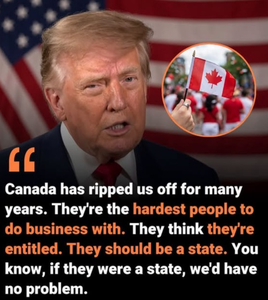
The president has renewed one of his most provocative claims about America’s northern neighbor, accusing Canada of exploiting U.S. trade while arguing statehood would eliminate the countries’ economic dispute.
WASHINGTON — President Donald Trump has renewed his suggestion that Canada should become an American state, escalating already extraordinary rhetoric as Washington and Ottawa remain locked in a widening trade confrontation.
Speaking during a September 11 radio interview, Trump accused Canada of taking advantage of the United States for years and described Canadians as exceptionally difficult trading partners.
Trump then said Canadians act as though they are “entitled” before repeating his longstanding suggestion that Canada should become a state, arguing such an arrangement would eliminate current disagreements.
The remarks were not presented as a formal annexation proposal. Trump instead connected the statehood rhetoric directly to his broader complaints about tariffs, automobiles, agriculture and Canadian access to American markets.
He specifically argued that tariffs are encouraging automobile production to relocate from Canada into the United States, portraying that movement as evidence that his trade strategy is producing results.
Trump also complained about Canadian treatment of American farmers and businesses, continuing his argument that previous U.S. administrations tolerated commercial arrangements that disadvantaged American producers.
Canada disputes that broader characterization. The two countries remain enormously integrated commercially, with roughly $800 billion in annual trade and supply chains that frequently cross the border multiple times.
The United States also relies heavily on Canada for certain commodities. Trump himself recently acknowledged America’s substantial dependence on Canadian aluminum while defending his administration’s broader tariff strategy.
The latest remarks come during a particularly difficult period in bilateral relations after negotiations intended to resolve the countries’ tariff dispute collapsed without an agreement in August.
Canadian officials said the two sides had appeared close to reaching a deal before disagreements involving automobiles, steel, aluminum and other economically important sectors prevented them from reaching acceptable final terms.
Trump’s administration subsequently imposed 50% tariffs on roughly $20 billion of Canadian imports, while threatening additional measures involving steel, automobiles and other industries.
Canada responded with retaliatory tariffs ranging from 15% to 50% on approximately $27 billion of American goods, including steel, appliances, agricultural equipment, paper products and electronics.
Those measures have begun creating consequences on both sides of the border, particularly for companies operating within supply chains that developed around decades of relatively unrestricted North American commerce.
PBS documented one Michigan furniture business reporting thousands of dollars in lost profit because tariffs sharply increased project costs, illustrating how the dispute can reach individual American companies.
Canadian Trade Minister Dominic LeBlanc nevertheless emphasized that Ottawa does not consider the relationship permanently broken, describing current tensions as economic turbulence that both governments will eventually need to navigate.
He also highlighted the unusual personal connections between the countries, noting that millions of Canadians maintain family, educational, business, tourism and property relationships across the border.
Trump’s renewed statehood language therefore introduces a sovereignty dispute into what might otherwise resemble a conventional disagreement over tariffs and market access between two deeply interconnected economies.
Canadian political leaders have consistently rejected the idea that their country could become an American state, while Ottawa increasingly emphasizes economic independence and diversification away from excessive reliance on U.S. markets.
Trump’s argument is different. He has repeatedly portrayed America’s enormous consumer market as economic leverage and argues foreign manufacturers can avoid tariffs by moving production directly into the United States.
His September 11 comments applied that logic specifically to Canadian automobiles, suggesting companies would increasingly relocate production as American tariffs make Canadian manufacturing less economically attractive.
The president also criticized Canadian restrictions involving private aircraft, telling listeners that Canadian policies had harmed Gulfstream while favoring domestic competitor Bombardier.
Whether those individual trade complaints justify Trump’s broader characterization of Canada as having “ripped off” America is disputed; trade balances alone do not establish that one country is exploiting another.
The dispute also involves an agreement Trump himself negotiated during his first presidency. The U.S.-Mexico-Canada Agreement replaced NAFTA and has governed much of North American commerce since taking effect in 2020.
Canadian officials now emphasize that major industries developed around tariff-free continental integration, arguing that imposing new duties creates costs for businesses and consumers on both sides rather than affecting Canada alone.
For Ottawa, the response increasingly involves building alternatives. Canada has been pursuing deeper economic and security relationships with Europe while seeking additional international markets for Canadian exports.
For Washington, the strategy remains centered on tariffs and American market access, with Trump arguing those tools can persuade companies to manufacture more products inside the United States.
That leaves two longtime allies pursuing increasingly different economic strategies while their leaders exchange rhetoric rarely associated with the historically close U.S.-Canada relationship.
Trump’s latest comments also demonstrate that his “state” rhetoric has not disappeared as trade tensions intensified. Rather than separating sovereignty from commerce, he continues publicly linking the two issues.
The key distinction for readers is that Trump did make the statehood remark, but his statement does not mean the United States has initiated a legal process to absorb Canada.
What exists today is a serious trade confrontation accompanied by unusually provocative presidential rhetoric — while Canada remains an independent sovereign country and rejects the prospect of becoming part of the United States.
Comments (0)
Loading comments...
May You Like

Russian Drone Strikes Kyiv Bridge as German Chancellor Arrives in Ukraine
OBAMA STEPS BACK INTO THE POLITICAL SPOTLIGHT














