Trump Says Canada Trade Deal Could Come “Fairly Soon” — But the Trade War Is Still Escalating
The president is publicly predicting a possible breakthrough with Canada, even as new tariffs, procurement restrictions and Ottawa’s push toward Europe complicate the path to an agreement.
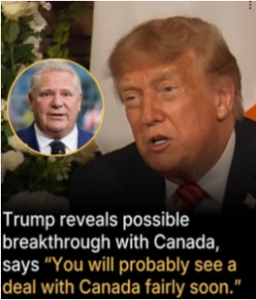
WASHINGTON/OTTAWA — President Donald Trump says the United States could reach a new trade agreement with Canada “fairly soon,” raising the possibility of a breakthrough after weeks of escalating economic confrontation.
Trump made the prediction during a September 12 visit to Ireland, where reporters questioned him about the future of the United States-Mexico-Canada Agreement and Washington’s increasingly difficult relationship with Ottawa.
The president said Canada wanted an agreement “very badly” and suggested Washington remained willing to negotiate despite accusing its northern neighbor of taking advantage of American trade for decades.
Trump identified agriculture as one of the biggest remaining obstacles, criticizing Canadian tariffs affecting some American farm products and demanding that Ottawa provide U.S. producers with better access.
He then delivered the line now circulating widely online, saying that once those issues disappear, Americans will “probably see a deal with Canada fairly soon.”
The remark represented a notable change in tone following the collapse of negotiations in August, when Canada rejected an American proposal and recalled its negotiating team from Washington.
Only weeks earlier, the two governments had appeared extraordinarily close. Canadian Trade Minister Dominic LeBlanc said August 20 that negotiators were “very close” following lengthy discussions with U.S. Trade Representative Jamieson Greer.
Trump similarly said negotiations were “moving along,” while officials attempted to finalize an agreement before another round of threatened American tariffs was scheduled to take effect.
The optimism briefly appeared justified. On August 18, Trump announced that the countries had a deal subject to final documentation and temporarily delayed planned 50% tariffs for three days.
Canadian Prime Minister Mark Carney was more cautious, saying substantial progress had been achieved but warning that important issues still needed to be resolved before Canada could accept a final agreement.
Those remaining differences ultimately proved decisive. Negotiations collapsed August 21, and the United States imposed 50% tariffs on nearly $28 billion worth of Canadian products.
Canada responded by suspending formal negotiations and announcing dollar-for-dollar retaliation against American imports, transforming what appeared close to resolution into another major escalation.
The situation has not substantially improved since Trump predicted a new agreement on September 12. Additional American tariffs affecting selected Canadian products took effect three days later.
Washington imposed 50% duties on products representing approximately 0.6% of U.S. imports from Canada, including certain boats, metal goods and paper products.
The administration simultaneously removed 50% tariffs from another small category of Canadian imports, including cement, sugar, toilet paper and fishing rods, demonstrating the increasingly complicated nature of the dispute.
Trump escalated further September 16 by directing federal agencies to remove Canadian-origin products from portions of U.S. government procurement, citing what his administration described as discriminatory Canadian purchasing practices.
The White House said the action was intended to pressure Canada over its “Buy Canadian” rules, which prioritize domestic suppliers and Canadian materials for some major federal purchases.
Canada has argued that the United States operates its own “Buy America” policies favoring domestic producers, making procurement another increasingly contentious component of the broader trade confrontation.
Carney responded Friday by calling Washington’s latest escalation a “miscalculation” and defending his government’s decision to walk away from the proposed August agreement.
The Canadian prime minister said the United States had offered too little while demanding too much, arguing that accepting the proposal would have compromised important Canadian economic and sovereignty interests.
Despite the confrontation, communication between officials has not completely stopped. LeBlanc said Canadian and American officials continued talking even though the countries were no longer conducting formal trade negotiations.
LeBlanc said he had spoken repeatedly with Greer and occasionally with Commerce Secretary Howard Lutnick, while emphasizing that Canada remained prepared for an agreement protecting its national interests.
That continuing communication provides some basis for Trump’s suggestion that another agreement remains possible, but there is currently no evidence that the two governments have returned to formal negotiations.
Meanwhile, Canada is rapidly developing alternatives. Carney has spent recent days deepening economic and strategic relationships with Europe as his government attempts to reduce Canada’s dependence on the American market.
European Commission President Ursula von der Leyen has proposed creating an unprecedented form of EU “associate membership” for Canada, although no such formal legal category currently exists.
Carney welcomed deeper integration while emphasizing that Canada is not seeking conventional EU membership or surrendering sovereignty to European institutions.
French President Emmanuel Macron has since backed the initiative, while Canada and France are pursuing expanded cooperation involving defense, energy, telecommunications, space and emerging technologies.
Trump has reacted skeptically to that European pivot, warning that a Canada-EU arrangement could potentially constitute a “hostile act” if Washington concluded it was deliberately directed against American interests.
He threatened heavy additional tariffs against Europe under that scenario, adding another potential source of conflict to negotiations that were already struggling over agriculture, automobiles, steel and other sectors.
Carney, meanwhile, says Canada can afford to wait. Speaking to investors last week, he argued that Ottawa should negotiate when conditions become favorable rather than rush into an unfavorable American agreement.
He said Canada intends to emerge from the confrontation stronger, more resilient and more independent, while attracting international investment and expanding trade relationships beyond the United States.
The economic relationship nevertheless remains enormous. More than 80% of bilateral trade remains tariff-free, according to Carney, meaning the dispute has disrupted but not dismantled North American economic integration.
Businesses on both sides are pressing for stability, warning that integrated supply chains involving machinery, agriculture and industrial components frequently cross the border several times during production.
That creates strong incentives for both governments eventually to find common ground, even as Trump and Carney publicly pursue increasingly different strategies for protecting their respective economies.
Trump’s “fairly soon” prediction should therefore be understood as an expression of optimism rather than evidence that another agreement has already been reached.
As of September 21, the two governments have announced no replacement agreement, formal negotiations remain suspended, and recent policy actions have moved the trade confrontation toward further escalation rather than resolution.
The door nevertheless remains open. Trump says Canada wants a deal, Canadian officials continue communicating with Washington, and Carney says Ottawa will negotiate again when an agreement serves Canadian interests
Comments (0)
Loading comments...
May You Like


Jack Smith Defends His Integrity as Trump Investigations Face Renewed Political Firestorm

South Korea–Ukraine Rift Deepens Over North Korean POW Transfer as PURL Draws New Scrutiny