Trump Says He Is Banning CNN, MS NOW and Politico From the White House
The president says three major news organizations will lose White House access over coverage he calls “fake news,” setting up another potential confrontation over press freedom and the First Amendment.
WASHINGTON, Sept. 19, 2026 — President Donald Trump has announced that CNN, MS NOW and Politico are being barred from the White House, escalating his long-running confrontation with news organizations whose coverage he opposes.
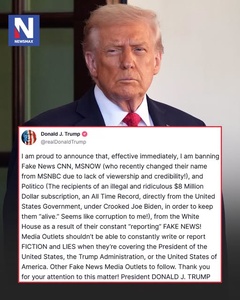
Trump announced the action Friday on Truth Social, saying the prohibition would take effect immediately and warning that additional news organizations could eventually face similar restrictions.
The president accused all three organizations of repeatedly publishing what he described as false stories about himself, his administration and the United States, without identifying specific reports that prompted Friday’s announcement.
Minutes later, Trump expanded on the decision while speaking with journalists during an Oval Office event, again accusing CNN, MS NOW and Politico of producing dishonest coverage.
Trump said Americans deserve honest journalism and suggested the affected organizations could potentially regain favor if, in his view, their coverage became more accurate.
The precise scope of the action, however, remained unclear Friday. Trump did not initially specify whether reporters would lose permanent credentials, access to particular events or all access to White House grounds.
AP reported that journalists representing CNN, MS NOW and Politico were still on White House grounds late Friday afternoon, with no immediate evidence that officials had physically removed them.
That makes the current situation more complicated than the word “ban” suggests: Trump has announced one, but questions remain about exactly how and when his administration intends to enforce it.
The Washington Post reported that Trump later described his intended action as extending “as far as you can,” while saying he did not want representatives of the organizations around him.
CNN immediately challenged the president’s position, defending its White House journalists and saying they have a constitutional right to report without government interference based on the substance of their journalism.
Politico similarly said it would continue reporting on the current and future White Houses and would vigorously defend its First Amendment rights against attempts to restrict its journalists.
MS NOW, the network formerly known as MSNBC, had not immediately provided AP with a response when the news organization published its initial report Friday.
The dispute has potentially significant constitutional implications because the government generally cannot discriminate against journalists simply because officials dislike the viewpoints or content contained in their reporting.
A key precedent is Sherrill v. Knight, a 1977 federal appeals court decision addressing White House press access and the procedural protections required when the government denies credentials.
The court held that although the White House need not create press facilities, once access is established for journalists, restrictions cannot simply be imposed arbitrarily based upon the content of coverage.
The latest confrontation follows Trump’s earlier battle with the Associated Press after the news organization declined to adopt his preferred terminology, “Gulf of America,” for the Gulf of Mexico.
The administration restricted AP access to certain presidential events, prompting the news organization to sue. That legal dispute remains ongoing after a series of federal court decisions concerning White House press access.
Trump’s announcement also singled out Politico for a different reason: federal government subscriptions to the publication, which the president has repeatedly portrayed as improper government financial support.
That part of the social-media post requires substantial context. Federal agencies have indeed paid millions of dollars for access to Politico and its specialized Politico Pro subscription products.
But federal spending records characterize those payments as contracts for subscriptions and professional information services, not grants, subsidies or direct government assistance designed to keep Politico operating.
FactCheck.org found federal obligations to Politico totaled approximately $22.8 million during fiscal years 2021 through 2024, spanning most of Joe Biden’s presidency.
However, government agencies also purchased Politico products during Trump’s first administration. Federal obligations totaled approximately $10.2 million during fiscal years 2017 through 2020, according to the same spending analysis.
The Executive Office of the President itself accumulated roughly $880,000 in Politico obligations during Trump’s first term, illustrating that government subscriptions were not unique to the Biden administration.
Politico has previously rejected claims that those purchases represented government funding, saying agencies purchased its professional products through ordinary procurement processes in the same way organizations purchase research, software and specialized information services.
That distinction matters because Trump’s Friday post characterized federal subscription payments as evidence that the outlets depended upon government money, while the available spending records establish contractual purchases rather than subsidies.
Trump’s broader confrontation with news organizations has expanded considerably during his second term, including litigation and public attacks involving The New York Times, Wall Street Journal, BBC and other media companies.
The CNN restriction could be especially consequential because the network traditionally participates in the small television pool that follows the president and provides independent coverage when every news organization cannot physically attend an event.
Press-freedom organizations strongly criticized Friday’s announcement. The National Press Club argued that excluding organizations because officials dislike their reporting would allow the government to influence which journalists can directly observe presidential activity.
Trump and his supporters frame the dispute differently, arguing that presidents should not be required to provide privileged access to organizations they believe repeatedly publish inaccurate or unfair reporting.
Defense Secretary Pete Hegseth publicly supported Trump’s announcement, saying his department backed the president’s decision to exclude the three organizations from White House access.
Trump also suggested Friday that the list could expand. He separately criticized The New York Times and Washington Post while warning that additional organizations might eventually receive similar treatment.
That makes the implementation of the first three restrictions particularly important. Any resulting lawsuits could test how far a president may go in controlling physical access to White House events based upon objections to editorial coverage.
Comments (0)
Loading comments...
May You Like
Jack Smith Defends His Integrity as Trump Investigations Face Renewed Political Firestorm