
TRUMP SAYS HE WILL PUNISH THE PHILIPPINES AFTER BURNING U.S. FLAGS NEAR THE PHILIPPINE PRESIDENTIAL PALACE!
TRUMP SAYS HE WILL PUNISH THE PHILIPPINES AFTER BURNING U.S. FLAGS NEAR THE PHILIPPINE PRESIDENTIAL PALACE!
MANILA, Philippines — November 19, 2026 — Protesters burned American flags and confronted police barricades near the Philippine presidential palace on Wednesday as President Donald Trump met President Ferdinand Marcos Jr. during a high-profile visit to Manila. The demonstrations exposed disagreements over U.S. military influence, a proposed technology development initiative and the economic consequences of Washington's foreign policy.
Thousands of demonstrators marched toward the Malacañang presidential palace on November 18, carrying banners and chanting slogans against Trump's visit.
Police prevented the marchers from reaching their intended destination, using barricades, container vans and razor wire.
The protest coincided with Trump's participation in the 49th Association of Southeast Asian Nations summit and bilateral talks with Marcos.
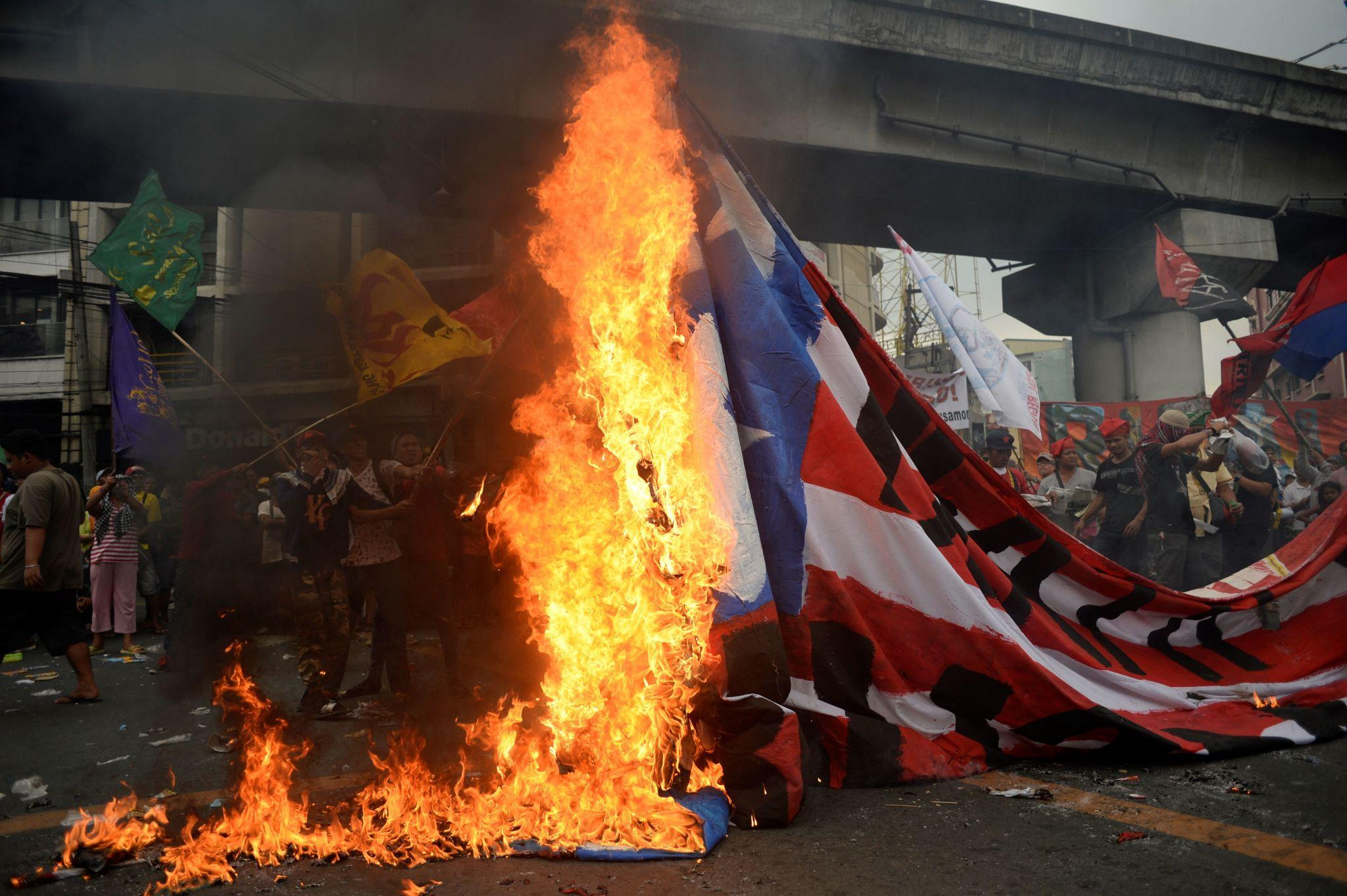
Local broadcaster GMA News confirmed that protesters burned a U.S. flag as Trump arrived at the palace. Photographs distributed through Reuters Connect independently documented a burning American flag on Recto Avenue.
The confrontation came after several days of demonstrations, some involving arrests and clashes with police.
At the center of the dispute were questions about the Philippines' relationship with Washington, a proposed American-backed technology hub and the consequences of U.S. military policy.
The protests were organized around Trump's visit to Manila for the ASEAN summit.
Activist organizations opposed what they described as excessive American influence over Philippine political, military and economic decisions.
Their concerns extended beyond the presidential meeting.
Demonstrators criticized the U.S.-led Pax Silica initiative, which aims to strengthen supply chains for advanced technology and critical minerals.
They also linked American foreign policy to rising energy costs and economic pressure on Filipino households.
The protests therefore combined several issues into a single political confrontation.
For organizers, Trump's presence represented broader concerns about the direction of U.S.-Philippine relations.
For Philippine authorities, the visit was a major diplomatic event requiring extensive security arrangements.
The competing priorities became visible when marchers attempted to approach the presidential palace.
GMA News reported that demonstrators gathered near Morayta and marched along Recto Avenue toward Mendiola.
Mendiola is a well-known location for political demonstrations near the presidential palace.
The marchers encountered a police barricade at San Sebastian Street.
Unable to proceed, they held a protest program along the road.
BAYAN secretary-general Raymond Palatino estimated that more than 2,000 people participated.
That figure was provided by the organizer and was not independently confirmed by the broadcaster.
The demonstrators criticized the barriers and the restrictions imposed on their movement.
Police maintained security arrangements around the presidential visit.
The resulting standoff reflected a dispute over how close protesters should be allowed to approach a highly protected government location.
The burning of American flags became one of the most visible images of the demonstrations.
Palatino told GMA News that protesters burned a U.S. flag when Trump arrived at Malacañang.
Photographs taken on November 18 showed a flag burning on a road leading toward the palace.
Other images documented demonstrators holding banners and confronting barricades.
The act was intended by participants as a symbolic rejection of American policy.
It did not mean that the Philippine government had withdrawn from its alliance with the United States.
Nor did it establish that all Filipinos opposed Trump's visit.
The demonstration represented the views of participating organizations and individuals.
The flag burning attracted attention because it occurred while the American president was receiving an official diplomatic welcome nearby.
The contrast between the official visit and the street demonstrations was striking.
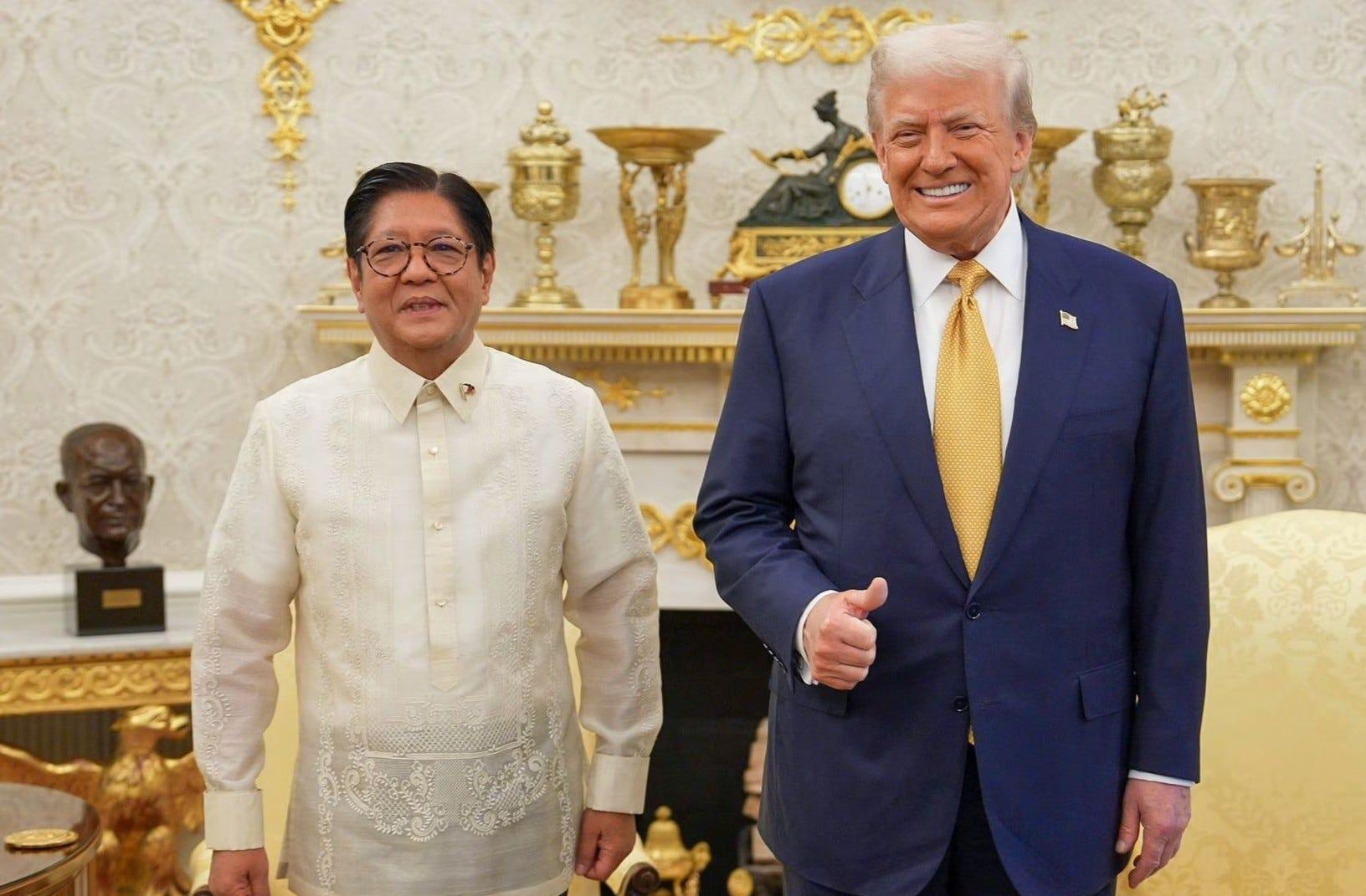
Inside the diplomatic setting, Trump and Marcos were expected to discuss security, economic cooperation and the bilateral alliance.
Outside, demonstrators denounced the same relationship as unequal and harmful to Philippine interests.
The Philippines and United States have maintained a mutual defense treaty for decades.
The relationship includes military cooperation and discussions about regional security.
Washington also views the Philippines as an important partner in Southeast Asia.
However, the alliance remains politically contested within the country.
Supporters emphasize its role in national defense and regional stability.
Critics question the extent of American military influence and the consequences of aligning closely with U.S. foreign policy.
The November 18 demonstrations brought those disagreements into public view.
Philippine authorities deployed extensive security measures during the ASEAN summit and Trump's visit.
Associated Press reported that nearly 23,000 security personnel were deployed for the summit period.
The operation involved protecting visiting leaders, diplomatic venues and major transportation routes.
AP News
Near Mendiola, police used physical barriers to prevent protesters from advancing toward the presidential palace.
Activists criticized the restrictions as excessive.
Palatino accused authorities of using public resources to suppress political expression.
Police had a separate responsibility to maintain security around a gathering of foreign leaders.
The dispute therefore involved both public-order concerns and the right to peaceful assembly.
Determining whether particular restrictions were justified requires examining the applicable laws, security circumstances and conduct of those involved.
The November 18 protest followed confrontations during the preceding days.
GMA News reported that clashes occurred near Liwasang Bonifacio as demonstrators protested the ASEAN summit and Trump's presence.
Police arrested 11 people, including a minor, in one reported confrontation.
The Philippine National Police said some officers were injured after objects were thrown and physical clashes occurred.
Those claims were attributed to police officials.
The reported injuries and arrests formed part of a broader period of unrest rather than a single incident outside the palace.
The distinction matters because different demonstrations took place at different locations.
Not every protest involved violence.
Local radio outlet DZRH reported that the November 18 demonstration along Recto Avenue ended peacefully after protesters were unable to reach Mendiola.
Human Rights Watch reported on November 18 that Philippine police had arrested or detained at least 245 people protesting Trump's visit and the ASEAN summit.
The organization called for the release of people detained solely for peaceful protest and urged authorities to respect freedom of assembly.
Its account described demonstrations beginning on November 15, including opposition to the proposed technology manufacturing hub in Tarlac province.
Human Rights Watch estimated that approximately 6,000 people had participated in protests during the broader period.
That figure referred to multiple demonstrations rather than solely the November 18 march near the presidential palace.
Different organizations reported different arrest totals as events unfolded.
Those figures should not be combined without accounting for the reporting period and the possibility of overlapping cases.
The arrests became an additional source of anger among demonstrators.
Human Rights Watch
For organizers, the detention of activists reinforced concerns about the government's treatment of political opposition.
Some groups demanded the release of people arrested during earlier demonstrations.
They also criticized restrictions on where protests could take place.
Human Rights Watch reported that authorities had sought to confine demonstrations to designated areas where gatherings could proceed without permits.
The organization argued that such restrictions should not be used to suppress peaceful political expression.
Police and government authorities faced the challenge of securing an international summit attended by multiple heads of government.
Those responsibilities can coexist with protections for peaceful assembly.
The legal question is whether particular restrictions and arrests were necessary and proportionate under the circumstances.
The publicly available reporting does not establish that every detained person engaged in violence.
Nor does it establish that every police action was unlawful.
Philippine authorities also reported monitoring online messages encouraging violence during the summit period.
On November 18, the Cybercrime Investigation and Coordinating Center said it had identified several posts that officials considered dangerous.
Executive Director Renato Paraiso said authorities had intervened and that one person had been apprehended in connection with alleged online incitement.
He described the overall situation as generally peaceful and orderly while acknowledging isolated concerns.
The agency did not publicly provide full details of the messages or the identity of the person arrested.
That limits independent assessment of the allegation.
The existence of suspected online threats does not establish that peaceful protesters were involved.
Similarly, the conduct of individual demonstrators cannot automatically be attributed to every organization participating in the rallies.
One of the most important issues behind the demonstrations was Pax Silica.
The initiative is intended to strengthen cooperation among the United States and partner countries in advanced technology supply chains.
Its areas of interest include semiconductors, artificial intelligence infrastructure and critical minerals.
Supporters of such cooperation argue that diversified supply chains can improve economic resilience and reduce dependence on a limited number of suppliers.
The Philippine government has discussed participation in a proposed technology and industrial development hub.
However, activists have questioned where the project would be located, who would benefit and how surrounding communities would be affected.
Those concerns helped turn what might otherwise have been a technical economic agreement into a major political issue.
The proposed development involves land in the New Clark City area of Tarlac province.
Reporting by The Verge described plans for an approximately 1,620-hectare industrial hub involving semiconductor manufacturing, critical-mineral processing and data centers.
Philippine officials have presented the project as an opportunity to attract investment and create jobs.
The reporting cited government expectations of as many as 190,000 jobs.
That figure is an anticipated benefit, not a verified employment outcome.
The project remains subject to questions about implementation, financing and its effects on existing communities.
Critics say large industrial developments can place pressure on land, water and electricity supplies.
Supporters argue that technology investment could provide employment and help the Philippines move into higher-value industries.
The disagreement concerns both the economic opportunities and the distribution of potential costs.
The planned development has drawn opposition from Indigenous Aeta communities and small farmers.
Human Rights Watch reported that opponents fear displacement from homes and farmland.
The Verge also described concerns about ancestral land claims and the availability of water and other resources.
Some residents have sought formal recognition of their ancestral territory for decades.
The Philippine government has maintained that the proposed development area involves public land outside formally titled ancestral domains.
That position does not resolve every concern about customary land use or the rights of affected communities.
The legal and environmental questions depend on land records, consultation processes and project plans.
For protesters, these concerns gave the Pax Silica initiative a direct local significance.
The dispute was not solely about relations between Washington and Beijing.
It also concerned what would happen to communities living near the proposed development.
The economic argument for Pax Silica centers on investment, technology and employment.
Advanced semiconductor production and related industries require specialized facilities, infrastructure and skilled workers.
Countries seeking to attract such investment often emphasize industrial parks, transport links and access to electricity.
The Philippines has an established electronics manufacturing sector.
Participation in international technology supply chains could potentially support additional industrial activity.
However, projected benefits depend on whether companies make investments and whether the necessary infrastructure is delivered.
Large job estimates should therefore be understood as expectations tied to future development.
They are not evidence that employment has already been created.
The government must also address environmental, land-use and community concerns if the project proceeds.
Those questions were central to the demonstrations in Manila.
Washington has sought closer cooperation with allies and partners on technology supply chains.
The United States has expressed concern about dependence on concentrated sources of critical minerals and advanced manufacturing components.
Reuters reported that Trump used his Manila visit to discuss economic security and supply-chain cooperation with regional partners.
At a meeting involving the United States, Australia, India and Japan, leaders expressed concern about economic coercion and restrictions affecting critical-mineral exports.
They also supported cooperation involving maritime security and artificial intelligence.
These initiatives form part of broader competition over advanced technologies and strategic resources.
For the Philippines, closer participation could create commercial opportunities.
For critics, the same arrangements raise questions about dependence on American policy and the consequences of geopolitical competition.
Reuters
The demonstrations also reflected concern about the cost of living.
Protest organizers linked American military policy to rising energy prices.
The Guardian reported that activists criticized the economic consequences of the conflict involving Iran, including higher oil costs.
For an economy dependent on imported petroleum products, international energy-price increases can affect transport and household expenses.
Higher fuel costs may influence fares, distribution costs and the prices of everyday goods.
However, not every increase in living costs can be attributed to one government or military decision.
Domestic taxes, exchange rates, supply conditions and market competition also matter.
The protesters' argument was that American foreign policy had contributed to economic pressures already affecting Filipino households.
That claim formed part of the political message of the demonstrations.
The Philippines and the United States signed their Mutual Defense Treaty in 1951.
The treaty remains a foundation of bilateral security cooperation.
The two countries also conduct military exercises and coordinate on regional defense matters.
Their relationship has become particularly important amid disputes in the South China Sea.
Philippine authorities have repeatedly raised concerns about confrontations involving Chinese vessels in waters claimed by Manila.
Washington has reaffirmed its treaty commitments to the Philippines.
Supporters of the alliance argue that cooperation strengthens deterrence and helps protect Philippine security interests.
Critics question whether the arrangement increases the country's exposure to conflicts involving major powers.
Those competing assessments help explain why a presidential visit could produce both an official welcome and large demonstrations.
The South China Sea remains a major source of regional tension.
The Philippines and China have competing maritime claims.
Philippine vessels have experienced confrontations with Chinese ships during resupply and patrol operations.
The United States has supported the Philippines' treaty rights while opposing coercive conduct in disputed waters.
These developments influence the security calculations of both governments.
However, opposition to U.S. military influence does not necessarily mean support for China's maritime claims.
During the November 18 demonstrations, the Philippine political organization Bayan Muna rejected suggestions that it opposed Washington while remaining silent about Beijing.
Its chairman, Teddy Casiño, said the organization had protested Chinese activities in the West Philippine Sea for years.
The statement illustrates the range of positions within Philippine political movements.
Trump's visit formed part of a wider Asian diplomatic trip.
Associated Press reported that the president arrived in Manila to participate in regional meetings and pursue trade and security agreements.
The agenda included discussions with Southeast Asian leaders and meetings involving Australia, India and Japan.
The visit also included a meeting with President Marcos.
Commercial discussions covered sectors such as aviation, defense, energy and technology.
Trump was scheduled to travel onward to China for further meetings.
The diplomatic program placed Manila at the center of several overlapping issues: regional security, economic cooperation, technology supply chains and relations among major powers.
The protests occurred against that broader background.
For the Philippine government, hosting the visit provided an opportunity to advance diplomatic and economic priorities.
For demonstrators, it provided a prominent occasion to challenge those priorities.
The reported demonstrations prompted a separate question about whether Washington would retaliate economically.
No verified public statement reviewed for this article establishes that Trump announced a freeze on U.S. aid to the Philippines because protesters burned American flags.
The accounts from Reuters, Associated Press and GMA News describe the visit, demonstrations, diplomatic agenda and security measures.
They do not report an aid suspension linked to the flag burning.
That distinction matters because U.S. assistance to the Philippines involves multiple programs and government agencies.
A change in foreign assistance would require identifiable policy action, not merely a claim circulating alongside protest footage.
A presidential statement, official agency announcement or documented funding decision would be necessary to establish that such a freeze had occurred.
The available evidence instead shows that Trump continued diplomatic engagement with the Philippine government during the visit.
U.S. assistance to the Philippines can include security cooperation, development programs and humanitarian support.
These categories operate under different authorities and funding arrangements.
A decision to restrict one program would not necessarily mean all American assistance had stopped.
The practical consequences would depend on which funds were affected, the legal authority used and whether existing commitments remained in force.
For that reason, the phrase aid freeze requires a specific definition.
It could refer to a pause in new commitments, a delay in disbursements or a broader policy change.
Those are materially different actions.
In the Manila case, no documented announcement identifies a program, funding amount or effective date for a protest-related suspension.
The reported flag burning therefore cannot be treated as the cause of a confirmed U.S. funding decision.
The protests created a visible security challenge near the presidential palace.
However, the reports reviewed do not establish that demonstrators entered Malacañang or prevented the two presidents from conducting their diplomatic program.
Police barricades stopped the November 18 march before it reached Mendiola.
GMA News reported that the demonstrators held their program along Recto Avenue.
The demonstration therefore remained physically separate from the official meeting.
That separation helps explain the contrasting images from the day.
One showed the American president attending diplomatic events with Philippine leaders.
The other showed protesters burning American flags and criticizing the policies being discussed.
Both scenes were part of the same visit, but neither erased the other.
Burning a national flag is a symbolic act that can carry different meanings depending on its context.
In Manila, organizers presented the burning of American flags as a rejection of Trump's visit and U.S. policy.
The act attracted attention because it occurred near a highly symbolic location during a visit by the American president.
The photographs made the confrontation immediately recognizable to international audiences.
But the underlying dispute involved issues more complex than the burning of a flag: economic development, military cooperation, land rights, energy costs and freedom of assembly.
The November 18 demonstration ended without protesters reaching the presidential palace, while the wider dispute over Pax Silica and U.S.-Philippine relations continued.
The immediate questions concern the treatment of detained activists, the future of the proposed technology hub and whether Philippine authorities will address concerns raised by affected communities.
The diplomatic relationship between Washington and Manila remains important to both governments.
The verified record shows that protesters burned American flags, police restricted their march and the demonstrations reflected disagreements over U.S. policy and Philippine development plans.
The confrontation was sparked by opposition to Trump's visit, the Pax Silica initiative and broader U.S. foreign policy—not by a confirmed announcement that American assistance would be suspended.
Comments (0)
Loading comments...
May You Like

PENTAGON'S DECLASSIFIED UFO FILES — THE MYSTERY OF AN UNDERGROUND STORAGE PROJECT!

AMERICA’S NEW-GENERATION AIRCRAFT CARRIERS — MILITARY MIGHT BUILT AT THE EXPENSE OF THE PEOPLE

TRUMP CALLS GDP FIGURE “FAKE” AFTER GOVERNMENT’S SCHEDULED REVISION









Popular Posts




