
Trump Says He’d Pardon Administration Officials Before Leaving Office
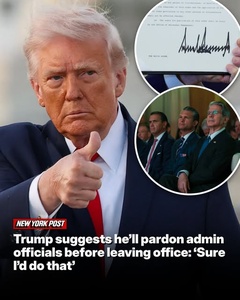
President Donald Trump said he would be willing to pardon members of his administration before leaving office, raising questions about how presidential clemency could shape future investigations.
Trump made the remark during a wide-ranging interview with TIME conducted at the White House on September 28 and published October 1, according to the magazine’s transcript.
Asked whether he was considering pardoning administration members before his term ends, Trump answered, “Yeah, sure, I’d do that,” according to TIME’s published interview transcript.
The question arose in the context of Trump discussing the possibility that Democrats could regain control of the House and investigate members of his administration after the midterm elections.
Trump linked his position to former President Joe Biden, arguing that Biden had granted pardons to people who could have faced scrutiny under the incoming Trump administration.
On January 20, 2025, Biden pardoned retired General Mark Milley, Dr. Anthony Fauci, members and staff of the House January 6 committee, and police officers who testified.

Biden said those pardons were intended to protect public servants from what he described as unjustified and politically motivated prosecutions, while emphasizing that pardons did not acknowledge wrongdoing.
The Biden administration also issued pardons to several family members on the president’s final day, including his brothers James and Francis Biden and sister Valerie Biden Owens.
Trump’s comments therefore place potential future pardons within a broader recent history of presidents using clemency during politically sensitive transitions and periods of heightened partisan conflict between administrations.
Under Article II, Section 2 of the Constitution, the president has authority to grant reprieves and pardons for offenses against the United States, except in impeachment cases.
The constitutional provision generally covers federal offenses rather than state crimes or civil violations, according to the Constitution Annotated published by the Library of Congress.
The Justice Department explains that a pardon and a commutation are different forms of executive clemency, with pardons addressing federal criminal consequences while commutations reduce sentences.
Trump has already used presidential clemency extensively during his second term, with Justice Department records listing numerous pardons and commutations issued since January 2025, according to agency records.
Those records include Trump’s January 2025 pardons and commutations involving offenses connected to the January 6 Capitol attack, as well as later individual clemency grants.
The latest comments do not announce any specific future pardons, identify particular officials who would receive them, or establish that any administration member currently faces criminal charges.
That distinction is important because a statement expressing willingness to pardon someone is different from an actual clemency order, which would have specific legal effect.
Questions about preemptive pardons have attracted legal attention because the Constitution permits presidential pardons for federal offenses, while courts have not definitively resolved every question surrounding prospective clemency.
Congressional oversight could also become relevant if lawmakers investigate administration officials, although the scope and consequences of any future investigation would depend on specific allegations and proceedings.
For now, Trump’s statement represents a public indication that he is open to using presidential clemency for administration members before his second term concludes, not an announced pardon.
The remarks add another dimension to the continuing debate over presidential pardon power, accountability, and the potential consequences of investigations following a change in congressional control.
Comments (0)
Loading comments...
May You Like
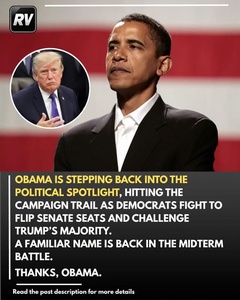
OBAMA STEPS BACK INTO THE POLITICAL SPOTLIGHT

Obama Steps Back Into the Political Spotlight as Democrats Target Trump’s Senate Majority














