
Trump Says Iran War Will End After Midterms — Really
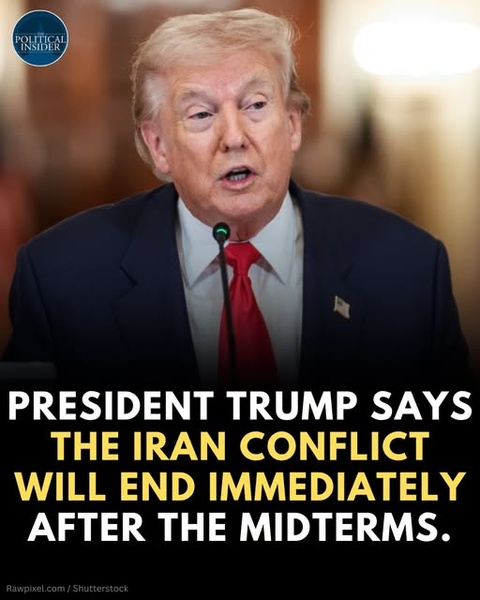
WASHINGTON — President Donald Trump has predicted that the U.S. war with Iran will end “immediately after” the November midterm elections, tying the timeline of the seven-month conflict to one of the most consequential political moments of his presidency.
Trump made the claim on Sept. 9 while traveling to Dallas for the Republican Party’s first-ever midterm convention. He argued that Iran is trying to influence the Nov. 3 election but will eventually be unable to withstand U.S. military and economic pressure.
“I think the war is going to end immediately after the election because they can’t hold out any longer,” Trump told reporters.
The prediction comes as the conflict shows few obvious signs of an imminent conclusion. Fighting around the region has intensified, oil prices have climbed above $100 a barrel and senior members of Trump's administration have reportedly been preparing for the possibility that the confrontation could last far longer.
Trump Links the War’s End to the November Election
Trump's comments represent his clearest timetable yet for ending the conflict.
He said Iran was desperate to influence the midterm elections and suggested Tehran hoped to weaken Republicans by prolonging the war.
Trump also predicted that oil prices would fall rapidly once the election was over and the conflict ended.
However, he acknowledged that diplomatic negotiations remain possible while making clear that his administration is not currently prioritizing them.
“Negotiation could possibly happen,” Trump said, according to Reuters, “but it's not something we're looking at.”
That leaves Trump's prediction dependent largely on an assumption that Iran will eventually capitulate under the combined pressure of military operations and economic sanctions.
There is currently no publicly announced agreement establishing that the war will end after the election.
The Conflict Has Lasted Far Longer Than Trump Initially Predicted
Trump's latest timeline also highlights how dramatically the conflict has outlasted some of his earlier expectations.
The war is now in its seventh month, despite Trump's earlier descriptions of the operation as something that could be resolved relatively quickly. The fighting has involved U.S. and Israeli strikes against Iran, Iranian retaliation and increasingly dangerous disruptions around the Strait of Hormuz.
The latest escalation has also spread beyond direct U.S.-Iran exchanges.
According to Reuters, Iran recently attacked 10 ships near the Strait of Hormuz after the United States destroyed five Iranian oil tankers. The escalation pushed Brent crude above $100 per barrel for the first time since July.
That creates a problem for Trump at home: the longer the conflict continues, the greater the potential economic consequences for American consumers.
Oil Prices Are Becoming a Political Problem
Energy prices have emerged as one of the biggest domestic consequences of the war.
Brent crude climbed above $100 a barrel this week as fighting and shipping disruptions around the Strait of Hormuz raised concerns about global supplies. The benchmark had previously remained below that level for much of the year.
U.S. gasoline prices have also risen sharply.
The Associated Press reported that the national average for gasoline had reached approximately $4.22 per gallon, while diesel and jet-fuel prices were also under significant pressure.
The economic consequences could extend well beyond gas stations. Higher transportation and energy costs can feed into prices for food, manufactured goods and other consumer products.
That makes the Iran conflict particularly sensitive ahead of an election in which the cost of living is already expected to be a major issue.
Trump Faces a Political Contradiction
Trump is attempting to present the war as a strategic success while simultaneously promising that it will soon end.
That message is becoming increasingly difficult to reconcile with events on the ground.
The conflict has continued despite months of military pressure, while Iran remains capable of retaliating against shipping and regional targets.
Trump has previously described the fighting as relatively limited, at one point calling it “small potatoes.” Vice President JD Vance has also avoided describing the conflict as a conventional war and declined to provide a firm end date.
Now Trump is offering a much more specific prediction: the war will end immediately after Nov. 3.
But he has not explained what event would cause the conflict to end at that precise moment.
Trump’s Advisers Are Preparing for a Much Longer Conflict
Perhaps the biggest complication for Trump's prediction is what his own senior advisers are reportedly discussing privately.
The Wall Street Journal reported that senior administration officials, including Vice President JD Vance and Secretary of State Marco Rubio, have confronted the possibility that the Iran conflict could continue through the remainder of Trump's presidential term, potentially into January 2029.
That does not mean the administration has decided that the war will last that long.
But it demonstrates the enormous gap between Trump's public prediction and the range of scenarios being considered inside his administration.
Iran has continued to demonstrate an ability to withstand pressure, while the United States has maintained a significant military presence in the region.
The Strait of Hormuz Remains the Critical Pressure Point
Much of the economic and strategic battle is now centered on the Strait of Hormuz, one of the world's most important energy corridors.
Before the conflict, roughly one-fifth of the world's petroleum supply moved through the waterway. The war has dramatically reduced and complicated those flows, forcing Gulf producers and international traders to search for alternative routes and sources.
The situation has become even more complicated in recent days.
Iran-linked Houthi forces in Yemen have also increased pressure on regional shipping routes, including the Red Sea and Bab el-Mandeb corridor. Reuters reported Sept. 12 that the Houthi advance in Yemen is creating an additional strategic challenge for Washington while the Strait of Hormuz remains destabilized.
That means even if fighting between the United States and Iran were to decline, regional disruptions could continue to affect energy markets.
The Midterms Could Become a Referendum on the War
The timing of Trump's prediction is politically significant.
The Nov. 3 elections will determine whether Republicans retain control of Congress during the final two years of Trump's presidency.
Republicans currently hold narrow majorities, meaning even relatively small shifts in voter sentiment could dramatically change Washington's balance of power.
The war could therefore become a major factor in the election — particularly if gasoline prices and inflation remain elevated.
Analysts have noted that voters do not necessarily need to change their party preference for the war to hurt Republicans. Disillusioned voters may simply stay home, reducing turnout among the president's supporters.
Iran Has Its Own Incentives
Trump argues that Tehran is trying to manipulate the U.S. election.
But Iran has its own strategic calculations.
Analysts cited by Al Jazeera have argued that Tehran's immediate objective may be survival and maintaining enough leverage to secure a future diplomatic settlement, rather than influencing American voters directly.
Iran can also use disruptions to global energy and shipping markets as leverage.
That creates a dangerous cycle: Washington wants Iran to surrender under pressure, while Tehran can attempt to increase the economic cost of the conflict without necessarily seeking a decisive conventional victory.
No Ceasefire or Peace Agreement Has Been Announced
Despite Trump's confidence, there is currently no confirmed agreement that would automatically end the conflict after the midterm elections.
His statement is a prediction — not a ceasefire announcement, treaty or negotiated settlement.
Even Trump acknowledged that negotiations could potentially occur, although he said they were not currently being pursued.
The distinction is important because the war could theoretically end before Nov. 3, continue beyond the election or enter another phase involving negotiations, sanctions and intermittent military action.
A High-Stakes Promise
Trump is now effectively putting a date on his prediction.
The war, he says, will end immediately after Americans vote on Nov. 3.
But the battlefield, energy markets and private discussions among senior administration officials tell a considerably less certain story.
The conflict has already lasted months longer than many early expectations, oil has climbed above $100 a barrel and Iran continues to demonstrate the ability to disrupt regional shipping.
For Trump, the coming weeks will therefore carry enormous political and strategic consequences.
If the war ends soon after the midterms, he can point to his prediction as evidence that his pressure campaign worked.
If the conflict continues well beyond Nov. 3, however, his promise could become a new political liability — particularly if Americans are still paying substantially more for fuel and everyday goods.
For now, Trump's “immediately after” deadline is a presidential prediction, not a guarantee.
Comments (0)
Loading comments...
May You Like

gfnhgmnghnmfgnbvvvvvvvvv


Jack Smith Defends His Integrity as Trump Investigations Face Renewed Political Firestorm













