Trump Says Iran War Will End “Immediately” After
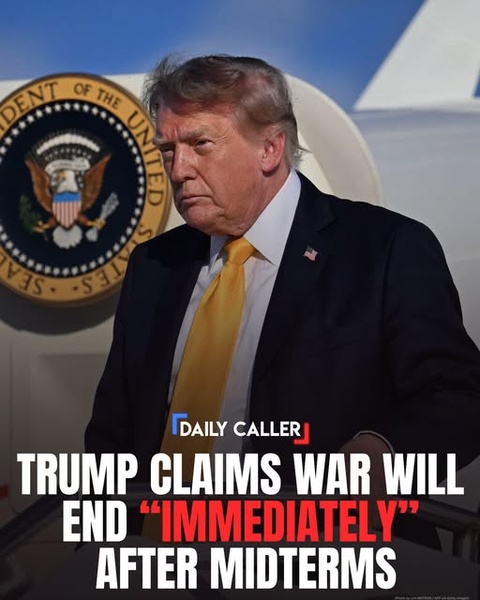
WASHINGTON — President Donald Trump said Wednesday that the war with Iran will end “immediately after” the November midterm elections, offering his most specific prediction yet about when the seven-month conflict could come to a close.
Trump made the claim as he prepared to travel to Dallas for the Republican Party’s first-ever national midterm convention. He argued that Iran is attempting to influence the U.S. election by prolonging the conflict, but said Tehran will eventually be unable to withstand the economic and military pressure imposed by the United States.
The prediction, however, is Trump’s forecast rather than a confirmed timetable. There is currently no announced ceasefire agreement or peace deal guaranteeing that the fighting will end after the Nov. 3 election.
Trump Links the End of the War Directly to the Election
Speaking to reporters before boarding Air Force One, Trump said he expected the conflict to end as soon as the midterms were over.
“I think the war is going to end immediately after the election because they can’t hold out any longer.”
Trump accused Iran of trying to affect the election by keeping the conflict alive, suggesting Tehran hopes Democrats could gain control of Congress and pursue a policy more favorable to Iran.
The president also argued that Iran's economic situation has deteriorated so severely that the country will eventually have little choice but to accept Washington's terms.
But Trump did not announce a new ceasefire, peace agreement or scheduled diplomatic meeting that would make his November prediction certain.
No New Negotiations Are Currently Underway
Trump also indicated that Washington is not actively seeking another nuclear agreement with Tehran, although he left open the possibility of negotiations.
Asked whether the United States would resume talks with Iran, Trump said a negotiation could happen but was not something his administration was currently pursuing.
He also suggested that any future agreement would go far beyond Iran's nuclear program.
“I’m doing much more than a nuclear deal,” Trump said, according to Al Jazeera. “There’s a lot more than nuclear.”
That position represents a significant obstacle to a quick diplomatic settlement.
Iran and the United States remain divided over the nuclear program, sanctions, military operations, regional security and the future of the conflict.
The Fighting Is Still Intensifying
Trump's prediction comes at a particularly dangerous moment.
On Tuesday, U.S. forces said they had attacked five Iranian oil tankers, while Iran subsequently attacked 10 ships near the Strait of Hormuz, according to Reuters.
The escalation has further disrupted one of the world's most important energy routes and pushed global oil prices above $100 a barrel for the first time since July.
The latest escalation makes Trump's prediction of an immediate post-election conclusion particularly difficult to assess.
Rather than moving steadily toward a ceasefire, the conflict has recently entered another period of intensified military confrontation.
Oil Prices Are Becoming a Political Problem
The war is no longer only a foreign-policy issue.
It is increasingly affecting the American economy.
Brent crude climbed above $100 per barrel on Wednesday as traders reacted to attacks on tankers and continued uncertainty over shipping through the Strait of Hormuz. U.S. gasoline prices have also risen sharply, while diesel and jet-fuel prices have reached unusually high levels.
Trump predicted that oil prices would fall after the election once the war ends.
But markets have no guarantee that the conflict will actually conclude in November.
Any further attacks on tankers, energy infrastructure or shipping routes could keep prices elevated and increase pressure on American consumers.
The War Has Already Lasted Far Longer Than Trump Initially Suggested
Trump's latest prediction also stands in contrast to his earlier descriptions of the conflict.
The fighting began on Feb. 28 and has now continued for roughly seven months.
Earlier in the conflict, Trump characterized the operation as something that could be resolved relatively quickly. The prolonged fighting has instead involved repeated U.S. and Iranian attacks, major military deployments and disruptions to energy markets.
The United States has suffered 18 military deaths in the conflict, according to figures reported by the Associated Press, while the financial cost of the campaign has surpassed $37.5 billion.
The administration has nevertheless continued to resist describing the conflict in conventional terms.
Vice President JD Vance recently argued that the confrontation should not necessarily be called a “war,” while Trump himself has described the fighting as a “military conflict” and previously called it “small potatoes.”
Trump’s Advisers Are Preparing for a Much Longer Conflict
Perhaps the biggest complication for Trump's new prediction is that some senior administration officials are reportedly preparing for the possibility that the conflict could continue well beyond the midterms.
The Wall Street Journal reported that senior Trump advisers, including Vance and Secretary of State Marco Rubio, have discussed the possibility that the Iran conflict could continue through the end of Trump's current term in January 2029.
That does not mean the administration has decided to pursue a three-year war.
Rather, it highlights the enormous gap between Trump's public prediction of a rapid end and the contingency planning required by a military campaign with no guaranteed diplomatic settlement.
The administration is also pursuing longer-term economic pressure against Tehran, including sanctions and efforts to restrict Iran's ability to export oil.
The Midterms Could Become a Referendum on the War
The timing of Trump's prediction is politically significant.
The November 3 elections will determine control of the House and Senate and are likely to be interpreted as a referendum on Trump's presidency.
The Iran conflict has become increasingly unpopular among Americans. A recent poll cited by Al Jazeera found that only 31% of Americans supported the conflict, down from 37% in March.
At the same time, Trump's overall approval rating has fallen amid frustration over the war, rising energy costs and broader cost-of-living concerns. Reuters reported that his approval ratings had recently reached their lowest levels of his presidency.
That makes the timing of an end to the war potentially consequential for both Trump and congressional Republicans.
If fighting continues into November, voters could judge the administration on casualties, oil prices and the broader economic consequences.
If the conflict ends soon after the election, Trump could instead portray the outcome as proof that his pressure campaign succeeded.
Iran Has Not Agreed to Trump’s Timeline
There is another fundamental problem with Trump's prediction: ending a war requires more than one side declaring that it is over.
Iran has continued military operations and has issued its own demands for an end to the conflict.
Recent attacks around the Strait of Hormuz demonstrate that Tehran still has the capacity and willingness to challenge U.S. forces and disrupt global energy supplies.
Iran's government has also continued to reject the idea that Washington can simply dictate the terms of a settlement.
Without a negotiated agreement, ceasefire or decisive change in Iran's military position, there is no clear mechanism guaranteeing that the conflict will stop immediately after Nov. 3.
Trump Says Iran “Can’t Hold Out Any Longer”
Trump's confidence rests heavily on the belief that American economic pressure is pushing Iran toward collapse.
He has repeatedly argued that sanctions, the naval blockade and attacks on Iranian energy assets are weakening Tehran's ability to continue fighting.
Secretary of State Marco Rubio has similarly warned that Iran will continue to pay a price when it attacks U.S. military vessels.
But military pressure can produce unpredictable outcomes.
A weakened government may seek negotiations — or it may escalate further.
That is why U.S. officials have simultaneously prepared for a prolonged conflict even while Trump publicly predicts an imminent conclusion.
What the Viral Graphic Gets Right — and Wrong
The Daily Caller graphic is based on a real statement made by Trump, but its presentation can make the prediction appear more certain than it is.
What is confirmed:
- Trump said on Sept. 9 that he expects the Iran war to end “immediately after” the November midterm election.
- The midterm election is scheduled for Nov. 3, 2026.
- Trump blamed Iran for trying to influence the election by prolonging the conflict.
- He said Iran was under severe economic pressure.
- He said negotiations remain possible but are not currently a priority.
- Fighting around the Strait of Hormuz has recently intensified, sending oil prices above $100 per barrel.
What remains uncertain:
- There is no confirmed agreement requiring the war to end after the election.
- Iran has not accepted Trump's proposed timetable.
- Senior U.S. officials are reportedly considering the possibility of the conflict lasting much longer.
- Trump's statement is a prediction, not a guaranteed end date.
A Promise, a Strategy — or an Election Message?
Trump's declaration puts a very specific political deadline on a war that has repeatedly defied predictions of a quick resolution.
If the conflict really ends immediately after the midterms, Trump will likely point to the outcome as evidence that his military and economic strategy forced Iran to surrender.
But if fighting continues, the president could face a very different political problem: voters heading to the polls with high energy prices, continued military casualties and no clear end to the conflict.
For now, the most important fact is simple:
Trump says the Iran war will end immediately after the November election. But nothing currently guarantees that it will.
With the conflict still escalating and oil prices climbing above $100 a barrel, the road from Trump's prediction to an actual peace agreement remains uncertain.
Comments (0)
Loading comments...
May You Like


Shocking news from Ohio: an unexpected development ahead of Trump's rally