
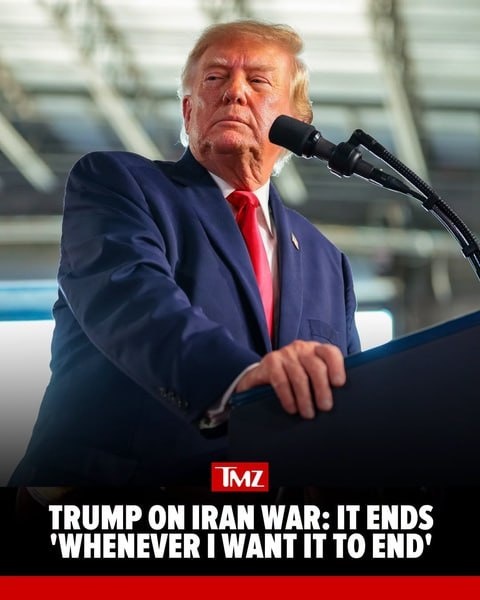
Trump Says Iran War Will End “Whenever I Want It to End” as Pressure Mounts for a Deal
Trump Says Iran War Will End “Whenever I Want It to End” as Pressure Mounts for a Deal
President Donald Trump says he will decide when the conflict with Iran ends, insisting that the United States must prevent Tehran from obtaining a nuclear weapon. The declaration comes after major Republican losses in the midterm elections, mounting economic pressure and renewed diplomatic efforts to negotiate an end to the war.
1. Trump Delivers a Defiant Message About Ending the Iran War
President Donald Trump has renewed his defiant rhetoric over the war with Iran, declaring that the conflict will end “whenever I want it to,” while insisting that the United States must finish the military campaign properly.
Trump made the remarks on November 4, 2026, while speaking to reporters during an event at the White House construction site. Asked directly when he believed the Iran war would end, he responded:
“Whenever I want it to, but it's got to be done right.”
He added that the United States would never allow Iran to obtain a nuclear weapon.
The statement reinforces Trump's position that the timing of the war's conclusion will depend on whether Washington believes its objectives have been achieved—not simply on pressure to stop fighting.
2. Trump Insists the United States Has Already Achieved Major Military Objectives
During the same exchange, Trump defended the results of the military campaign, claiming that Iran's military capabilities had been severely damaged.
He said Iran's navy, air force and air-defense systems had been effectively destroyed. He also referred to Operation Midnight Hammer, the U.S. military operation targeting Iranian nuclear facilities, arguing that the administration had already prevented Iran from obtaining nuclear weapons.
However, Trump's assessment should be understood as the administration's account of military results. A claim that nuclear facilities or military capabilities have been destroyed does not, by itself, establish that Iran's nuclear program has been permanently eliminated.
The central disagreement remains whether military damage can translate into a lasting political agreement that prevents Iran from rebuilding its capabilities.
3. The Midterm Election Defeat Has Increased Pressure on the White House
Trump's comments came one day after Republicans suffered sweeping losses in the November 3 midterm elections, with Democrats winning control of both the House of Representatives and the Senate.
On November 4, Trump acknowledged that the Iran war had contributed to his party's defeat.
“I think a part of it was Iran,” he told Fox News, according to Reuters. He separately told The Wall Street Journal that Iran had been one factor in the results.
Despite acknowledging the political consequences, Trump defended his decision to launch the campaign, saying: “I did the right thing. I would have done it again.”
The election results have therefore created a difficult political situation: Trump remains committed to his military strategy, but voters have delivered a strong warning about the economic and political costs of the conflict.
4. Rising Energy Costs Have Become a Major Political Problem
The Iran conflict has affected more than military calculations. It has also contributed to rising energy costs and increased pressure on American households.
The war has disrupted oil markets and raised concerns about shipping through the Strait of Hormuz, one of the world's most important energy transportation routes.
According to the Associated Press, higher energy costs linked to the conflict became a major issue for voters during the midterm elections. Its voter survey found that roughly two-thirds of voters believed Trump's policies had contributed to inflation.
Trump acknowledged that the war had pushed gasoline prices higher in the short term, although he argued that the long-term security benefits justified the costs.
For the administration, bringing the conflict to an end without creating another major energy shock will be an important test.
5. The Strait of Hormuz Remains Central to the Conflict
The Strait of Hormuz is a critical shipping corridor connecting the Persian Gulf with international markets. Any prolonged disruption can affect oil supplies, shipping costs and the broader global economy.
Trump claimed on November 4 that the strait was open and that oil production and shipments were performing strongly.
However, the broader situation remains unsettled. Reuters reported on November 5 that Iran had continued to link negotiations and the reopening of the strait to demands directed at Washington.
The waterway therefore remains both an economic pressure point and a major part of the diplomatic negotiations. Any agreement that fails to address maritime security could leave the region vulnerable to renewed confrontation.
6. Iran Sends a New Nuclear Proposal Through Qatar
A potentially important diplomatic development emerged on November 5, when a senior Iranian official told Reuters that Tehran had sent a new nuclear proposal to the United States through Qatar.
The official said Washington was reviewing the proposal but that discussions would take place only after the United States addressed Iran's seven demands.
Iran's conditions reportedly include lifting U.S. sanctions, releasing frozen Iranian assets and paying war reparations. Tehran has also insisted that the Strait of Hormuz cannot be reopened and negotiations cannot proceed unless its conditions are met.
Washington, meanwhile, has maintained that Iran's nuclear program must be part of any initial negotiations.
The differences are substantial. Both sides appear interested in exploring a diplomatic path, but they have not publicly agreed on the central terms needed to end the conflict.
7. Trump Keeps the Possibility of Renewed Military Action on the Table
Although Trump has repeatedly said the war could end soon, he has not ruled out additional military operations if negotiations fail.
The Associated Press reported on November 5 that Trump had continued to threaten a return to a full-scale bombardment of Iran if Tehran did not accept an agreement under terms Washington considers acceptable.
The president also said that the United States was building additional weapons and remained prepared to continue military action if necessary.
This creates an uncertain situation for Iran and regional governments. Negotiations could produce a settlement, but the threat of renewed strikes remains a significant part of Washington's strategy.
8. The War Has Become a Test of Trump's Foreign-Policy Leadership
Trump's handling of Iran is now facing scrutiny from several directions.
Republicans are confronting the political consequences of an unpopular conflict, Democrats are preparing to use their new congressional majorities to challenge the administration, and international mediators are trying to prevent another escalation.
The administration's position is that military pressure has weakened Iran and created an opportunity for a settlement. Critics argue that the shifting timelines and repeated threats of renewed attacks reveal the absence of a clear exit strategy.
The next stage will depend on whether the United States and Iran can agree on nuclear restrictions, sanctions relief, maritime security and the future of military operations.
A ceasefire or temporary pause would not necessarily resolve these deeper disputes.
9. “Whenever I Want It to End” — But What Will Actually End the War?
Trump's statement projects confidence and emphasizes presidential control over the military campaign. But ending a war requires more than a declaration from the White House.
Iran must decide whether it is willing to accept Washington's nuclear demands, while the United States must determine whether it is prepared to offer concessions that Tehran considers meaningful.
The November 5 proposal delivered through Qatar offers a possible opening for diplomacy, but the two sides remain far apart on sanctions, compensation and control of the Strait of Hormuz.
For now, Trump's message is clear: he does not intend to end the conflict simply because political pressure is increasing. Whether that approach produces a lasting agreement or prolongs the confrontation remains one of the most consequential questions facing the United States and the Middle East.
Comments (0)
Loading comments...
May You Like


Latest Posts









Popular Posts




