Trump Says Strait of Hormuz Oil Flows Have Rebounded to 90
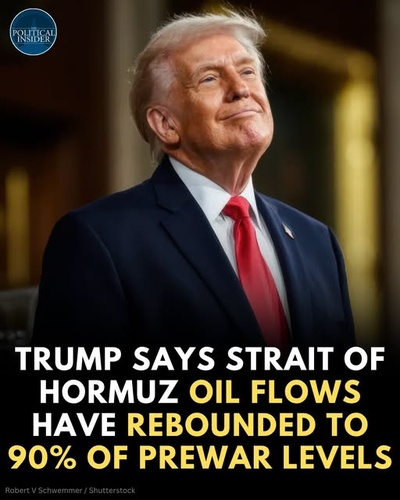
WASHINGTON — President Donald Trump is claiming that oil flows through the Strait of Hormuz have recovered to roughly 90% of their pre-war level, presenting the development as evidence that one of the world's most important energy chokepoints is returning to normal.
Trump recently shared graphics on social media showing approximately 18 million barrels per day moving through the strait, compared with about 20 million barrels per day before the U.S.-Israeli war with Iran. The figures imply a recovery to around 90% of previous volumes.
But independent shipping data indicates that the picture remains considerably more uncertain.
Trump Declares: “Hormuz Oil Volumes Are BACK”
Trump's claim is based on an estimate that puts current oil movement through the strategic waterway at approximately 18 million barrels per day.
Before the conflict began, roughly 20 million barrels of oil passed through the Strait of Hormuz each day — equivalent to around one-fifth of global oil consumption.
The president's message therefore portrays the recovery as a major success, suggesting that fears of a prolonged energy blockade have eased substantially.
The claim comes after months of intense disruption to Gulf shipping, U.S. military efforts to protect maritime traffic and repeated Iranian threats involving the strategic waterway.
Yet the latest evidence suggests that saying the strait has fully “rebounded” may be premature.
Shipping Traffic Remains Far Below Normal
Reuters reported Wednesday that only six commodity vessels transited the Strait of Hormuz on Tuesday, down from nine the previous day and well below the 10-day average of about 12 vessels.
The numbers are also complicated by the fact that some vessels switch off their tracking transponders while traveling through the region. That means publicly observable traffic does not necessarily capture every shipment.
Nevertheless, the extremely low number of visible commercial crossings highlights the gap between claims about oil volumes and the broader state of maritime traffic.
Reuters reported earlier in September that oil exports through the region had been fluctuating between roughly 4 million and 6 million barrels per day during much of the conflict, although flows increased during periods of reduced tensions.
Why the Numbers Are So Difficult to Verify
The Strait of Hormuz has become one of the hardest places in the world to measure accurately during the conflict.
Tankers can disable their automatic identification systems, while ships may be escorted, rerouted or use less visible routes. As a result, estimates from governments, satellite-based monitoring companies and commercial shipping analysts can differ dramatically.
Reuters reported that U.S. officials had claimed flows reached more than 17 million barrels per day on Aug. 31, while shipping analytics company Kpler estimated the figure at only around 6 million barrels per day.
That discrepancy is enormous.
It means that the central question is not simply whether oil is moving through Hormuz again — it clearly is — but how much oil is actually getting through and reaching international markets.
The Strait Remains a Global Energy Chokepoint
The significance of Hormuz goes far beyond the United States and Iran.
Before the war, the waterway handled roughly 20 million barrels of oil a day, alongside a major share of global liquefied natural gas shipments. Its narrow geography makes it one of the world's most strategically important maritime passages.
Any sustained disruption can therefore affect fuel prices, inflation, shipping costs and economic growth far beyond the Middle East.
And despite Trump's optimistic message, oil markets remain nervous.
Brent crude recently moved close to $100 a barrel, with traders increasingly concerned that continued attacks and shipping disruptions could keep supplies constrained.
Insurance Costs Are Surging
Even when ships are able to pass through Hormuz, the journey is becoming considerably more expensive.
An executive at Emirates National Oil Company told Reuters that war-risk premiums have risen sharply, with insurance costs in some cases reaching as much as 6% of a cargo's value. War-risk premiums themselves can reach roughly 10%, potentially adding millions of dollars to the cost of transporting a single cargo.
That means reopening a shipping route is not the same as restoring normal trade.
For many shipowners, the question is whether the economic reward is worth the risk of sending vessels through a conflict zone.
The U.S. Says Its Military Has Helped Restore Traffic
The Trump administration has argued that U.S. military operations have helped make the waterway safer.
Energy Secretary Chris Wright recently said oil transits through Hormuz were averaging more than 9 million barrels per day, while additional pipelines and alternative export routes were helping bring total regional flows to roughly two-thirds or more of pre-conflict levels.
The administration has also used naval forces to protect commercial shipping and enforce restrictions on Iranian oil exports.
But Iran continues to threaten retaliation, and the security situation remains volatile.
Reuters reported that Iran has threatened to establish a restricted zone around the Strait of Hormuz, while the conflict has expanded to attacks involving oil tankers and energy infrastructure across the Gulf.
A 90% Recovery Could Be Misleading
The most important distinction is between estimated oil volumes and normal maritime operations.
Trump's 18-million-barrel figure would indeed represent about 90% of the roughly 20 million barrels per day that passed through Hormuz before the war.
But independent measurements do not currently provide a clear picture supporting such a stable recovery.
Reuters reported Wednesday that commercial vessel traffic remained well below its recent average, while its analysis also warned that conflicting data and “dark” shipping activity have made it unusually difficult to determine the true volume of oil moving through the waterway.
In other words, Trump's 90% figure should be treated as an administration claim or estimate, not as an independently established fact.
The Bigger Test Is Whether the Recovery Lasts
The coming weeks could provide a much clearer answer.
If shipping companies continue sending tankers through Hormuz, insurance costs decline, vessel traffic rises and oil exports remain elevated despite continuing military tensions, Trump's optimistic assessment could gain credibility.
But if attacks intensify, more vessels avoid the strait or insurance and security costs remain prohibitively high, the apparent recovery could prove temporary.
For now, the Strait of Hormuz is open enough for significant oil to move — but far from normal by conventional measures.
Trump is portraying the recovery as a major strategic victory. The shipping data suggests a more complicated reality: oil is flowing again, but the world's most important energy chokepoint remains deeply exposed to war, uncertainty and disruption.
Comments (0)
Loading comments...
May You Like

Obama Steps Back Into the Political Spotlight as Democrats Target Trump’s

FIGHT OVER OBAMA’S IRAN POLICY