
Trump Says He Could Have Done “Very Bad Things” to Obama, Biden and Clinton, Citing Past Impeachments
A new political dispute has emerged after President Donald Trump said he could have done “very bad things” to former President Barack Obama, former President Joe Biden and former Secretary of State Hillary Clinton, while arguing that his political opponents had crossed lines by impeaching him.
The comments, reportedly made from the Oval Office, have drawn attention because they invoke the use of presidential power against named political rivals. But the distinction between what Trump said, what he claimed about his predecessors, and what the law actually permits is essential: his remarks do not establish that he has unlimited authority to punish former officials.
The Oval Office remarks: what Trump said
The remarks are real. On October 7, 2026, during an Oval Office event, a reporter asked Trump what Democrats might impeach him for if they regained control of Congress in November. Trump responded by naming Hillary Clinton, Joe Biden and Barack Obama.
“I could have done very bad things to Hillary Clinton. I could have done very, very bad things to Joe Biden. I could have done very bad things to Barack Hussein Obama,” he said. He then argued that he had refrained because the presidency should be treated with respect, before adding: “I can do whatever I want, if I want.”
The context is important. Trump was presenting himself as having exercised restraint toward political opponents, and linked that restraint to his own two impeachments. Later in the same exchange, he said people had urged him to pursue those figures, but that he had declined. The full answer therefore includes both the provocative language and his claim that he had chosen not to act.
Why the impeachment reference matters
Trump’s remarks were made against the backdrop of the November 3 midterm elections. Republicans were warning that a Democratic victory could lead to another impeachment effort, while Democratic leaders were discussing congressional oversight and accountability.
Trump was impeached twice during his first presidency. The first impeachment, in December 2019, followed his dealings with Ukraine; the second, in January 2021, followed the January 6 attack on the U.S. Capitol. The Senate acquitted him in both trials.
There is an important factual distinction in Trump’s account: Obama, Biden and Clinton did not collectively impeach him. Under the Constitution, the House of Representatives has the sole power to impeach, while the Senate conducts the trial. The two impeachment proceedings were congressional actions, not personal decisions made by those three former officials.
Does a president have the power to do “whatever” he wants?
Trump’s statement raises a broader constitutional question, but the words should not be confused with a legal description of presidential authority.
The U.S. Constitution divides power among the executive, legislative and judicial branches. Congress has powers including impeachment, legislation and oversight. Federal courts interpret the law, and executive agencies are subject to statutory and constitutional limits. The president has substantial authority, but the office is not constitutionally unlimited.
The Supreme Court’s 2024 decision in Trump v. United States also needs to be understood precisely. The Court held that former presidents have absolute criminal immunity for conduct within their exclusive constitutional authority, at least presumptive immunity for other official acts, and no immunity for unofficial acts. It did not establish that a sitting president may lawfully use government power for any purpose or target political opponents without legal constraints.
That distinction is central to interpreting Trump’s comments. His statement that he could do “whatever I want” expresses his own view in the exchange; it does not settle the constitutional or legal question of what actions would be lawful.
Obama’s campaign appearances are a separate part of the story
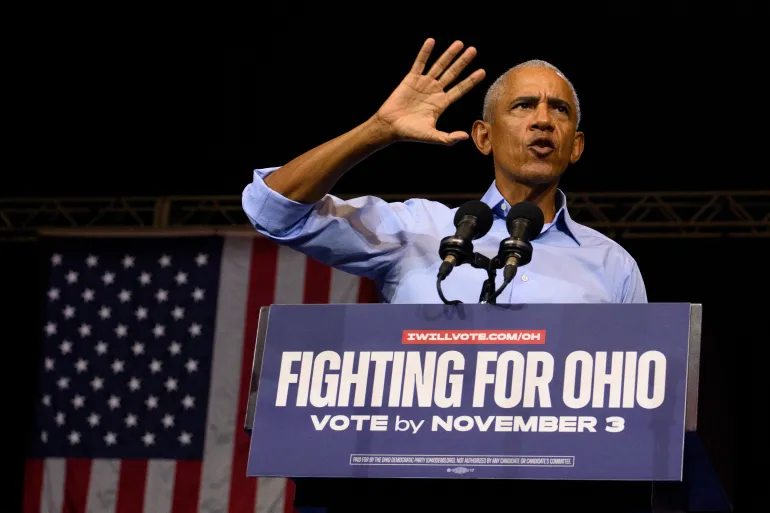
The photograph supplied with the story shows Obama speaking at an Ohio campaign event. The podium sign reads “Fighting for Ohio” and urges voters to vote by November 3. It is a campaign image, not a photograph of the October 7 Oval Office exchange.
Obama has indeed been campaigning for Democrats and criticizing Trump. At an Ohio rally, he attacked the administration over economic conditions and White House renovations. He also campaigned in Georgia on October 28, where he again mocked Trump’s renovation comments and raised concerns about affordability and the president’s conduct in office.
However, the claim that Obama responded to Trump’s October 7 remarks with a specific warning about “terrible things” is not established by the reporting reviewed here. The verified campaign criticism should not be presented as a direct response to the Oval Office comments unless a recording or transcript confirms that connection.
The midterm election adds political significance
With Election Day approaching on November 3, the argument over presidential authority has become part of the wider campaign debate. Democrats are presenting congressional control as a means of increasing oversight of the Trump administration. Republicans are warning that a Democratic majority could pursue impeachment and obstruct the president’s agenda.
A Reuters report published October 29 described a final campaign stretch dominated by personal attacks, cultural disputes and arguments about Trump’s power, even as voters continued to identify affordability and rising energy costs as major concerns.
The outcome of the election will determine the composition of Congress, not automatically remove the president from office. Even if Democrats regain control of the House, impeachment would require a separate process, and conviction in the Senate would require a two-thirds vote of senators present.
What the full record tells us
Trump did make the “very bad things” and “I can do whatever I want” remarks. The October 7 transcript confirms that he named Clinton, Biden and Obama while discussing his own two impeachments. It also confirms that he said he had refrained from acting against them out of respect for the presidency.
What remains unproven is the caption’s suggestion that presidential guardrails have officially disappeared, or that Obama delivered a specific counter-warning about “terrible things” in response. Those are interpretations and claims that require additional evidence.
The underlying story is therefore about more than a provocative quotation. It concerns the boundaries of presidential power, the role of Congress in checking the executive branch, and the way both parties are framing those questions in the final days before the midterms.
Comments (0)
Loading comments...
May You Like

AMERICAN FLAG BURNING IN CHICAGO — FREE SPEECH OR DISRESPECT TOWARD AMERICA?

STORM WARNING: MILLIONS FACE EVACUATION, MACY'S GIANT BALLOONS GROUNDED!

ANTISEMITIC THREAT CONCERNS IN NEW YORK — HAVE WE LEARNED NOTHING FROM HISTORY?












