Trump Says U.S.-Canada Trade Deal Could Come “Fairly Soon” — But Major Obstacles Remain
President Donald Trump is suddenly sounding more optimistic about ending his trade confrontation with Canada, even as Ottawa deepens European ties and formal negotiations remain suspended.
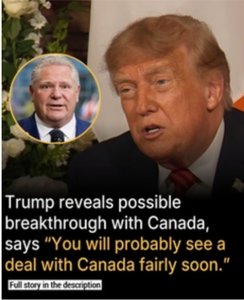
WASHINGTON/OTTAWA — President Donald Trump says the United States could reach a trade agreement with Canada “fairly soon,” offering one of his most optimistic assessments since negotiations collapsed last month.
Trump made the prediction during his September 12 visit to Ireland, where reporters asked whether he was considering withdrawing the United States from the U.S.-Mexico-Canada Agreement, or USMCA.
Rather than directly threatening withdrawal, Trump said Washington would maintain a strong relationship with Mexico and then turned to his increasingly complicated economic relationship with Canada.
“Canada wants to make a deal very badly,” Trump told reporters, before saying an agreement could emerge relatively soon if Ottawa addressed American complaints involving agricultural trade.
The president specifically accused Canada of imposing extraordinarily high tariffs on American farmers and said those barriers would need to disappear before Washington could reach a satisfactory agreement.
Trump’s reference appears largely connected to Canada’s supply-management system, under which some dairy imports exceeding tariff-rate quotas can face exceptionally high duties, rather than a universal tariff on American farm products.
His comments nevertheless represented a significant tonal shift after weeks of increasingly hostile rhetoric between Washington and Ottawa following the breakdown of negotiations in August.
Canadian Prime Minister Mark Carney suspended those negotiations on August 21, saying last-minute changes to the American proposal were “unfair, uneconomic” and undermined confidence in any prospective agreement.
Carney said Canada had entered the negotiations seeking continued tariff-free access for most businesses, reduced U.S. duties on strategic industries and greater long-term stability for cross-border commerce.
But he insisted Ottawa would never accept an agreement “at any price or on any deadline,” arguing Canadian sovereignty and economic independence could not become bargaining chips in negotiations.
After talks collapsed, Washington moved ahead with a 50% tariff on approximately C$28 billion of Canadian goods, while Ottawa announced dollar-for-dollar retaliation against American imports.
The confrontation subsequently deteriorated further as Trump resumed criticizing Canada publicly, while Carney accused Washington of prioritizing political pressure and provocative messaging over serious negotiations.
Carney nevertheless left the door open. On September 3, he said Canada remained prepared to negotiate an agreement benefiting Canadian and American workers, businesses and consumers if Washington was ready.
The Canadian prime minister repeated that message September 10, revealing that he and Trump had spoken “in recent days” and saying Ottawa remained interested in a fair, mutually beneficial agreement.
Those contacts provide some basis for Trump’s optimism, but there is an important qualification: Canadian officials said last week that formal trade negotiations had not resumed.
Canada-U.S. Trade Minister Dominic LeBlanc said officials from both governments continued communicating even without formal negotiating sessions, indicating diplomatic channels remained active despite the public confrontation.
Trump also provided no timetable, negotiating framework or specific concessions when predicting an agreement “fairly soon,” leaving unclear how close the two governments actually are to resolving their disagreements.
The agricultural dispute is only one obstacle. Previous negotiations also involved automobiles, steel, aluminum, market access and other strategically important sectors integrated across the North American economy.
Another complication is Trump’s repeated argument that Canada has economically exploited the United States for decades, a characterization Canadian officials reject while emphasizing the enormous two-way benefits of continental trade.
The president repeated that criticism in Ireland, saying America had been “ripped off for 50 years by Canada” before pivoting to his more optimistic prediction about reaching an agreement.
Trump even compared Ottawa’s desire for negotiations with Tehran’s, telling reporters both Canada and Iran wanted agreements with Washington while saying neither necessarily had the conditions right yet.
Meanwhile, Canada is increasingly preparing for the possibility that its economic relationship with the United States may never return to what existed before Trump’s second presidency.
Carney told investors this week that Canada intends to emerge from the confrontation “stronger, more resilient, more independent,” while expanding investment and reducing dependence on the American market.
That diversification strategy took a dramatic step forward Thursday when Carney addressed the European Parliament and welcomed discussions about an unprecedented new relationship between Canada and the European Union.
European leaders are proposing an “Alliance for the Future” covering trade, defence, critical minerals, artificial intelligence, energy, research and financial services, potentially taking Canada-EU relations significantly beyond their existing trade agreement.
Trump responded by calling the proposed Canada-EU associate relationship “laughable” and threatening additional tariffs on Europe if he determined the initiative was intended as a hostile action toward America.
That creates an unusual backdrop for Trump’s prediction of a Canadian breakthrough: while he says a bilateral agreement may be close, Ottawa is simultaneously building alternatives designed to reduce American economic leverage.
Canada still has powerful reasons to reach an agreement. Roughly 70% of Canadian exports go to the United States, making American market access exceptionally important to Canadian companies and workers.
Washington likewise has incentives to resolve the dispute because decades of economic integration have created deeply interconnected supply chains spanning automobiles, energy, agriculture, manufacturing and numerous other industries.
The next breakthrough would therefore require more than another optimistic statement. Both governments would need to resume substantive negotiations and resolve disagreements that were serious enough to collapse the previous talks.
For now, Trump’s statement represents a prediction rather than an agreement. His tone has become more optimistic, Carney says Canada remains available for a fair deal, and communication between the governments continues.
Comments (0)
Loading comments...
May You Like
gfnhgmnghnmfgnbvvvvvvvvv
South Korea–Ukraine Rift Deepens Over North Korean POW Transfer as PURL Draws New Scrutiny