
Trump Says U.S. Will Win Iran War “Very Soon” — But the Conflict Is Still Unresolved
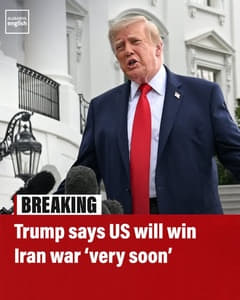
President Donald Trump has repeatedly predicted that the United States will win its war with Iran “very soon,” expressing confidence in America’s military position while promising that energy prices will fall once the conflict ends. But as of October 28, 2026, the war remains unresolved, and diplomatic efforts have yet to produce a lasting settlement.
The image’s headline reflects remarks Trump made in the Oval Office on September 28. Speaking to reporters, he said U.S. officials had communicated with mediators working to end the conflict and insisted that victory would come quickly. He did not, however, announce a peace agreement, a confirmed end date for the war or a detailed plan for ending the fighting.
The difference between a president’s prediction and a verified military or diplomatic outcome is central to understanding the story.
What Trump said about the war
According to Reuters, Trump made his remarks on September 28 as U.S. and Iranian officials were communicating indirectly through mediators.
“We’re going to win, as far as I’m concerned,” Trump told reporters, adding that the conflict would move quickly. He also predicted that gasoline prices would fall sharply after the war ended.
Trump framed preventing Iran from obtaining a nuclear weapon as a central objective of the campaign. But his comments did not provide independently verified evidence that Iran had accepted U.S. terms or that the fighting was about to stop.
The remarks were part of a broader series of optimistic predictions. In October, Trump continued to say the war would end soon, while also leaving open the possibility of further military action if negotiations failed.
Why the war has been difficult to end
The conflict began in late February 2026 with U.S. and Israeli attacks on Iran. It has since involved wider regional security risks, disruption to energy supplies and repeated attempts to negotiate an end to hostilities.
Several major issues remain unresolved:
-
Iran’s nuclear program: Washington wants assurances that Iran cannot develop a nuclear weapon, while international inspectors have been unable to verify the full status of Iran’s highly enriched uranium stockpile.
The Strait of Hormuz: Iran’s restrictions on shipping through the strategic waterway have disrupted global energy markets. Reopening it safely is a major focus of negotiations.
Sanctions and the U.S. blockade: Tehran wants sanctions eased and restrictions on Iranian ports and oil exports lifted. Washington has sought nuclear-related concessions in return.
Security guarantees: Both sides remain wary of making concessions first, complicating efforts to secure a lasting agreement.
These are not minor details. Even if military operations were reduced, disagreements over nuclear inspections, sanctions, shipping and regional security could still prevent a comprehensive peace deal.
Diplomacy is continuing, but there is no confirmed breakthrough
Recent developments show that diplomatic efforts have not stopped.
On October 27, Reuters reported that Iranian officials had met representatives from Saudi Arabia, Turkey and Pakistan as part of regional discussions about security and the conflict. Iran continued to insist that its conditions for ending the war be addressed, including the U.S. blockade and sanctions on Iranian oil exports.
On October 28, The Guardian reported that Gulf states were working on a broader proposal intended to prevent renewed fighting. Discussions included reopening the Strait of Hormuz and addressing regional security concerns. But major differences remained, particularly over nuclear inspections and the conditions Washington expects Iran to accept.
The diplomatic activity offers a possible route toward de-escalation, but negotiations are not the same as an agreement. Neither report establishes that the war has ended or that both governments have accepted a final settlement.
Will the end of the war bring gasoline prices down?
Trump has repeatedly linked an American victory to lower fuel prices. The reasoning is that reducing the threat to shipping and reopening the Strait of Hormuz could ease pressure on global oil supplies.
However, oil prices depend on more than the outcome of the war. Shipping security, production levels, sanctions, insurance costs and the risk of further attacks all influence energy markets.
On October 27, Reuters reported that oil prices had fallen nearly $2 per barrel amid renewed diplomatic hopes. Yet prices remained elevated because the conflict and threats to shipping continued. Brent crude settled at $113.88 per barrel, while U.S. West Texas Intermediate crude settled at $99.90.
That movement suggests markets are responding to the possibility of diplomacy, not that a lasting peace has already been secured. A sustained decline in fuel prices would depend on whether the region becomes safer and oil supplies return to more predictable conditions.
What the viral graphic gets right — and what it leaves out
What it gets right
-
Trump did publicly say that the United States would win the Iran war “very soon.”
He said officials were communicating with mediators.
He predicted that gasoline prices would fall after the conflict ended.
What it leaves out
-
The statement dates to September 28, 2026; it is not, by itself, evidence of a new development today.
Trump did not announce a confirmed end date or a finalized peace agreement in the remarks shown.
Negotiations remain complicated by disagreements over Iran’s nuclear program, sanctions and the Strait of Hormuz.
Lower oil prices are a prediction, not a guaranteed result of a U.S. victory.
Bottom line
Trump’s statement is real, but it should be understood as a declaration of confidence rather than confirmation that the United States has won the war.
As of October 28, diplomatic efforts continue, major disputes remain unresolved, and energy markets are still reacting to the risks surrounding the conflict. Whether Trump’s prediction comes true will depend on developments on the battlefield and at the negotiating table—not on the statement alone
Comments (0)
Loading comments...
May You Like

COASTAL DISASTER — 112 KM/H WINDS, SEAWATER FLOODING, 79,000 NEW JERSEY HOMES AT RISK!

WWE BRONSON REED DEAD AT 38, STIMULANTS DETECTED, $10M INSURANCE PAYOUT FROZEN!

WWE BRONSON REED—STAR COLLAPSES AT COMPANY EVENT, FATAL DRUG REACTION SUSPECTED!









Popular Posts



