
Trump Sparks Election Firestorm With Controversial Remark About Racism — What Did He Really Mean?
President Donald Trump is drawing renewed attention in the closing days of the 2026 midterm election campaign as a provocative political message suggests he is urging voters to look beyond accusations of racism when deciding which party should control Washington.
The circulating image features Trump speaking into a microphone alongside the headline, “Not Beating the Racist Accusations.” Although the wording is dramatic, the image does not identify a specific speech, provide a complete quotation, or establish that Trump made those exact remarks.

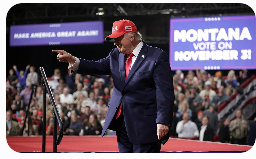
The controversy highlights a familiar feature of Trump's political career: his willingness to confront criticism directly, often using provocative language that attracts intense reactions from supporters and opponents alike.
With the November 3 elections approaching, the president's rhetoric has become an important part of the Republican effort to energize voters and defend the party's congressional majority.
Republicans are emphasizing immigration enforcement, public safety, economic policy, and their broader governing agenda. Democrats are challenging the administration's record while raising concerns about civil rights, democratic institutions, and presidential accountability.
The dispute over racism is particularly sensitive because Trump's political career has repeatedly involved arguments about immigration, national identity, and the treatment of minority communities.

Trump and his allies have frequently rejected accusations of racism, arguing that his policies are intended to protect American citizens regardless of their backgrounds.
His critics contend that some of his statements and policy proposals have unfairly targeted particular racial, ethnic, or immigrant communities. Those disagreements have contributed to years of political confrontation.
For voters, the challenge is distinguishing between the political claims made by each side and the actual consequences of government policy.
A controversial remark may generate headlines, but its significance depends on the original context, the audience, and whether the statement reflects a concrete policy position.
The latest viral image does not provide enough information to verify a new, specific statement by Trump about racism. It is therefore more accurate to examine the broader political debate than to attribute an unconfirmed quotation to the president.
Trump's campaign messaging has consistently emphasized the importance of voter turnout. He has warned Republican supporters that losing control of Congress could make it significantly harder to advance his administration's legislative priorities.

The stakes are substantial. All 435 seats in the House of Representatives and roughly one-third of the Senate are being contested in the November elections, along with numerous state and local offices.
Democrats are seeking to make the election a referendum on Trump's second term. Republican candidates, meanwhile, are attempting to persuade voters that their party offers a stronger approach to national security, border enforcement, and economic growth.
Accusations of racism can carry significant political consequences, particularly when they involve a sitting president. Such allegations can influence public perceptions of leadership, fairness, and the values represented by the federal government.
At the same time, political labels are not substitutes for examining specific statements and actions. Responsible scrutiny requires considering what was actually said, whether the language was accurately reported, and how it relates to government decisions.
The debate also illustrates how social media can amplify political conflict. A single photograph accompanied by a sensational headline may reach millions of people before the underlying claim has been independently verified.
For Trump's supporters, his confrontational style remains part of his political appeal. They often view his refusal to retreat from criticism as evidence of determination and political independence.
For opponents, the same approach raises concerns about the tone of national leadership and the potential consequences of divisive rhetoric.
As Election Day draws closer, both parties are competing to define what voters should consider most important: the administration's policy achievements, its controversies, or the future direction of the country.
Comments (0)
Loading comments...
May You Like

BANGCHAK REFINERY DISASTER IN THAILAND—120,000 BARRELS A DAY SHUT DOWN, U.S. OIL PRICES SURGE 10%!

STORM WARNING: MILLIONS FACE EVACUATION, MACY'S GIANT BALLOONS GROUNDED!

U.S. REPORTEDLY STRIKES OIL TANKER NEAR IRAN — COULD GAS PRICES SURGE?












