
Nicki Minaj’s Trump Support Sparks Backlash After Her Music Is Reportedly Rejected at a Democratic Rally
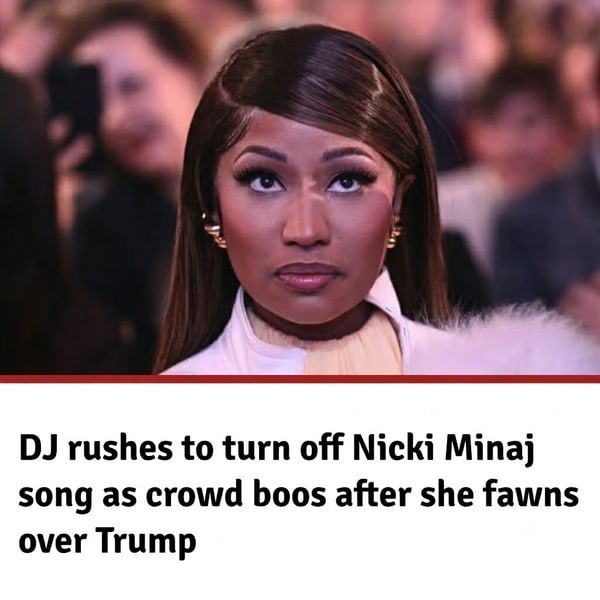
Nicki Minaj’s increasingly visible support for Donald Trump has placed the rapper at the intersection of celebrity culture and an intensely divided American political landscape. A viral account now claims that her music was played at a Democratic rally, prompting boos from the crowd and a demand that the DJ switch to Stevie Wonder. The episode, if accurately described, would offer a vivid example of how a celebrity’s political associations can change the way audiences respond to music that once carried no obvious partisan meaning.
But the details need to be separated from the viral framing. Minaj’s public praise of Trump and her appearance alongside him have attracted substantial attention. The reported rally interruption is a separate claim: its location, date, organizers and full recording matter before it can be treated as a confirmed account of what happened.
What happened when the song played?
The incident was reported on October 24, 2026, during a Democratic campaign event featuring former President Barack Obama. According to video-based accounts published by AOL and the International Business Times, a Nicki Minaj track began playing during the pre-event DJ set. Some people in the audience booed, one attendee shouted, “Turn this off!”, and another suggested playing “Stevie Wonder or something.” The DJ then stopped the track and moved to another song.
The available footage and reporting support the basic sequence, but there is some inconsistency in how outlets identify the event’s location. Some coverage connects the clip to an Obama appearance in Detroit alongside Democratic Senate candidate Abdul El-Sayed; other reports discuss Obama’s Ohio campaign stop on the same day. It is therefore safer to identify it as a Democratic event associated with Obama’s October 24 campaign appearances rather than state an exact venue without further verification.
The interruption happened before Obama took the stage, according to the reports. It was a brief moment in the event’s music playlist—not a formal announcement by the campaign that Minaj’s music had been banned. The distinction is important: the video captures a reaction from people in the audience and the DJ’s response, but it does not establish an official policy by Democratic organizers or a nationwide boycott of the rapper’s music.
Why Minaj’s political alignment has become part of the story
The crowd’s reaction came just one day before Minaj appeared alongside Trump at a Republican campaign rally in Port Huron, Michigan, on October 25. She had travelled aboard Air Force One and took the stage at McMorran Place Arena, where thousands of supporters had gathered ahead of the November midterm elections.
Her remarks went well beyond a general expression of admiration. Minaj told the audience, “We love Trump,” praised what she described as his resilience and promised to continue supporting him “forever and ever.” She also encouraged Michigan voters to support Republican candidates, including Senate candidate Mike Rogers and gubernatorial candidate John James.
The endorsement marked a highly visible step in her political involvement. Minaj had previously criticized Trump’s immigration policies during his first administration, particularly the separation of children from their parents at the U.S.–Mexico border. Her more recent public alignment with the president represents a change from those earlier positions, although the reasons behind her political evolution should not be assumed without her own explanation.
Her appearance also attracted attention because of an unusual exchange with Trump. During the rally, the president made a remark about her physical appearance before inviting her to stand in front of the audience. Minaj subsequently led a pro-Trump chant and reiterated her support. The episode generated additional coverage, but the central political development was her direct appeal for voters to support Republicans.
A celebrity endorsement—and a divided audience
Celebrity endorsements can bring attention, media coverage and access to audiences that political campaigns may struggle to reach through conventional advertising. But they can also create tension when an entertainer’s political positions differ from those of a particular audience.
Minaj’s experience illustrates that tension. Her music has been popular across audiences with different political views, but her increasingly explicit support for Trump has made her a more politically identifiable public figure. At a Democratic event, that association appears to have influenced at least some attendees’ response to her song.
Still, the viral clip should not be treated as a scientific measure of public opinion. A crowd at one campaign event is not representative of all Democratic voters, all music fans or Minaj’s entire audience. Nor does a brief episode of booing demonstrate that her music has suffered a measurable decline in popularity.
Social-media reactions have been sharply divided. Some users celebrated the DJ’s decision to stop the track, while others questioned why the song had been included in the playlist in the first place. These reactions show how quickly a short video can become a political argument, but they do not establish a broader cultural consensus.
Obama’s campaign message provides the wider context
The music interruption was a sideshow to a broader Democratic campaign effort. Obama returned to the campaign trail on October 24 to support Democratic candidates ahead of the November 3 midterms. In Ohio and Michigan, he criticized the Trump administration over its record, the cost of living and the direction of federal policy.
At the Ohio rally, Obama described the election as an opportunity for voters to constrain the administration’s actions. He also argued that grocery and fuel costs had become more burdensome. His remarks were campaign arguments, rather than an independent economic assessment, but they reflected the issues Democrats were emphasizing in the final stretch of the election campaign.
In Michigan, Obama also campaigned alongside Abdul El-Sayed, the Democratic Senate candidate challenging Republican Mike Rogers. The race had become a focus of national attention, with both parties using high-profile appearances to energize supporters and reach undecided voters.
The contrast between the two political appearances was striking: Minaj was booed when her music played at a Democratic event, then appeared onstage with Trump the following day to encourage support for Republicans. That sequence made the incident particularly shareable and helped turn a brief playlist interruption into a national entertainment-and-politics story.
What the incident really tells us
The reported episode is genuine enough to merit coverage: video-based reporting describes a Nicki Minaj song being met with boos at an Obama-associated Democratic campaign event on October 24, with the DJ switching tracks after audience members objected. The next day, Minaj appeared with Trump in Port Huron and publicly urged voters to support Republicans.
But the strongest claims in the viral framing need qualification. There is no evidence here of a formal nationwide blacklist of Minaj’s music, an organized boycott by all anti-Trump crowds or a measurable collapse in her fanbase. The available reporting documents a specific crowd reaction, not a national verdict on her career.
The broader story is about the increasingly visible intersection of celebrity identity, political endorsement and audience expectations. Minaj has chosen to make her support for Trump public, and that decision has brought both a prominent political platform and criticism from some listeners. Whether that support changes her long-term relationship with fans will depend on reactions well beyond one rally and one viral video.
Comments (0)
Loading comments...
May You Like

1,000+ MILITARY FAMILY RECORDS BREACHED, 200+ MILITARY SITES AT RISK!

WEYMOUTH HORROR—80-MPH WIND GUSTS, FIRE TRUCK FLIPS, 3 FIREFIGHTERS CRITICAL!

DAVENPORT AIRBNB HORROR — “SHOTS AT THE DOOR” GAME, 1 DEAD, 6 INJURED!









Popular Posts



