Trump Takes Mail-In Voting Fight Back to the Supreme Court as 2026 Midterms Draw Closer
Trump Takes Mail-In Voting Fight Back to the Supreme Court as 2026 Midterms Draw Closer
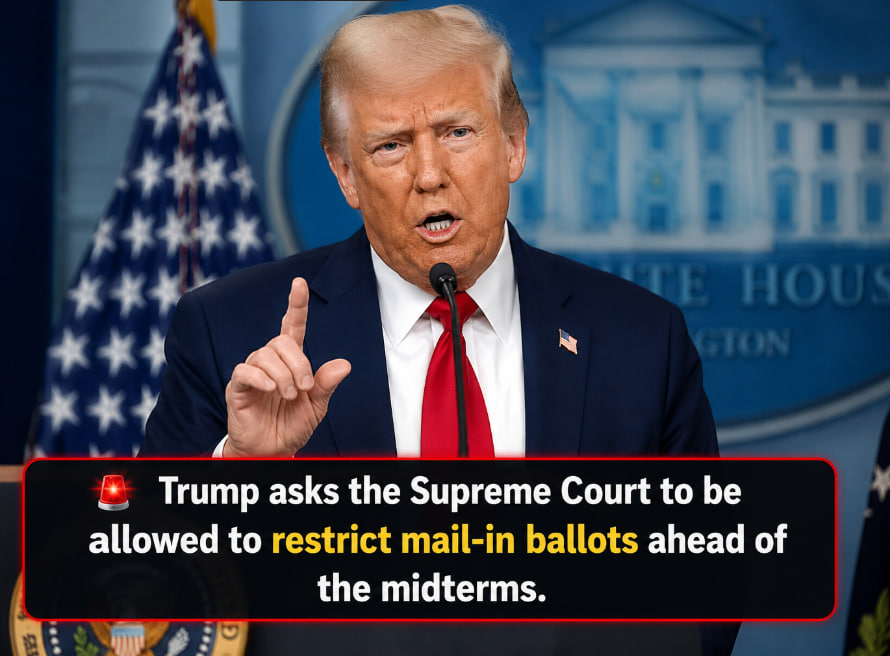
WASHINGTON — President Donald Trump’s administration has taken its battle over mail-in voting back to the U.S. Supreme Court, asking the justices to clear the way for new restrictions on how states and the U.S. Postal Service handle mail-in ballots ahead of the November midterm elections.
The emergency request comes at a particularly consequential moment. With states beginning to prepare and distribute ballots for the 2026 elections, the administration is attempting to revive a policy that federal courts have repeatedly blocked or limited.
The dispute has now become a major constitutional battle over who has the authority to regulate federal elections — the president and federal government, or the states that traditionally administer them.
The Supreme Court has already intervened in related litigation this summer. But a separate federal court order continues to prevent the Postal Service from implementing the new mail-ballot requirements, prompting the administration to return to the nation's highest court.
For voters, election officials and both political parties, the timing could hardly be more important.
Trump Administration Makes Another Emergency Appeal
On September 3, the Justice Department filed an emergency application asking the Supreme Court to lift a federal judge's order that prevents the U.S. Postal Service from enforcing the administration's new mail-ballot rules.
The administration is seeking emergency relief rather than waiting for the ordinary appeals process to run its course.
The move follows a series of legal battles that have unfolded rapidly over the summer, with courts considering whether Trump's executive order can lawfully impose new federal requirements on a voting system largely administered by individual states.
The administration argues that the new requirements are necessary to strengthen election integrity and prevent improperly addressed or unauthorized ballots from entering the mail system.
Opponents see the situation very differently.
They argue that the administration is attempting to impose significant changes to election procedures shortly before voters head to the polls — potentially creating confusion and disenfranchising voters who rely on mail ballots.
The Supreme Court is now being asked to decide whether those restrictions can take effect while the broader legal battle continues.
The New Rules Could Change How Mail Ballots Are Delivered
At the center of the dispute is a March executive order signed by Trump that sought to impose new requirements on mail-in voting.
Under the Postal Service's proposed implementation, states would be required to provide USPS with lists of voters who are approved to receive mail ballots.
Ballot envelopes would also be required to carry unique barcodes, and USPS would be permitted to deliver ballots only to voters appearing on the relevant eligibility lists.
Supporters say the system would create additional safeguards around mail voting.
But election officials and voting-rights groups warn that the requirements could create problems if voter information is incomplete, inaccurate or not transferred between state election systems and the Postal Service in time.
That concern becomes especially significant when the rules are being introduced only weeks before a major national election.
Federal Judge Extends the Block
The administration's latest Supreme Court appeal comes just as the legal obstacles to the policy have grown.
On September 4, U.S. District Judge Indira Talwani extended an order blocking implementation of Trump's mail-voting restrictions. The preliminary injunction prevents the Postal Service from putting the new system into effect as the November election approaches.
Talwani's ruling was particularly significant because election preparations are already moving forward.
Some states are beginning to distribute ballots, while election offices are already working under established procedures and deadlines.
The judge raised concerns about the potential consequences of introducing a new system at such a late stage.
The Postal Service itself has faced questions about whether the technology and procedures required to implement the new rules are ready.
A federal whistleblower has also raised concerns about potential operational problems, including the possibility that ballots could be delayed by the new verification system.
That has transformed the legal dispute from an abstract constitutional argument into a race against the election calendar.
The Supreme Court Has Already Given Trump a Partial Victory
The latest appeal is not the administration's first attempt to bring the issue before the Supreme Court.
On August 24, the justices handed Trump a significant but limited victory in related litigation.
The Court lifted a lower-court order that had blocked parts of Trump's election executive order, concluding that the states challenging the order had not yet demonstrated sufficient immediate harm to proceed in that particular case.
But that ruling did not give the administration everything it wanted.
A separate injunction involving the Postal Service remained in place.
That distinction is crucial.
The Supreme Court's August decision did not definitively resolve whether Trump has the constitutional authority to impose the mail-ballot requirements nationwide. Instead, the ruling dealt with procedural questions surrounding the states' challenge.
As a result, the administration's attempt to implement the policy remained entangled in separate litigation.
Now, the Justice Department is asking the Supreme Court to intervene again.
Why Trump Wants to Restrict Mail Voting
Trump has spent years criticizing mail-in voting.
He has repeatedly argued that the system is vulnerable to fraud and has pushed for tighter restrictions on how ballots are distributed and counted.
His administration has framed the current effort as part of a broader campaign to strengthen election security.
Trump has also pledged to reduce or eliminate the use of mail-in ballots nationwide.
But election experts and voting-rights organizations have repeatedly pointed out that documented cases of widespread fraud involving mail ballots are rare.
The political implications are also substantial.
Democratic voters have historically been more likely than Republicans to use mail voting in many elections. That means restrictions on mail ballots could have a disproportionate effect on Democratic voters, although the precise impact would vary by state and election.
That has made the issue intensely partisan.
Republicans generally argue that stricter procedures are necessary to protect election integrity.
Democrats and voting-rights groups argue that the restrictions could make voting more difficult for eligible citizens without solving a significant fraud problem.
States Say Washington Is Trying to Take Over Election Administration
One of the central legal questions is not simply whether mail voting is secure.
It is who gets to decide how it works.
American elections are administered primarily by the states. State and local election officials establish procedures for registering voters, distributing ballots and conducting elections, subject to federal law and constitutional requirements.
The Trump administration's executive order seeks to impose additional federal requirements on that process.
Democratic-led states and voting-rights groups argue that the president does not have the authority to unilaterally rewrite state election procedures through an executive order.
They have challenged the administration's policy in court, arguing that the Constitution and federal election laws limit the president's ability to dictate how states conduct elections.
The administration disputes that interpretation.
That disagreement could eventually produce one of the most consequential election-law cases of Trump's second presidency.
Election Officials Fear the Timing Could Create Chaos
Even if the Supreme Court ultimately sides with the administration, implementing the new rules could prove difficult.
The biggest problem is timing.
The November midterms are approaching rapidly, and election offices have already spent months preparing ballots, voter lists, equipment and procedures.
North Carolina, for example, was preparing to become the first state to issue mail-in ballots for the 2026 general election in early September.
That means election administrators cannot simply pause the entire system while courts debate the rules.
A sudden change could require states to modify procedures, update databases and coordinate with USPS on extremely short notice.
Election officials have warned that even a technically valid change could create confusion if implemented too close to Election Day.
For voters, the consequences could include uncertainty over whether a ballot has been mailed, whether it can be delivered, or whether it must meet additional requirements to be counted.
The Political Stakes Are Enormous
The dispute is unfolding as Republicans and Democrats prepare for the 2026 midterm elections, in which control of Congress will be at stake.
That gives the mail-ballot fight an obvious political dimension.
Mail voting is particularly important in states where large numbers of voters routinely use absentee or mail ballots.
A change in the rules could therefore affect not only election administration but potentially turnout.
Republicans have generally benefited from emphasizing election-security concerns and stricter voting rules.
Democrats have warned that restrictive policies can make it harder for eligible voters to participate.
Both sides are now preparing for an election in which relatively small changes in turnout could determine control of the House or Senate.
The Postal Service Has Become an Unexpected Player
The U.S. Postal Service is at the heart of the controversy.
The agency normally plays a crucial logistical role in delivering ballots to voters and returning completed ballots to election offices.
Under the administration's proposed system, however, USPS would have additional responsibilities in verifying and delivering mail ballots based on information supplied by states.
That raises practical questions about technology, data sharing and timing.
The Postal Service has argued in court that some of the infrastructure required to implement the new system is not yet available.
Critics say that creates an extraordinary situation: a federal election policy could potentially be implemented even though the agency responsible for carrying it out is still developing the necessary systems.
The administration, meanwhile, is pushing the courts to allow the policy to proceed.
Voting-Rights Groups Warn of Disenfranchisement
Civil-rights organizations and voting-rights advocates have strongly opposed the restrictions.
Their central argument is that the new procedures could create barriers for legitimate voters, particularly if voter lists contain errors or if ballots are sent before the new verification system is fully operational.
They also argue that the federal government should not impose new requirements that could override state election laws.
The American Civil Liberties Union and other organizations have criticized the administration's effort, while a coalition of states has continued its legal challenge.
For these groups, the issue goes beyond mail voting.
They view the case as a test of the limits of presidential power over American elections.
Trump's Election Agenda Is Facing a Series of Court Battles
The mail-ballot case is part of a much broader legal campaign by the Trump administration to reshape election administration.
The president's March executive order included several provisions aimed at changing federal election procedures, including requirements related to voter information and election administration.
States and voting-rights organizations have challenged multiple aspects of the administration's approach.
Courts have therefore become an increasingly important battleground over Trump's election policies.
The administration has repeatedly asked higher courts to intervene when lower courts have blocked its actions.
The Supreme Court's willingness to consider those emergency requests could play a major role in determining how much of Trump's election agenda can take effect before the midterms.
A Supreme Court Decision Could Come Under Intense Pressure
The timing places the justices in an unusually difficult position.
A ruling in favor of the administration could allow the new USPS rules to take effect while election preparations are already underway.
A ruling against the administration would keep the restrictions blocked while the broader legal challenges continue.
Either outcome could have immediate practical consequences.
And because the case involves the president's authority, state control of elections and voting rights, the legal significance could extend far beyond the 2026 midterms.
The Court could ultimately be asked to answer a much larger question:
How much power does a president have to change the way Americans vote without an act of Congress?
The Clock Is Now Running
The administration's latest appeal arrives with the election calendar rapidly closing the window for major changes.
Ballots are already being prepared.
Election offices are already working.
And voters are beginning to make decisions about how they will cast their ballots.
That leaves the Supreme Court with an unusually time-sensitive dispute.
The justices are not merely being asked to resolve an argument about election law.
They are being asked to determine whether a controversial new system can be put into operation before millions of Americans cast their votes.
The Trump administration says the restrictions are necessary to protect election integrity.
Opponents say they threaten access to the ballot and intrude on powers traditionally reserved to the states.
Meanwhile, election officials are left preparing for an election while the rules governing one of the country's most widely used voting methods remain uncertain.
The 2026 midterms may ultimately become a test not only of political power in Washington, but of how much control the federal government can exercise over the mechanics of American elections.
And with ballots already beginning to move, the Supreme Court may soon have to decide whether Trump's mail-voting restrictions move forward — or remain blocked until after voters have had their say.
Comments (0)
Loading comments...
May You Like

FIGHT OVER OBAMA’S IRAN POLICY

Obama Steps Back Into the Political Spotlight as Democrats Target Trump’s Senate Majority