
Trump Takes Narrow Supreme Court Rulings as Big Wins
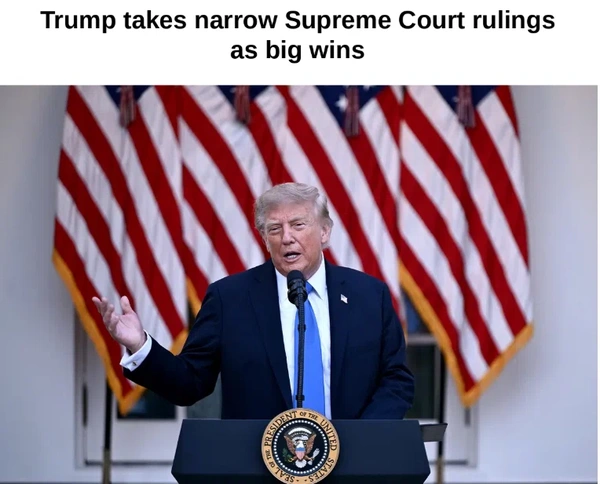
President Trump is celebrating a series of procedural victories at the Supreme Court as big wins, allowing him to press forward with key agenda items — including the $400 million White House ballroom project — even as legal battles over their ultimate legality remain unresolved.
WASHINGTON – The construction of a massive White House ballroom is moving full steam ahead after the Supreme Court found a historic preservation group likely had no right to stop it.
"We have a lot of very happy construction workers," President Trump told reporters in the Oval Office on Wednesday. The $400 million project on the site of the former East Wing, he said, was "under budget and ahead of schedule."
It's yet another example of the president taking a narrow procedural ruling as permission to press ahead with a contested piece of his agenda — often before courts have even had a chance to fully weigh in on whether the actions are lawful.
The Ballroom Battle
The Supreme Court ruled 5-4 on August 31 to lift a lower-court order that had halted above-ground construction of the 90,000-square-foot ballroom complex. The court's unsigned order did not rule on whether the ballroom itself is lawful. Instead, it found that the National Trust for Historic Preservation, the group challenging the project, likely lacked the legal standing to bring the case.
In doing so, the majority sidestepped the question of whether Trump had the authority to tear down the East Wing without congressional approval. The Trump administration has insisted it doesn't need express authorization and maintains it abided by the required review and permitting processes.
Chief Justice John Roberts, joined by the three liberal justices, wrote in a dissenting opinion that the president's actions were "likely unlawful" and disagreed that the plaintiffs didn't have standing.
"The White House is not just any building, and—when it comes to historic preservation—[Alice] Hoagland is not just any person," Roberts wrote. "In failing to appreciate as much, the Court misconceives the plaintiff's injury, allowing the Executive's likely infringement of the Legislature's power of the purse and authority to regulate federal property in the District of Columbia to continue."
Trump Celebrates 'Golden Age'
Trump welcomed the decision, calling the lawsuit "baseless" and celebrating what he described as a victory for his ballroom and wider military complex.
"I am pleased to report that the United States Supreme Court has just ruled in favor of the Ballroom/Military Complex being built without any further contingency, doubt, or threat," Trump said in a post on Truth Social.
"We are living in the Golden Age of America, and this Building will be one of the Greatest ever constructed in Washington, D.C."
The administration has defended the project not only as an expansion of the White House but also as a national security measure. Justice Department lawyers told the Supreme Court that the complex would include a highly secure ballroom linked to an underground military installation.
Trump has said the underground complex will include bomb shelters, medical facilities and protection against drones and missiles. The administration has argued that stopping construction could compromise security arrangements at the White House.
A Pattern of Procedural Victories
The ballroom is not an isolated example. The Trump administration has successfully used the emergency docket to advance Trump's priorities numerous times during his second term, securing a temporary win in his efforts to restrict mail-in voting for the midterms as recently as last week.
In that case, the majority found that a group of Democratic-led states had challenged new U.S. Postal Service regulations too early and tossed out a lower court injunction. The matter is now back on the Supreme Court's emergency docket after the Justice Department asked the justices on Thursday to lift a Boston-based federal judge's second block.
Justice Ketanji Brown Jackson argued in dissent to the first mail-in voting ruling that her conservative colleagues were helping facilitate the administration's "Catch-Me-If-You-Can approach" by granting interim relief while the merits are still being weighed.
And the White House doesn't deny that Trump is moving quickly to implement his agenda.
"President Trump is moving at lightning speed because we don't have time to waste in our mission to make America greater than ever before," spokesperson Davis Ingle said in a statement.
The Race Against the Courts
Experts said the court's interpretation of standing leaves Congress as the only viable challenger. But even if the issue wound its way back through the courts and was eventually found unlawful, it may be too late to reverse course because the ballroom is already standing.
"At that point, a court asking to halt further construction won't do much by granting that relief — which could itself undermine any request for an injunction in the first place," said Joshua Wurtzel, a partner at Schlam Stone & Doland LLP who specializes in construction litigation.
"Thus, the real risk to a challenger here isn't losing on the merits — it's the project being finished before any court gets there," he added.
The National Trust has accused the White House of attempting to accelerate construction and "outrun the courts" before the legal battle over the project's authority is resolved. Court filings say the project is already more than 65% complete, with 250 workers operating 20 hours a day.
The Bottom Line
| What Happened | The Details |
|---|---|
| Ruling | Supreme Court 5-4 allowed construction to continue |
| Reason | Plaintiffs likely lacked legal standing |
| Not Decided | Whether the ballroom is lawful |
| Project Cost | $400 million (disputed; some reports say up to $600M) |
| Project Status | 65% complete; 250 workers, 20 hours/day |
| Key Dissent | Roberts: construction "likely unlawful" without Congress |
| Security Justification | Underground bunker, bomb shelters, drone/missile protection |
The concept of the emergency docket has been around since the court's inception, historically reserved as a process for handling urgent matters. But its usage grew significantly under the first Trump administration, according to legal experts.
Comments (0)
Loading comments...
May You Like


South Korea–Ukraine Rift Deepens Over North Korean POW Transfer as PURL Draws New Scrutiny

Russian Drone Strikes Kyiv Bridge as German Chancellor Arrives in Ukraine












