
Trump vs. “The Machine”: Putin’s Criticism of Washington Raises Questions About Who Really Shapes U.S. Foreign Policy
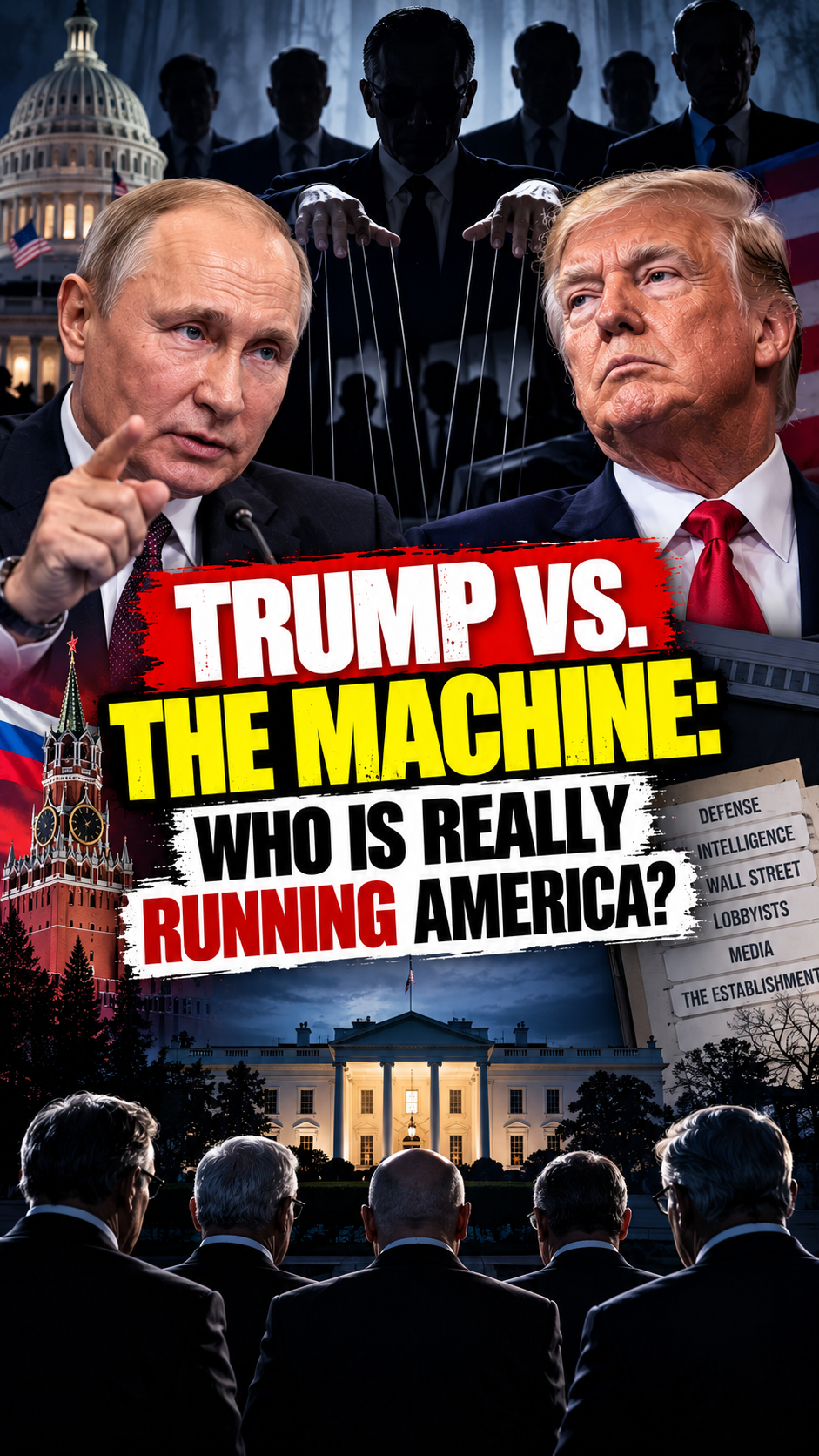
Who really determines American foreign policy: the president elected by voters, or the vast network of institutions, agencies, political interests and security organizations that operate around the White House?
That question sits at the center of a provocative argument advanced by Russian President Vladimir Putin in public comments about the American political system. Putin has suggested that Washington's institutional structure makes major changes in foreign policy difficult, regardless of who occupies the Oval Office.
His remarks offer a useful starting point for examining the limits of presidential power. But they do not prove that an invisible group of officials secretly controls every American president, nor do they establish that Trump is acting under Moscow's direction.
The historical record is more complicated.
In March 2018, Putin described the U.S. political system as inefficient and unpredictable, saying it was difficult to interact with a system that appeared to undermine itself. In September 2023, he again attacked American institutions, this time using the criminal cases against Trump to argue that the United States had exposed what Putin called the “rottenness” of its political system.
The comments came at different moments and addressed different disputes. Taken together, however, they reveal a recurring feature of Putin's public messaging: he has portrayed American political conflict as evidence of institutional weakness while questioning Washington's credibility when it criticizes Russia's political system.
That framing serves Moscow's interests. It encourages audiences to view U.S. democratic institutions as hypocritical or dysfunctional, while presenting Russia as a country that understands the realities of state power.
Yet the question of how much influence American institutions exert over a president is legitimate, and it deserves an answer grounded in evidence rather than conspiracy theories.

The institutions that constrain a president
The phrase “the machine” is often used in political commentary to describe the officials, agencies, donors, lobbyists and established interests that can influence government decisions. It is a powerful metaphor, but it can obscure important differences between institutions that exercise lawful authority and private actors seeking to influence policy.
The American system does not place all foreign-policy authority in the president's hands.
Congress controls federal appropriations, regulates foreign commerce and has constitutional responsibilities involving war, treaties and oversight. The president directs the executive branch, serves as commander in chief and leads diplomatic engagement. Courts can review certain government actions and block measures that violate the law or the Constitution.
The distribution of power creates friction by design. It is intended to prevent any single branch from exercising unchecked authority, even when that friction makes policy slower or less predictable.
Beyond those formal constitutional checks, presidents must work through the departments and agencies responsible for diplomacy, defense, intelligence, trade and economic policy.
The State Department maintains diplomatic relationships. The Pentagon translates strategic decisions into military planning. Intelligence agencies assess foreign threats, while the Treasury Department and other agencies implement sanctions and financial restrictions.
These organizations have specialized expertise, established procedures and institutional priorities. Their assessments can shape the options presented to a president, and their capacity to implement decisions can influence how quickly a policy takes effect.
That does not mean officials possess a single, unified agenda or secretly dictate presidential decisions. Agencies can disagree with one another, political appointees can change priorities, and presidents can dismiss senior officials or reorganize parts of the executive branch within legal limits.
The more accurate conclusion is that presidential authority is substantial but operates through a complex system of laws, people, procedures and competing interests.
Why foreign policy can outlast a president

Putin's argument that American policy can remain consistent despite changes in leadership touches on a genuine feature of international relations: governments inherit commitments and constraints that cannot be discarded without consequences.
Security alliances, military deployments, intelligence-sharing arrangements, trade agreements and sanctions regimes develop over time. They involve negotiations with other governments, financial commitments, legal obligations and planning by institutions that may take years to adjust.
A newly elected president can announce a dramatic change in direction, but translating that announcement into durable results may require congressional funding, administrative action, cooperation from foreign governments or new legislation.
Some decisions can be reversed relatively quickly. Others are much harder to change because they depend on several institutions or because abandoning them would carry significant economic or security costs.
Research from the Carnegie Endowment for International Peace identifies bureaucratic resistance, congressional pressure, interest groups and public opinion as important constraints on presidential ambitions. It also notes that government agencies are necessary instruments of national power, even as their established practices can make rapid changes difficult.
Consider U.S. policy toward Russia. A president might favor a less confrontational relationship, but sanctions, military assistance to allies, congressional positions and the broader security environment can limit the options available.
Likewise, a president seeking a tougher approach may discover that allies will not automatically support every measure and that economic pressure can impose costs on American companies and consumers.
These constraints do not make elections meaningless. They help explain why campaign promises sometimes produce less change than supporters expect—and why a president's actual record can differ from the rhetoric used to win office.

What Putin actually said about Trump
The historical record provides a more precise account of Putin's argument than the dramatic imagery of shadowy figures pulling invisible strings.
In March 2018, during interviews broadcast on Russian state television, Putin expressed admiration for Trump's communication style but distinguished his view of the president from his assessment of the American political system.
Putin said he was disappointed not in Trump personally but in a system he considered inefficient and self-defeating. He described it as difficult to deal with because it was unpredictable.
Five years later, Putin returned to the theme in a different context.
On September 12, 2023, he commented on the criminal cases against Trump, who was then seeking the Republican presidential nomination. Putin characterized the prosecutions as politically motivated and claimed they demonstrated the “rottenness” of the American political system.
Those were Putin's allegations, not an independent legal finding that the cases were politically orchestrated. The criminal proceedings involved specific charges, evidence and judicial processes, and Trump's legal arguments had to be assessed through those proceedings rather than through the Russian president's commentary.
Putin also suggested in 2023 that a change of president would not necessarily produce a fundamental transformation in U.S.–Russia relations. He argued that American political attitudes toward Russia had become entrenched and would be difficult for a future administration to reverse.
That prediction reflected Moscow's assessment of American politics at the time. It did not demonstrate that every president was controlled by the same hidden group.
Indeed, U.S. policy toward Russia has changed significantly across administrations, even when some strategic concerns have persisted.
Does the evidence support the idea that Trump is a puppet?
The image accompanying this story places Trump and Putin opposite one another beneath shadowy officials, suggesting a struggle between the president and an unseen establishment.
As political artwork, that image conveys a clear theme. As evidence, it establishes nothing about who controls government decisions.
The same distinction applies to the longstanding claim that Trump is Putin's puppet. Critics have cited Trump's public praise of Putin and controversial moments in their relationship as grounds for concern. But claims of direct control require evidence, not merely an image, an unusual diplomatic exchange or agreement between two leaders on a particular issue.
A 2019 commentary published by the Cato Institute argued that the “Putin's puppet” allegation was not supported by the evidence it examined. The author pointed to Trump administration policies that conflicted with Russian interests, including military assistance to Ukraine and other measures opposed by Moscow. That article represents an analyst's argument, rather than a definitive ruling on every question concerning the relationship.
The broader lesson is that foreign-policy decisions should be examined individually.
If a president lifts a sanction, delays military assistance, negotiates an agreement or changes an alliance commitment, the relevant questions include what was decided, what reasons were given, who participated, what evidence informed the decision and who benefited.
A claim of secret control requires additional proof of influence or direction. It cannot be established simply because a policy benefits a foreign government.
The reverse is also true: the existence of institutional constraints does not prove that every controversial decision was forced upon a president by advisers or bureaucrats.
Presidents make consequential choices. They also operate within a system that can limit, redirect or frustrate those choices.
Who has the greatest influence over American foreign policy?
There is no single answer that applies to every issue.
-
The president and senior advisers set priorities, direct diplomacy and make many executive decisions.
Congress influences spending, trade policy, legislation, oversight and certain decisions involving military force and international agreements.
Government agencies provide expertise, implement policy and shape the options available to political leaders.
Courts can constrain government actions when legal disputes fall within their authority.
Allies and adversaries affect the choices Washington can realistically make through their own decisions and responses.
Lobbyists, businesses, advocacy groups, think tanks, journalists and voters can influence debate and policy priorities, although their power varies considerably.
The Council on Foreign Relations describes U.S. foreign policymaking as a process shaped by both government institutions and outside forces, including public opinion, the press and interest groups.
These actors do not form one coordinated machine. They compete, cooperate and sometimes work at cross-purposes.
A president may want to change policy but lack congressional support. A government agency may recommend caution while political advisers advocate a rapid response. An ally may refuse to cooperate, forcing Washington to reconsider its strategy. Public opposition may increase the political cost of continuing a conflict.
Such pressures can explain continuity without requiring a theory of secret control.
The real question behind the “machine” debate
The most important issue raised by Putin's remarks is not whether an invisible group literally runs America. It is whether voters can meaningfully change national policy by changing the people in power—and how effectively elected leaders are held accountable when institutions resist their plans.
The American system deliberately distributes authority, but that distribution can make responsibility difficult to trace. Presidents can blame Congress, lawmakers can blame the administration, and officials can point to legal or procedural constraints.
That is why transparency, congressional oversight, credible journalism and public scrutiny matter. They help citizens distinguish between decisions made by elected leaders, constraints imposed by law and influence exercised by private interests.
Putin's criticism should also be considered in context. As the leader of an authoritarian political system, he has a strategic interest in portraying American democracy as ineffective and divided. His observations about institutional friction may describe a real feature of American government, but his interpretation is not politically neutral.
The evidence supports a nuanced conclusion: American presidents have substantial power, but they do not operate without constraints. Institutions, legal rules, political coalitions, economic realities and foreign governments all shape the choices available to them.
That is very different from proving that Trump—or any other president—is secretly controlled by a single establishment.
The more useful question is not simply who is pulling the strings? It is which institutions and interests influence a particular decision, what evidence supports that conclusion and whether the people responsible can be held accountable.
Comments (0)
Loading comments...
May You Like

BOMBSHELL NEW JERSEY FLOOD — 112 KM/H WINDS, SEAWATER FLOODING INLAND, 120,000 HOMES AT RISK!

MINNESOTA NIGHTMARE—UNDERGROUND GAS LEAK, HUNDREDS OF HOMES AT RISK, $300M DAMAGE!











Popular Posts






