
Trump Threatens EU Tariffs Over Canada ‘Associate Member’ Proposal — What He Actually Said

A fast-moving dispute involving the United States, Canada and the European Union has produced a dramatic headline — but the verified story is more specific than the viral version.
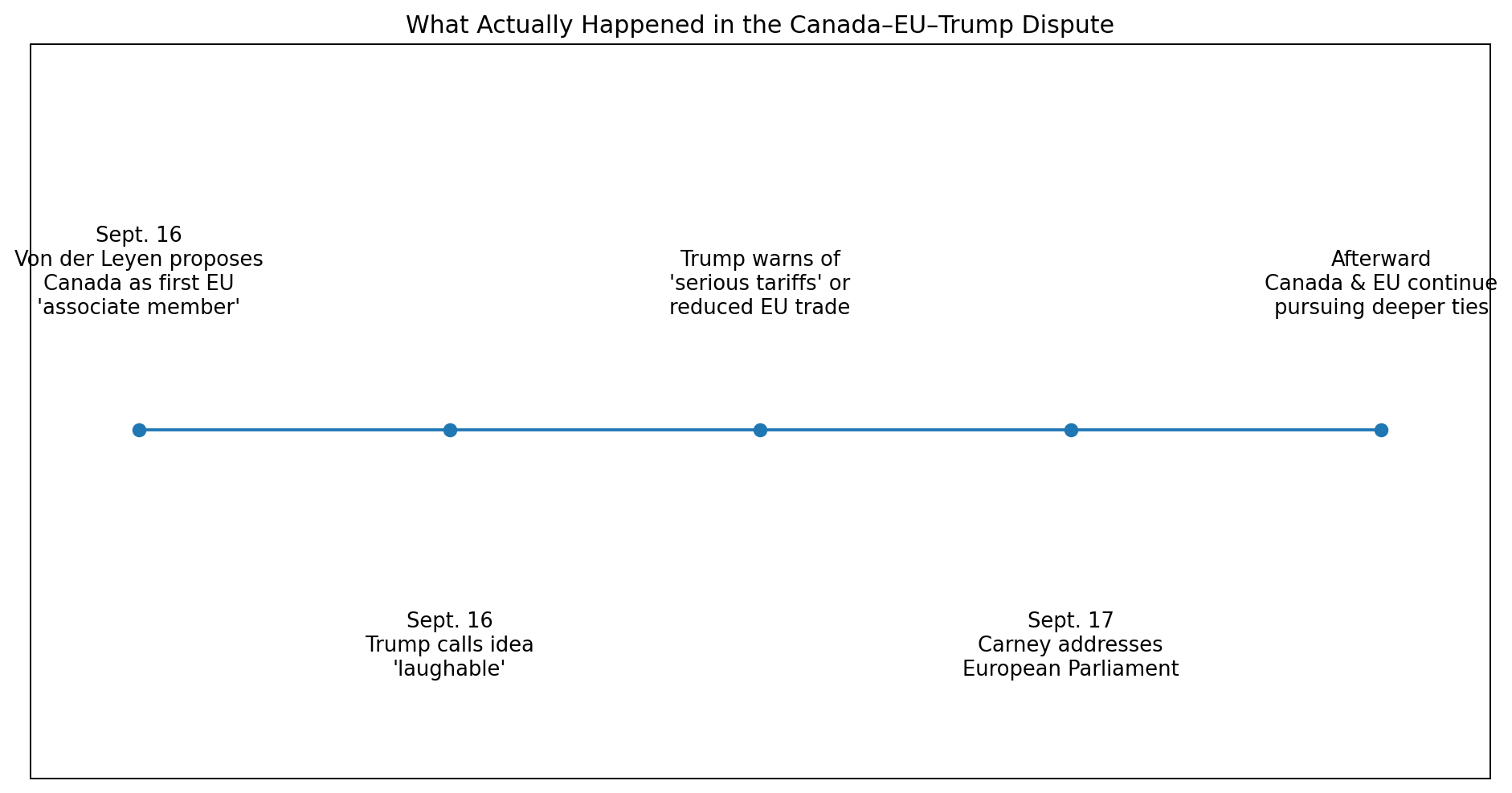
President Donald Trump did threaten economic action against the European Union after European Commission President Ursula von der Leyen proposed opening the door to a new form of “associate member” relationship with Canada.
Trump called the idea “laughable” and said that if he considered the move hostile, the United States could impose serious tariffs on Europe or stop trading with Europe in some areas.
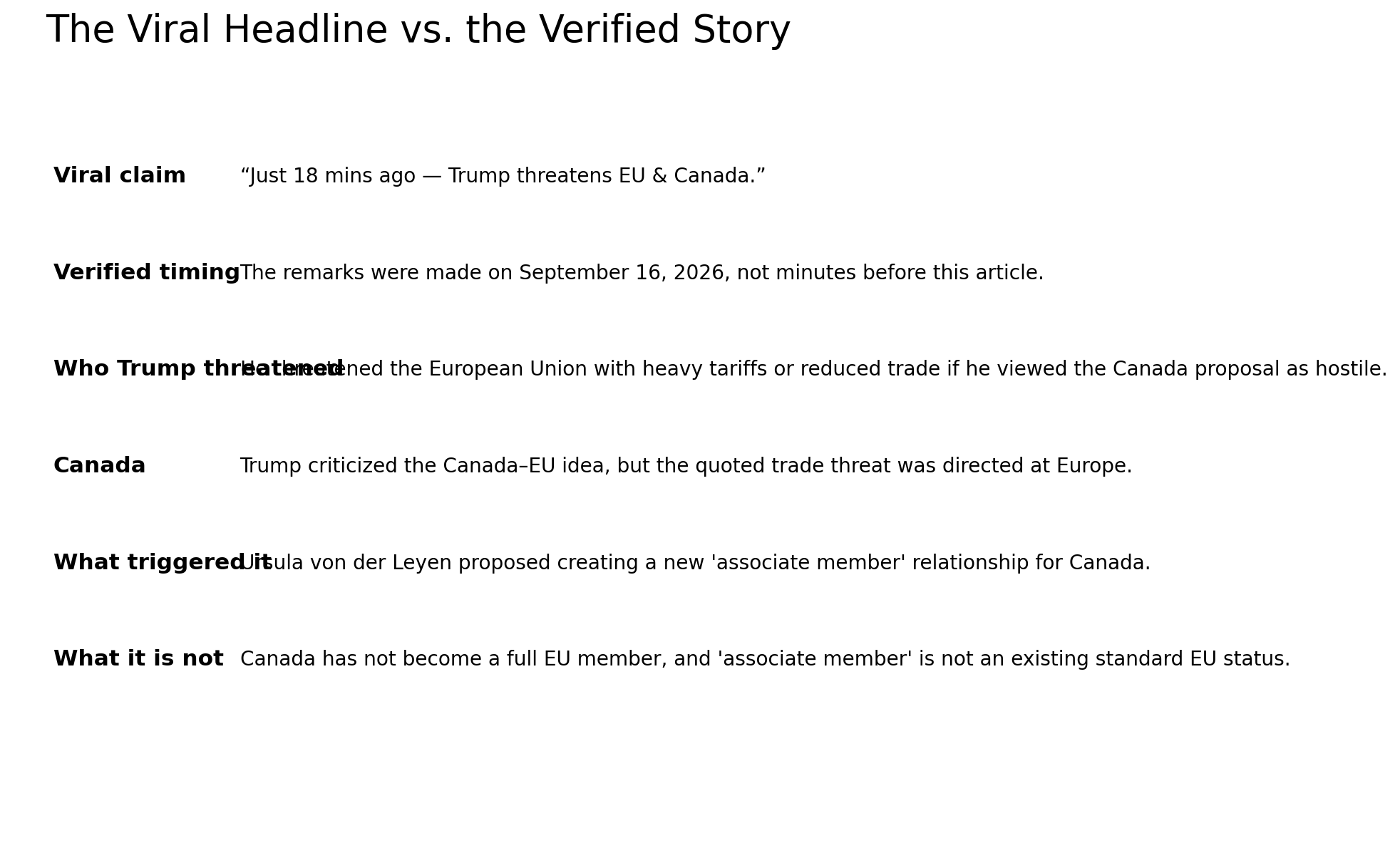
The remarks were made on September 16, 2026.
They were not made “18 minutes ago,” and the quoted threat was directed primarily at the European Union rather than being a blanket threat against both Europe and Canada.
What Triggered Trump’s Warning
The confrontation began in Strasbourg during von der Leyen’s annual State of the European Union address.
With Canadian Prime Minister Mark Carney in attendance, she said she wanted to work toward making Canada the European Union’s first “associate member.”
The phrase immediately drew attention because the EU does not currently have a standard associate-membership category in its treaties.
Von der Leyen presented the idea as part of a broader effort to deepen partnerships with countries that share European interests on democracy, defence, trade, technology and economic security.
She also emphasized that a stronger Canada–EU relationship was not intended to be directed against another country.
Trump’s Response Was a Trade Threat
Trump reacted while traveling to an event in North Carolina.
He said the proposal could be acceptable if it had what he considered good intentions.
But he warned that if he viewed it as a hostile act, he would respond with very serious tariffs or restrict trade with Europe in multiple areas.
That distinction matters.
Trump did not announce a new military confrontation or sever diplomatic relations. He threatened to use trade measures — one of the central tools of his broader economic policy — if the EU proceeded in a way he believed harmed U.S. interests.
Why Canada Is Looking More Closely at Europe
Canada’s interest in Europe comes after a period of unusually difficult trade relations with the United States.
Canada and the U.S. have been involved in an increasingly acrimonious tariff dispute, and earlier trade talks broke down.
Carney has also said Canada needs to diversify its economic relationships rather than remain overwhelmingly dependent on the American market.
His government has set a goal of significantly expanding non-U.S. trade over the coming decade.
Europe is a natural target for that strategy because Canada already has deep political, defence and commercial ties with the bloc.
Carney Did Not Describe the Plan as Joining the EU
The phrase “associate member” can easily be misunderstood as a step toward Canada becoming a normal EU member state.
That is not what Carney said.
In his address to the European Parliament the following day, he welcomed the ambition behind von der Leyen’s proposal but focused on the substance of the relationship rather than the label.
He said Canada and Europe should work together to strengthen strategic autonomy and resilience.
He also made clear that the goal was not to create a new great-power bloc designed to compete directly with the United States and China.
The Areas Under Discussion Go Far Beyond Tariffs
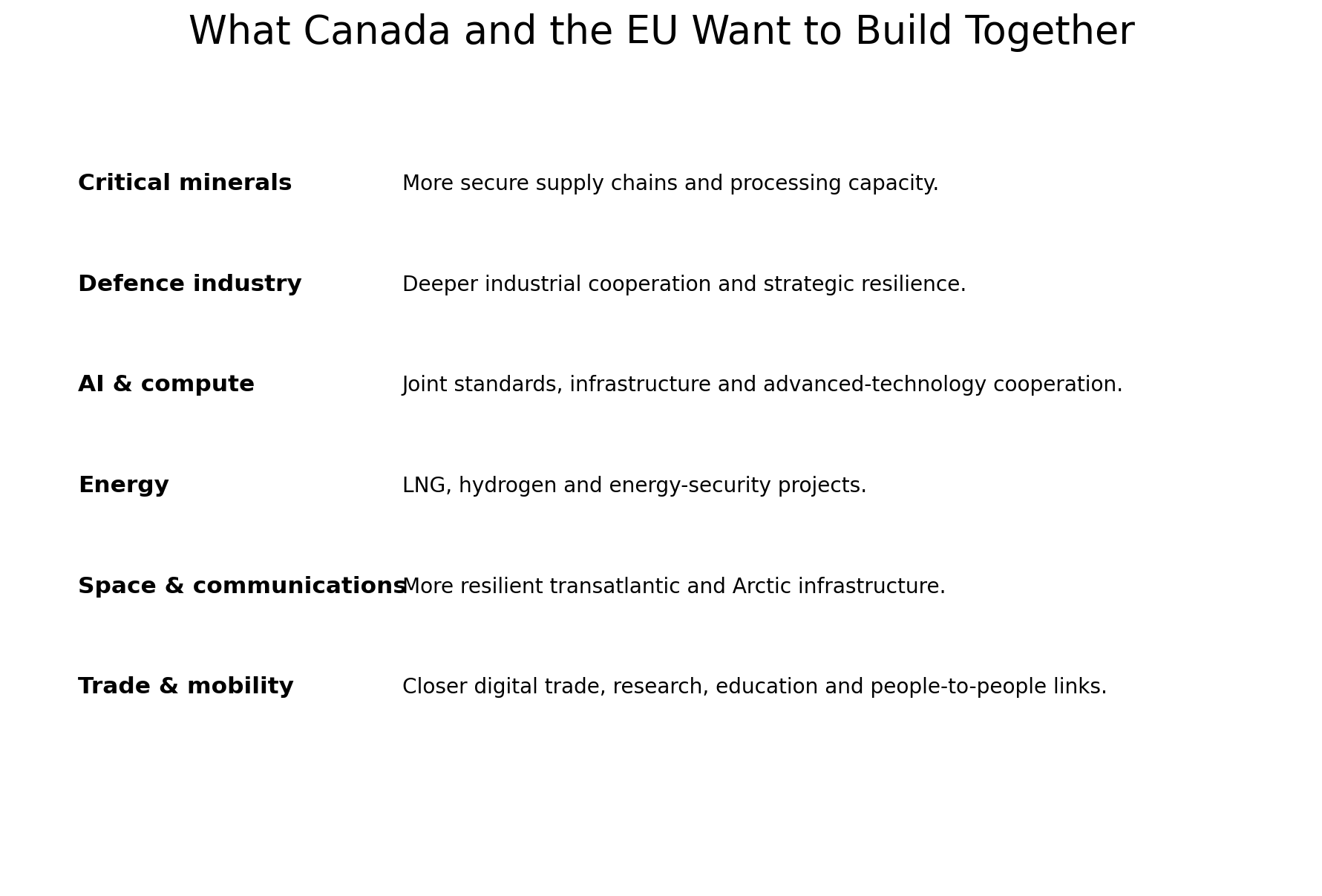
Canada and the EU are exploring deeper cooperation in several strategic industries.
Those include critical minerals, defence manufacturing, artificial intelligence, computing capacity, energy security, space systems and financial infrastructure.
Carney also discussed closer digital trade, research cooperation and expanded opportunities for students and workers.
The two sides already have a substantial foundation.
Their Comprehensive Economic and Trade Agreement, known as CETA, has governed much of the commercial relationship for years, and Canada has also become the first non-European participant in the EU’s SAFE defence procurement instrument.
Why the Proposal Is So Politically Sensitive
The issue is not simply that Canada wants more trade with Europe.
The proposed relationship comes at a time when economic dependence itself has become a geopolitical issue.
Governments are increasingly treating supply chains, energy, semiconductors, critical minerals and data infrastructure as questions of national security.
Carney has argued that democracies need enough economic resilience that no single outside power can dictate their choices.
Trump’s reaction shows why that language is sensitive in Washington.
A deeper Canada–EU partnership could reduce some of Canada’s dependence on the United States, even if the relationship is not formally designed as anti-American.
Europe Pushed Back on the Idea That Washington Has a Veto
European officials rejected the suggestion that the United States should determine whether the EU deepens ties with Canada.
France’s Europe minister said Washington does not have the power to choose Europe’s political or geopolitical direction.
The European Commission also said the proposal was not hostile and repeated that the goal was to strengthen Canada and Europe together.
Carney delivered a similar message.
He said Canadians would not accept another country dictating their culture, language or international agreements.
The ‘Associate Member’ Idea Is Still Vague
Despite the strong rhetoric, the proposal remains undefined.
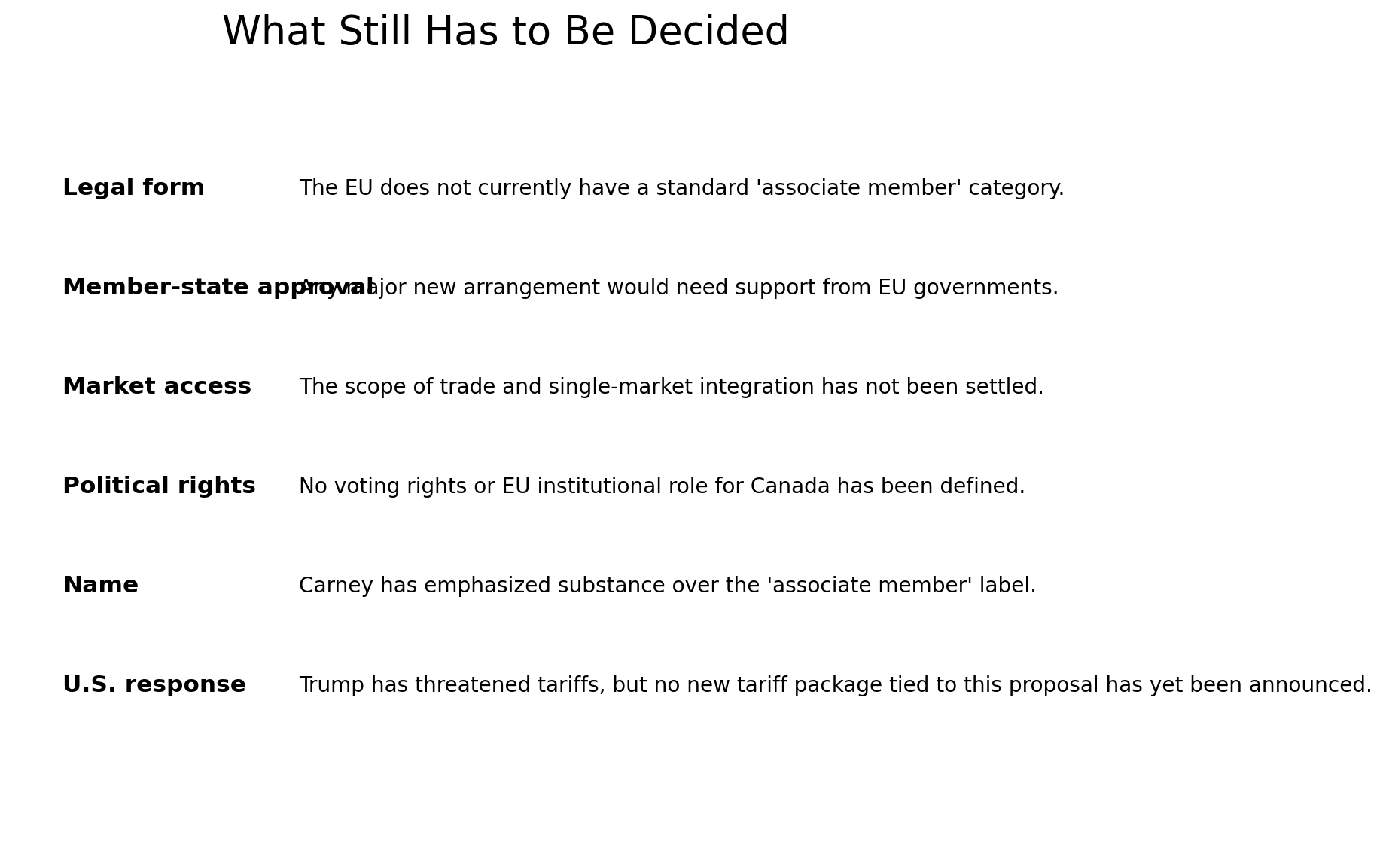
There is no ready-made EU legal category called associate membership that Canada can simply enter.
Any serious arrangement would have to be negotiated, and major elements would require support from EU member states.
Questions remain over market access, regulatory alignment, financial contributions, movement of people and whether Canada would gain access to additional EU programs.
No voting rights or institutional role comparable to full EU membership has been agreed.
Some Europeans Are Skeptical Too
Trump is not the only person questioning the proposal.
European diplomats have also expressed uncertainty about what associate membership would actually mean.
Some officials have warned that the idea was announced before member states had worked through the details.
That means the debate is not simply the United States against Canada and Europe.
The EU itself still has to determine whether there is enough political support to create a new model of partnership.
Canada’s Strategy Is About Diversification
Carney’s argument is that Canada does not need to become economically independent from the United States to reduce vulnerability.
Instead, it can add more options.
Deeper European ties could create alternative markets for Canadian energy and critical minerals, new investment channels and closer defence-industrial links.
For Europe, Canada offers resources, Arctic geography, technology capacity and a politically stable North American partner.
The relationship therefore has practical incentives on both sides even without a new membership label.
Trump’s Threat Has Not Yet Become a New Tariff Package
Another important distinction is the difference between a warning and an implemented policy.
Trump threatened serious tariffs or reduced trade if he decided the arrangement was hostile.
But the remarks did not themselves create a new tariff schedule.
No final Canada–EU associate-member agreement has been completed, and no new U.S. tariff package specifically triggered by that agreement has been announced.
The dispute is therefore still at the stage of political warning, negotiation and positioning.
Why the Viral Headline Overstates the Moment
The underlying event is significant.
A U.S. president publicly warned one of America’s largest trading partners that closer integration with Canada could trigger economic retaliation.
That is a real diplomatic and trade dispute.
But the social-media framing goes further than the verified facts.
The event was not minutes old. Trump’s threat was directed at Europe over the proposed relationship, not a simultaneous blanket threat against both Canada and the EU. And Canada has not suddenly joined the European Union.
What Happens Next
The next phase will depend on whether Canada and the EU can turn political ambition into a concrete agreement.
They still have to define the legal structure, the areas of integration and the obligations each side would accept.
EU governments would need to support any major new arrangement.
Washington will then have to decide whether Trump’s tariff warning remains rhetoric or becomes policy.
For now, the most accurate description is straightforward: Canada and Europe are trying to build a much deeper partnership, Trump has threatened trade retaliation if he sees that partnership as hostile, and the final shape of the relationship has not yet been decided.
Comments (0)
Loading comments...
May You Like

Shocking news from Ohio: an unexpected development ahead of Trump's rally

gfnhgmnghnmfgnbvvvvvvvvv













