
Trump Threatens Russia: Tell Putin to Stop Supporting Iran, or "There Will Be Consequences"
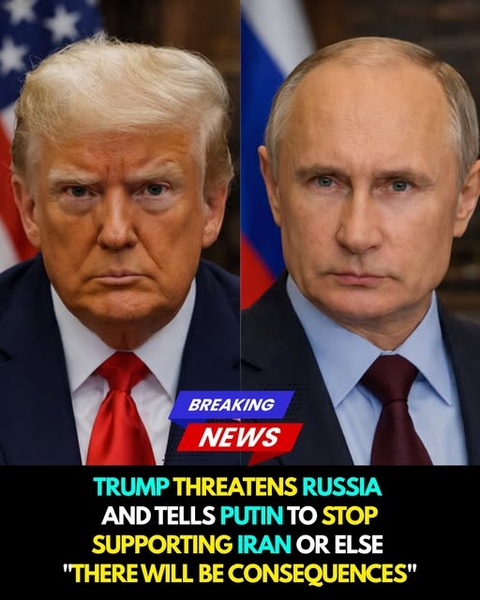
President Donald Trump has issued a stark warning to Russia, demanding that President Vladimir Putin cease all support for Iran amid the ongoing Middle East conflict. The threat, delivered through the Pentagon and echoed in a personal phone call between the two leaders, comes as the U.S. finds itself increasingly bogged down in a costly war of attrition against Iran, with its military stockpiles depleted and global standing shaken.
WASHINGTON – The viral image is direct and dramatic: "TRUMP THREATENS RUSSIA AND TELLS PUTIN TO STOP SUPPORTING IRAN OR ELSE 'THERE WILL BE CONSEQUENCES'." It captures a moment of high-stakes brinkmanship as the U.S. confronts not only Iran but also the complex geopolitical web that sustains it.
The quote is real. On March 10, 2026, Defense Secretary Pete Hegseth issued a public, explicit warning to Russia to stay out of the Iran conflict . This followed a private phone call between Trump and Putin just a day earlier, suggesting that direct diplomacy had already failed . While public reports have not captured the exact phrase "there will be consequences," the public warning and the strategic context leave little doubt that the U.S. was drawing a firm red line.
The Warning: 'Russia Must Stay Out'
The Pentagon's message was unambiguous. Hegseth stated that Russia must "stand aside" and not intervene in the conflict . This was a direct attempt to isolate Iran diplomatically and militarily, preventing Moscow from providing critical support that could tip the scales against U.S. and Israeli forces .
"We don't want the war to spread or become a global confrontation, but we want Russia out of Iran," a senior U.S. official was quoted as saying . The administration's approach was to cut off Russia's support while offering a potential off-ramp: a de-escalation of the Ukraine war in exchange for Moscow's cooperation in the Middle East .
Why the U.S. Is Pressuring Russia
The urgency behind the administration's threats to Russia stems from a series of escalating crises. The U.S.-led campaign against Iran, which began in late February 2026, has not gone to plan .
-
A Costly Stalemate: The conflict has devolved into a grinding war of attrition. Iran has employed a strategy of asymmetric warfare using drones, missiles, and proxy militias to tie down American forces, making a quick victory impossible .
Depleted Military Stockpiles: The U.S. has fired a staggering number of its most advanced and expensive missiles. By mid-2026, it had exhausted roughly half of its 'Patriot' interceptor inventory, two-thirds of its 'THAAD' interceptors, and around one-third of its 'Tomahawk' cruise missiles . These stockpiles could take years to replenish .
The Russian Factor: U.S. officials believe Russia has provided Iran with intelligence on American military positions, which has been instrumental in Tehran's ability to strike U.S. assets effectively .
Putin's 'Triple-A' Strategy
Trump's threats have proven largely ineffective against a Russian president who has few cards left to lose. Putin's response to the U.S. pressure has been described as a "triple-A" strategy: Apathy, Arrears, and Abscond .
Putin's "apathy" is born from a position of strength—Russia is already sanctioned to the hilt and has little left to fear from the U.S. . His "arrears" refer to his ability to continue bleeding U.S. resources in the Middle East while Russia profits from high oil prices . His "abscond" is a strategy of "limited involvement," appearing to cooperate publicly with the U.S. while simultaneously providing covert support to Iran to keep America entangled .
U.S. officials have painted a picture of Washington being "dragged into the Middle East" by Russia . The fear is not that Russia will directly intervene with troops but that it will continue to provide the intelligence and diplomatic cover needed to keep the conflict boiling . As one analysis concluded, Putin is using the conflict as a tool to run down American power on the cheap .
The Geopolitical Chessboard: What's at Stake
The confrontation over Iran is part of a larger, multi-layered crisis.
-
The Toll of War: The conflict has taken a massive economic and strategic toll on the U.S. Beyond the billions spent on munitions, it has diverted critical military resources from Europe and the Pacific, leaving NATO capabilities "critically short" and highlighting a potential vulnerability that Moscow is watching closely .
Strained Alliances: U.S. calls for a global naval coalition to secure the Strait of Hormuz have been met with tepid responses from European allies, exposing a rift in the Western alliance .
Negotiating from Weakness: The U.S. attempted to use the war as leverage to force a favorable peace deal in Ukraine, but these efforts have largely failed . This has left the Trump administration in a position where its threats are met with skepticism.
The Bottom Line
| What the graphic says | What actually happened |
|---|---|
| Trump threatened Russia to stop supporting Iran | Defense Secretary Hegseth issued a public warning to Russia on March 10, 2026, following a failed private call between Trump and Putin . |
| There would be "consequences" | This is the implied meaning of the warning. The threat was to end the war in Ukraine on less favorable terms for Russia and to break relations further . |
| Russia is helping Iran | U.S. intelligence assessed that Russia provided Iran with sensitive military intelligence . |
| Putin is taking the threats seriously | Putin's response has been to call Trump's bluff, offering minimal cooperation while using the war to weaken the U.S. . |
The viral image accurately captures the tone and intent of the Trump administration's warnings to Russia. However, the full story reveals a much more complex reality, with the U.S. facing a weakened military position, an intransigent Iran, and a Russian leader who seems to have the upper hand in the global chess match.
Comments (0)
Loading comments...
May You Like

OBAMA STUNS ON INSTAGRAM: MESSAGE MARKING 34-YEAR MILESTONE SPARKS A BUZZ

South Korea–Ukraine Rift Deepens Over North Korean POW Transfer as PURL Draws New Scrutiny

gfnhgmnghnmfgnbvvvvvvvvv












