
Trump Unleashes 1,323-Word Truth Social Attack on Bill Maher as Obama Intensifies Midterm Criticism
WASHINGTON — October 27, 2026 | U.S. Politics & Media
President Donald Trump has launched an extraordinary, approximately 1,323-word attack on television host Bill Maher, turning a recent White House dinner and a critical episode of HBO's Real Time into a public confrontation just days before the November 3 midterm elections.
The lengthy Truth Social post, published on Sunday evening, October 25, began with Trump describing Maher as a “COMPLETE AND TOTAL LOSER.” It continued with accusations about the comedian's television ratings, political commentary, personal conduct and the private conversations the two men had shared during their meetings at the White House.
CNN reported that the message was Trump's longest Truth Social post to date, according to its analysis and an independent tracking service. The post was nearly twice the length of his previous longest message.
The confrontation coincided with another high-profile political dispute: former President Barack Obama had returned to the campaign trail in Ohio and Michigan, delivering pointed criticism of Trump's administration and urging voters to examine the consequences of Republican control of Congress.
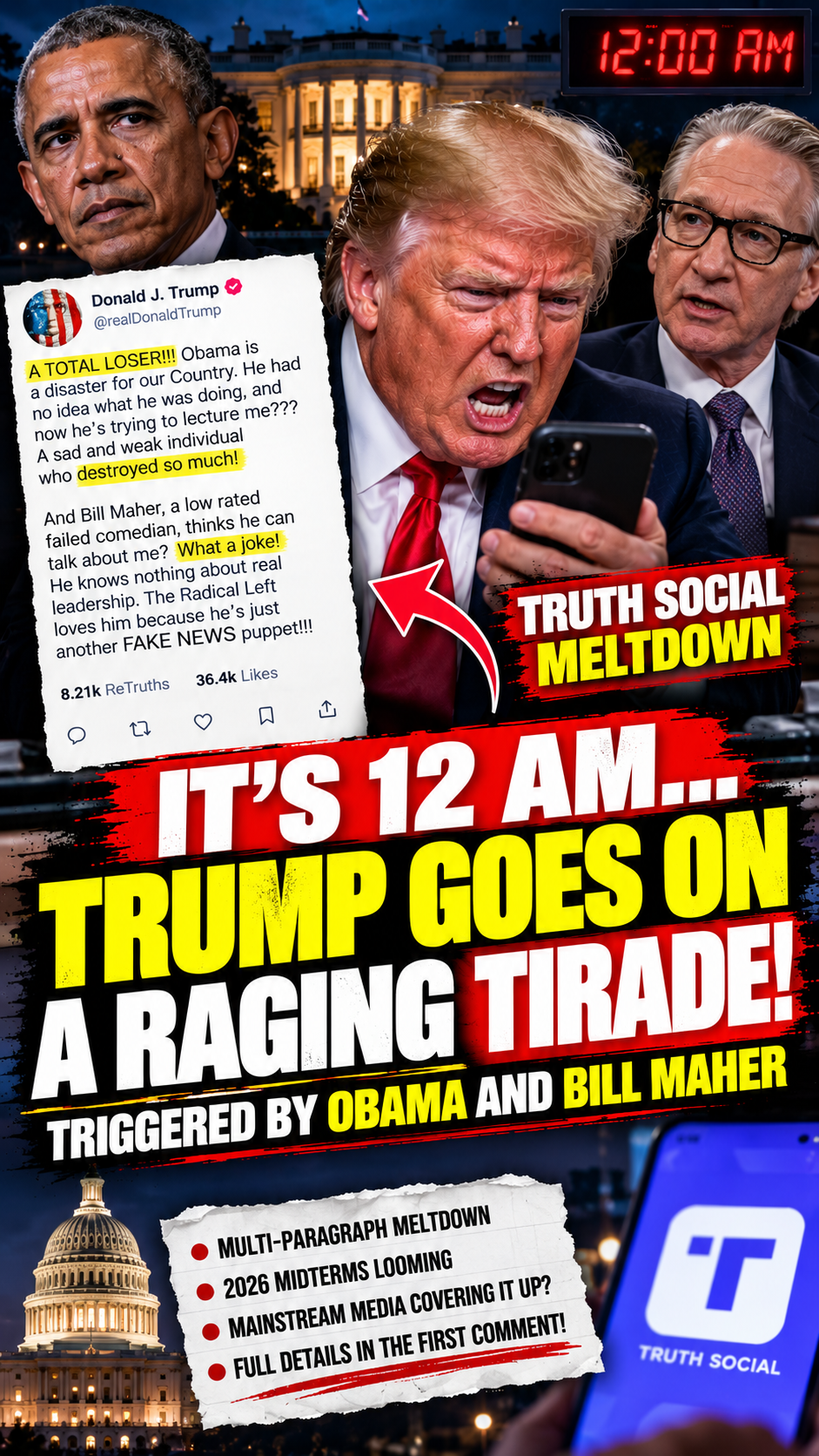
The two developments generated intense coverage as the midterms approached, but an important distinction is necessary. Trump's lengthy social-media attack was directed primarily at Maher, not Obama, and the verified post does not match the text displayed in the accompanying viral graphic.
Obama's criticism formed part of the same weekend's political news, but available reporting does not establish that the former president's remarks triggered Trump's 1,323-word message.
The real sequence of events is sufficiently revealing without combining separate confrontations into a single supposed midnight outburst.

The dispute between Trump and Maher is particularly notable because the two men had recently attempted to maintain a cordial relationship despite years of public disagreements.
On October 15, Maher attended a White House dinner with the president. Also present were musician Kid Rock and ESPN commentator Stephen A. Smith.
It was not their first meeting. Maher had previously visited Trump at the White House in March 2025, an encounter that drew attention because the comedian had frequently criticized the president on television.
Following the October dinner, Trump initially sounded pleased with the meeting, suggesting that Maher liked him more than many people realized and indicating that he, too, had a favorable impression of the comedian.
Maher also defended the decision to attend.
On the October 23 episode of Real Time, he argued that speaking directly with a president he disagreed with was preferable to criticizing him exclusively from a distance.
Maher said the participants had discussed several contentious issues, including immigration enforcement, Supreme Court decisions and American foreign policy.
He described the dinner as lasting approximately four hours and said Trump had allowed him to raise difficult questions without interrupting or losing his temper.
Stephen A. Smith separately characterized the evening as substantive, saying the president had responded to criticism and addressed questions throughout the discussion.
That account contrasted sharply with Trump's subsequent portrayal of the dinner.
In his Sunday post, the president disputed Maher's description of the meeting, saying it had lasted considerably less than four hours.
He accused Maher of misrepresenting their interactions and suggested that the comedian behaved differently in private than he did before television audiences.
Trump also alleged that Maher had been drinking during the visit and criticized his appearance. Those personal accusations were Trump's claims, not independently established facts.
The president's central complaint appeared to be that Maher had returned to criticizing him publicly after what Trump regarded as a friendly private encounter.

The October 23 television broadcast provided the immediate context for the dispute.
During the program, Maher interviewed former White House press secretary Karoline Leavitt and questioned the administration's political standing as the midterms approached.
He raised the possibility that Trump could face reduced political influence if Republicans lost control of either chamber of Congress.
Maher also discussed Trump's relationship with critics and questioned how the president might respond to a political setback.
Those exchanges were part of a broader program that included commentary on the administration, the economy and Trump's conduct.
The comedian's remarks did not amount to a verified prediction of the election outcome. They were political commentary about possible consequences of a change in congressional control.
Trump nevertheless responded at extraordinary length.
According to CNN's analysis, the post contained 1,323 words. Forbes counted approximately 1,321, a small discrepancy that likely reflects different word-counting conventions.
Both organizations agreed that the message was unusually long by Trump's own social-media standards.
The post criticized Maher's television program, challenged his account of the dinner and questioned his motives for maintaining contact with the White House.
Trump also suggested that Republican politicians should stop appearing on or otherwise supporting Maher's show.
Near the conclusion, he addressed the comedian directly with a short message: “Bill: Don't call anymore.”
The remark appeared to mark a public breakdown in the personal relationship the two men had attempted to establish.

The lengthy message also contained policy-related statements that were largely separate from the president's personal criticism of Maher.
Trump disputed the comedian's discussion of election administration in California, defended his political endorsements and rejected speculation about changes to the White House press briefing room.
On that last subject, the president acknowledged that he was considering moving journalists who cover his administration to another location.
He denied intending to restore the historic swimming pool beneath the James S. Brady Press Briefing Room, while saying the current space could be used for other White House needs.
That statement was significant because it confirmed that a possible relocation of the press corps remained under consideration, although no completed move or detailed construction proposal had been announced.
The subject illustrates how the president's social-media message moved between personal grievances, television criticism and questions involving the operation of the White House.
It also helps explain why the post attracted coverage beyond entertainment media.
The message came from the sitting president and included statements about potential government decisions, not merely an exchange between two public personalities.
At the same time, a separate confrontation involving Obama was unfolding.

On October 24, Obama appeared at Democratic campaign events in Cleveland and Detroit.
The former president used the rallies to criticize Trump's policies and argue that voters should use the midterms to hold the administration accountable.
In Ohio, Obama supported Democratic Senate candidate Sherrod Brown and gubernatorial candidate Amy Acton.
In Michigan, he campaigned for Senate candidate Abdul El-Sayed and gubernatorial candidate Jocelyn Benson.
His speeches addressed economic pressures, the administration's Iran policy, questions about government ethics and the president's attention to White House renovations.
Obama also criticized the administration's approach to the Strait of Hormuz, arguing that the conflict with Iran had contributed to higher energy costs and greater uncertainty for international shipping.
Those were Obama's political arguments, and the administration has presented its own rationale for its foreign-policy decisions.
One of Obama's most widely discussed remarks concerned the appearance of the White House.
He joked that Trump appeared unusually focused on renovation projects and suggested he should be hosting a home-improvement television program.
The former president also mocked the extensive use of gold-colored decorations and other changes to the presidential residence.
The comments were part of a broader criticism of the administration's priorities.
Obama argued that the government should devote greater attention to household expenses and public accountability rather than presidential image-making.

Trump responded separately to Obama in a Truth Social message early on October 25.
According to Reuters, he criticized Obama's record as president and made serious allegations against Michigan Democratic Senate candidate Abdul El-Sayed.
Trump characterized El-Sayed using language linking him to Islamist extremism, but the accusations were not substantiated in the report.
The remarks drew attention because El-Sayed, a physician and former Detroit health official, is a Muslim American candidate competing against Republican Mike Rogers.
Trump also criticized the Obama administration's 2015 nuclear agreement with Iran, arguing that it had benefited Tehran.
Supporters of that agreement have maintained that it imposed restrictions and international monitoring on Iran's nuclear activities, while critics have argued that its provisions were insufficient and did not address other Iranian activities.
The United States withdrew from the agreement during Trump's first administration.
These exchanges illustrate the differences between the two former and current presidents over foreign policy and government accountability.
They also establish that Trump did respond to Obama publicly—but through a separate message from his much longer attack on Maher.
The distinction matters when evaluating the viral image accompanying this story.
The graphic shows a supposed Trump post attacking both Obama and Maher in the same message. Its wording does not match the authenticated reporting of the president's October 25 posts.
The displayed social-media text therefore should not be presented as a genuine screenshot without independent authentication.
The confirmed record involves two related but distinct political confrontations: Trump's response to Obama's campaign speeches and his much longer personal attack on Maher.

Both disputes occurred during the closing phase of the 2026 midterm campaign.
The November 3 elections will determine all 435 seats in the U.S. House of Representatives and the Senate seats scheduled for election this cycle.
The results will shape Congress's ability to advance legislation, conduct oversight, approve nominations and negotiate with the White House.
For Republicans, the election provides an opportunity to defend the administration's record and maintain congressional support for its policies.
For Democrats, it provides an opportunity to challenge the administration's priorities and seek greater influence over federal legislation and oversight.
The parties are presenting different arguments about the economy, immigration, healthcare, foreign policy and the exercise of presidential authority.
Obama's return to the campaign trail is part of the Democratic Party's effort to communicate those arguments through a former president who remains influential among many party supporters.
Trump's campaign appearances and social-media statements are part of the Republican Party's effort to defend its governing record and mobilize its own supporters.
But the existence of a lengthy or confrontational post does not establish that the president is privately panicking about the election.
There is no verified evidence in the material reviewed that demonstrates his private emotional state, and the viral caption's suggestion of a media cover-up is unsupported.
In fact, the Truth Social message has been covered by CNN, Forbes, The Guardian, Fox News, Variety and several other major news organizations.

Maher's subsequent public comments added another layer to the controversy.
In a Club Random podcast episode released on October 26, Maher described Trump as a president whose political position had changed because he was serving his second term.
Maher used the term “lame duck” and argued that Trump's political influence should be assessed differently from the period before his first election.
The episode, however, had been recorded before Trump's lengthy Truth Social attack.
That timing is important: the podcast remarks cannot accurately be described as a direct response to the October 25 post.
As of reporting published October 27, Maher had not issued a confirmed direct response to the entire message.
The dispute therefore remains a public exchange in which Trump's position is extensively documented, while Maher's subsequent reaction to the post itself is less clear.
It also raises questions about the relationship between political leaders and entertainers who criticize them.
Maher has defended his willingness to speak directly with Trump despite their disagreements.
Trump, meanwhile, has suggested that Maher's private conduct was inconsistent with his public criticism.
Those are competing interpretations of their interactions.
The available accounts confirm that the meetings occurred, that the participants discussed political issues and that the relationship deteriorated publicly after Maher's October 23 television broadcast.
They do not independently establish the accuracy of every allegation made by either participant about what happened behind closed doors.

The broader political significance of the episode lies in the contrast between the president's public communications and the substantive questions facing voters.
The administration is defending its policies during a consequential election period.
Obama and other Democratic figures are criticizing those policies and arguing for changes in congressional representation.
Maher is using his television platform to question the president and his advisers while maintaining that private conversations across political divisions can still be worthwhile.
Trump's lengthy post has become part of that wider debate because it reveals the subjects he chose to address publicly: personal loyalty, criticism from entertainers, election commentary, media coverage and the operation of the White House.
The message also demonstrates how quickly a private dinner can become a national political controversy when its participants offer conflicting public accounts.
But the verified facts do not support every element of the viral narrative.
There was a lengthy Truth Social attack on Bill Maher. There were separate criticisms exchanged between Trump and Obama. Both took place as the midterm campaign entered its final days.
What has not been established is that Obama and Maher jointly triggered a single midnight message, that the purported screenshot reproduces Trump's actual words, or that the president's public statements prove private panic.
As November 3 approaches, the political consequences of these exchanges remain uncertain.
The more durable questions concern the administration's policy record, the arguments being presented by congressional candidates and the decisions voters will make at the ballot box.
The social-media confrontation is real. Its most dramatic viral interpretation requires considerably more caution.
Comments (0)
Loading comments...
May You Like

EAST COAST MEGASTORM—2 MILLION HOUSES DAMAGED, 5 MILLION AT RISK OF BLACKOUTS, WATER FAILURES!

1,000+ MILITARY FAMILY RECORDS BREACHED, 200+ MILITARY SITES AT RISK!

WWE BRONSON REED—STAR COLLAPSES AT COMPANY EVENT, FATAL DRUG REACTION SUSPECTED!









Popular Posts



