
Trump Vows to Block “Every Communist Bill” if Democrats Win Congress
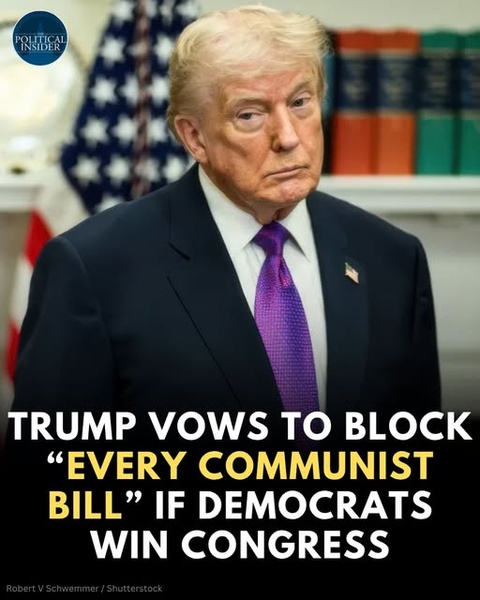
DALLAS — President Donald Trump is warning voters that a Democratic takeover of Congress in the 2026 midterm elections would trigger a fierce confrontation with his administration, saying he would use his presidential powers to stop legislation he describes as “communist.”
The warning is part of an increasingly aggressive Republican campaign message ahead of the Nov. 3 elections. Trump and senior Republicans have repeatedly portrayed progressive Democrats and the broader Democratic Party as embracing socialism or communism, making the ideological label a central theme of the GOP's midterm strategy.
The viral graphic circulating online summarizes Trump's position as a vow to block “every communist bill” if Democrats win control of Congress.
The underlying political message is real, but the headline requires an important legal qualification: Trump could veto legislation he opposes, but he could not automatically stop every Democratic bill from becoming law. Congress can override a presidential veto with a two-thirds vote in both the House and Senate.
Trump Turns the Midterms Into a Battle Over “Communism”
Trump's comments come as Republicans use the first-ever GOP midterm convention in Dallas to mobilize voters around a stark choice between his administration and what he portrays as an increasingly radical Democratic Party.
At the convention, Trump repeatedly warned that Democrats could take control of Congress and push the country sharply to the left.
Other Republican speakers adopted similar language.
House Speaker Mike Johnson warned that Democrats were becoming aligned with socialists and said the party could bring “communists” into Congress. Sen. Ted Cruz described what he called a “red-green alliance” involving communists and Islamists. Trump Jr. also attacked Democratic candidates who openly identify with democratic socialism.
The rhetoric reflects a strategy that Trump and his political allies have been developing for months.
A Reuters analysis in July found that Trump's use of the word “communism” had sharply increased after progressive candidates scored victories in Democratic primaries in New York. The escalation came as Trump's political team tested whether anti-communist messaging could motivate voters beyond his core supporters.
What Trump Could Actually Do With a Democratic Congress
If Democrats win both chambers of Congress in November, Trump would still remain president until January 2029.
That means a Democratic House and Senate could pass legislation that Trump strongly opposes, but the president would retain his constitutional veto power.
A presidential veto, however, is not absolute.
Under the Constitution, Congress can override a veto if two-thirds of both the House and Senate vote to do so. In a closely divided Congress, reaching that threshold would generally be difficult.
Trump could therefore make it substantially harder for a Democratic Congress to enact legislation without his approval.
But saying he could simply “block every bill” would overstate the president's power.
Some legislation can also become law without a conventional presidential signature under certain circumstances, and Congress controls appropriations and other legislative powers that can constrain the executive branch.
The practical result would likely be legislative gridlock, rather than an automatic presidential blockade of everything Democrats propose.
Why the Threat Matters for 2026
The warning is especially significant because Republicans currently control both chambers of Congress.
The 2026 elections will determine whether that arrangement survives into the final two years of Trump's presidency. Republicans therefore have a strong incentive to portray a Democratic victory not simply as a change in congressional leadership, but as a direct threat to Trump's agenda.
Trump himself has urged Republican voters to behave as though he is personally on the ballot.
At the Dallas convention, he asked supporters to “pretend” that he was running in the election and warned that a Republican defeat could leave him effectively a lame-duck president.
That framing turns the midterms into a referendum on Trump's presidency.
Republicans Are Broadening the Definition of “Communist”
One of the biggest features of the campaign rhetoric is the expanding use of the word “communist.”
Trump and Republican allies have used the label against progressive politicians who advocate policies such as expanded government programs, stronger labor protections, universal or publicly supported health care, higher taxes on wealthy Americans and greater government involvement in the economy.
The term has also been used against prominent Democratic figures associated with democratic socialism.
But democratic socialism and communism are not interchangeable political systems.
Democratic-socialist politicians in the United States generally operate within a constitutional democratic system based on private property, elections and a market economy. Communist governments historically have involved very different political and economic structures.
That distinction has not stopped “communist” from becoming a powerful political attack line.
A recent analysis from the Peterson Institute for International Economics likewise noted that increased government ownership or intervention in the U.S. economy does not automatically constitute a transition to communism.
Democrats Reject the Characterization
Democrats have pushed back against the Republican rhetoric, arguing that the GOP is using extreme labels to portray mainstream Democratic economic and social policies as existential threats.
The Democratic Party contains a wide ideological spectrum, from moderates to progressive lawmakers who openly identify with democratic socialism.
Republicans, however, increasingly argue that the distinction is irrelevant when it comes to the direction of the party.
That disagreement is likely to become even more intense as the election approaches.
A Veto Showdown Could Define the Final Years of Trump's Presidency
If Democrats win control of Congress while Trump remains in the White House, the country could enter one of the most confrontational periods of his presidency.
Democrats would control the congressional agenda, committees and legislative priorities.
Trump would retain the veto.
The result could be a cycle in which Democrats pass legislation knowing Trump is likely to reject it, while Republicans attempt to prevent Democrats from reaching the two-thirds majorities needed to override his vetoes.
The White House could also rely on executive authority to pursue policies independently of Congress, while Democrats could use congressional oversight and control of funding legislation to challenge the administration.
In other words, a Democratic victory would not necessarily allow Democrats to implement their entire agenda — nor would it give Trump unlimited power to stop them.
The Bigger Battle Is Already Underway
Trump's “communist” rhetoric is therefore about more than individual pieces of legislation.
It is becoming a central organizing theme of the 2026 Republican campaign.
Republicans are telling voters that Democratic control of Congress would unleash an ideological transformation of the United States. Democrats are likely to argue that Republicans are using exaggerated language to distract voters from inflation, the Iran conflict, health care and other issues affecting everyday life.
At the GOP convention, Trump and his allies made their preferred choice explicit: keep Congress Republican or risk a direct clash between a Democratic legislature and a Republican president.
For Trump, the message is blunt.
If Democrats take Congress, he says he will stand in their way.
But whether that produces a powerful presidential veto shield or years of Washington gridlock will ultimately depend on the size of the Democratic majorities — and whether either party can attract enough lawmakers from the other side to overcome the constitutional barriers built into the legislative process.
Comments (0)
Loading comments...
May You Like

TRUMP’S OHIO WARNING UNDER THE SPOTLIGHT
OBAMA STEPS BACK INTO THE POLITICAL SPOTLIGHT

Shocking news from Ohio: an unexpected development ahead of Trump's rally













