
Trump vs. Sanders: Two Very Different Grades for America as Economic Frustration Deepens
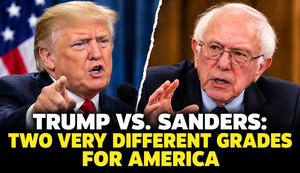
WASHINGTON — President Donald Trump and Sen. Bernie Sanders have offered sharply different assessments of the American economy, reflecting a broader political divide over whether the country is experiencing economic progress or whether high prices and financial pressures are overwhelming the gains.
The contrast has become especially striking as Americans head toward the 2026 midterm elections. Trump continues to defend his economic record, while Sanders has focused heavily on affordability, inequality and the financial pressures facing working-class households.
Trump Gave His Economy a Near-Perfect Grade
The image circulating online refers to a December 2025 exchange in which Trump was asked what grade he would give his own economy.
Trump initially answered “A-plus” and then expanded that assessment to “A-plus-plus-plus-plus-plus.” Sanders responded by questioning that assessment, arguing that Americans were still struggling with high prices for housing, food and health insurance.
Trump's argument has centered on the idea that his administration inherited an economy with high prices and that conditions have improved under his policies. His administration has continued to emphasize manufacturing investment, energy policy, trade measures and other economic initiatives.
But the public's assessment has been considerably more mixed.
Americans Are Giving a Different Assessment
A new AP-NORC poll conducted Sept. 24-28 found that only 26% of U.S. adults approve of Trump's handling of the economy, while just 17% approve of his handling of the cost of living. About 65% said Trump's policies were more responsible for persistently high prices than factors outside his control.
The poll also found that about six in 10 Americans believe the country is worse off than when Trump began his second term.
At the same time, the economic picture is not uniformly negative.
September payrolls increased by 29,000, below economists' expectations, while the unemployment rate rose slightly to 4.2%. Wage growth slowed to 3% annually. Reuters described the labor market as relatively stable but operating in a low-hiring environment.
That creates an important distinction between economic indicators and how Americans experience the economy.
Sanders Has Focused on the Cost of Living
Sanders has consistently argued that headline economic statistics do not adequately describe the financial reality facing many working Americans.
In recent months, he has continued to focus on health care costs, housing, wages, wealth inequality and energy prices.
On Oct. 1, Sanders and 19 Democratic senators called for emergency home-heating assistance to be increased to $7 billion, arguing that higher energy costs connected to the Iran war were putting additional pressure on households.
Sanders has also continued pushing policies aimed at increasing government intervention in areas ranging from health care and energy to artificial intelligence and taxation.
On Sept. 23, he and Rep. Greg Casar introduced legislation seeking to create a federal agency focused on regulating advanced artificial intelligence and temporarily pausing certain forms of AI development until stronger safeguards are established.
The Two Men Describe the Problem Differently
Trump's economic message emphasizes growth, production, investment, energy and trade.
Sanders' message places greater emphasis on purchasing power, inequality, health-care affordability and the distribution of wealth.
That difference extends beyond economic statistics.
Sanders has argued that the Democratic Party needs to reconnect with working-class Americans and address the economic frustrations that helped reshape American politics. In interviews this year, he has repeatedly argued that people are angry about the cost of living and that the political system has not adequately addressed those concerns.
Trump, meanwhile, has continued to campaign on his economic record while confronting growing public concern over prices.
The Numbers Tell More Than One Story
There are competing economic indicators worth considering.
The U.S. unemployment rate remains relatively low, and stock markets have continued to trade near record levels. On Oct. 2, the S&P 500 closed at 7,722.72, less than 1% below its record high.
But households face a different set of pressures.
Energy prices have risen sharply amid the war involving Iran, while food, transportation and other household expenses remain important concerns for voters. The AP-NORC survey found that about half of Americans are now extremely or very concerned about being able to afford gasoline and food.
The result is a political argument over which measurements should define the state of the country.
Sanders Is Not Offering the Same Economic Model
Sanders' approach would involve significantly greater federal intervention in the economy than Trump's.
His recent proposals include expanded assistance for low-income households, stronger regulation of large technology companies, greater taxation of wealthy Americans and expanded public investment.
Sanders has also argued that the concentration of wealth among billionaires gives wealthy individuals excessive influence over American politics and the economy. In a recent policy argument, he called for wealthy Americans to pay a larger share of taxes.
Trump's administration has pursued a substantially different approach, emphasizing deregulation, tariffs, domestic production and private-sector investment.
These differences are not simply disagreements over individual policies. They reflect competing views about the government's role in shaping the economy.
The Midterms Put the Debate Under a Spotlight
The disagreement is unfolding as both parties prepare for the November 2026 midterm elections.
Trump has begun an intensive campaign schedule, holding rallies and promoting Republican candidates across the country. His economic record is expected to remain a central part of the Republican message.
Democrats, meanwhile, are attempting to turn dissatisfaction over prices and affordability into a broader argument about Trump's economic policies.
Sanders is playing a visible role in that debate, although he is not speaking for the entire Democratic Party. Recent reporting has also highlighted disagreements within the party over how prominently Sanders and progressive economic ideas should feature in competitive races.
What Happens Next?
The contrasting grades offered by Trump and Sanders are ultimately less about a single economic statistic than about which economic reality Americans experience in their daily lives.
Trump points to economic activity, investment, production and other indicators as evidence of progress. Sanders emphasizes the cost of living, inequality and household financial pressure.
Current data show elements of both pictures: the labor market remains relatively stable and financial markets are strong, while public concern about prices and affordability remains unusually high.
As the midterm campaign intensifies, that gap between economic performance on paper and economic experience at the household level is likely to remain one of the central issues in the political debate.
The question facing voters is therefore not simply whether America deserves an “A” or an “F,” but which measures of economic well-being should matter most — and whether current policies are improving those measures over time.
Comments (0)
Loading comments...
May You Like

Obama Steps Back Into the Political Spotlight as Democrats Target Trump’s

South Korea–Ukraine Rift Deepens Over North Korean POW Transfer as PURL Draws New Scrutiny

gfnhgmnghnmfgnbvvvvvvvvv












