Trump Warns EU Over Canada’s Proposed “Associate Member” Status as Ottawa and Brussels Move Closer
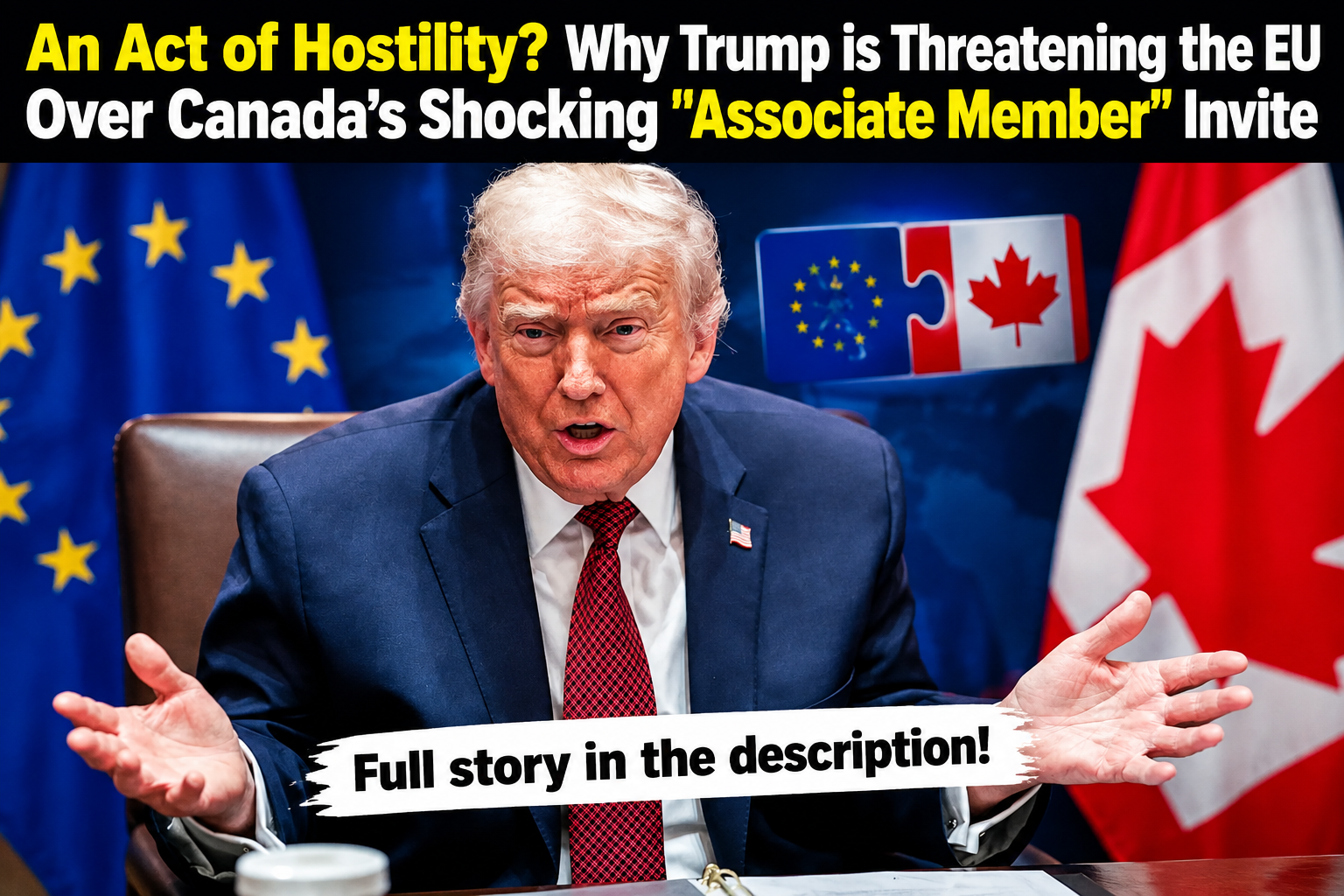
WASHINGTON/BRUSSELS — September 17, 2026 — President Donald Trump has warned the European Union that it could face heavy tariffs or restrictions on trade with the United States if the bloc moves ahead with a proposal to make Canada its first “associate member,” escalating an already tense economic relationship involving Washington, Ottawa and Brussels. memcite
The warning came after European Commission President Ursula von der Leyen announced on September 16 that she wanted to “open the door” for Canada to become the EU’s first associate member during her annual State of the Union address in Strasbourg.
The proposal would not make Canada a full EU member. Instead, it would create a new form of partnership whose legal structure, rights and obligations have yet to be negotiated.
Trump, however, said the proposal could constitute a “hostile act” depending on the intentions behind it.
“If it’s a good intention, that’s fine. If it’s a bad intention, we’ll put very heavy tariffs on Europe,” Trump said, according to The Associated Press. He also raised the possibility of cutting off trade with Europe in certain areas.


President Donald Trump’s warning adds another layer to the existing trade tensions between Washington, Ottawa and Brussels.
What Did the EU Actually Offer Canada?
The controversy began with von der Leyen's September 16 address to the European Parliament.
With Canadian Prime Minister Mark Carney in attendance, the European Commission president proposed working toward Canada becoming the EU's first “associate member.”
Von der Leyen framed the proposal as part of a broader effort to build stronger partnerships in an increasingly uncertain international environment.
She outlined cooperation in areas including:
- advanced manufacturing
- artificial intelligence and technology
- defense industries
- Arctic cooperation
- energy
- critical minerals
- batteries
- cybersecurity
- economic security
The European Commission's official summary lists the Canadian proposal among its major 2026 initiatives and describes the planned relationship as an “Alliance for the Future.”
Importantly, von der Leyen explicitly said the partnership was not directed against another country.
That point matters because Trump's response interpreted the development through the increasingly contentious economic relationship between the United States and both Canada and the EU.
Trump’s “Hostile Act” Warning
Trump's response was conditional rather than an announcement of immediate new tariffs.
Speaking in Charlotte, North Carolina, on September 16, Trump said the EU's intentions would determine how Washington responds.
He described the possibility of Canada becoming associated with the EU as “laughable” and criticized Canada as a “terrible trade partner,” according to AP. He said the United States could impose substantial tariffs on European goods if he considered the move hostile.
Reuters likewise reported that Trump threatened tariffs or potentially restrictions on trade with Europe if the EU's move were deemed hostile.
This means the headline's phrase “threatening the EU” is broadly grounded in Trump's reported remarks, but the situation is more conditional than the graphic suggests: the proposed Canadian status has not yet been approved, and Trump did not announce a specific new tariff package against Europe on September 16.
Canada Is Not Joining the EU
One of the biggest potential misunderstandings surrounding the story is the meaning of “associate member.”
Canada is not applying to become a conventional EU member, and the proposal does not currently give Canada automatic access to EU institutions or voting rights.
There is also no existing EU treaty category formally called “associate member.”
Reuters reported that creating such a status would require substantial negotiations and agreement among the EU's 27 member states.
Full EU membership is also legally different. EU membership provides participation in the bloc's political institutions and access to the Single Market under the applicable EU framework.
By contrast, an associate arrangement would have to define precisely:
- which parts of the Single Market Canada could access;
- which EU regulations Canada would follow;
- whether Canadian companies would receive preferential treatment;
- how much influence Ottawa would have over EU rules;
- how disputes would be resolved;
- and which sectors would actually be covered.
Those questions remain unresolved.


Canadian Prime Minister Mark Carney and European Commission President Ursula von der Leyen met in Strasbourg on September 16, 2026, as the new proposal was unveiled.
Carney Welcomes Deeper Ties — But Stops Short of Endorsing “Associate Membership”
Carney welcomed von der Leyen's broader proposal for a stronger Canada-Europe relationship.
His office said Canada and Europe should pursue a “far stronger, more ambitious alliance” and strengthen strategic cooperation.
But there is an important distinction: Carney did not explicitly endorse or announce Canada's acceptance of associate membership. Reuters reported that his response focused on deeper strategic cooperation rather than directly embracing the new status.
That distinction is significant because the exact structure of the proposed relationship has not yet been determined.
Canada's government has, however, already been moving toward closer European cooperation.
Canada and the EU Were Already Deepening Their Relationship
The September announcement did not emerge from nowhere.
Canada and the EU have spent the past year expanding cooperation in trade, defense, technology and critical minerals.
At their June 2025 summit, Canada and the EU launched a new strategic partnership and signed a Security and Defence Partnership. Canada subsequently became the first non-European country to participate in the EU's Security Action for Europe, or SAFE, a defense-industrial initiative.
Canada's Foreign Affairs Department said earlier this month that Ottawa and Brussels were also advancing cooperation on:
- defense industries;
- critical minerals;
- economic security;
- digital trade;
- Ukraine;
- and supply-chain resilience.
The two sides are also preparing for a Canada-EU summit scheduled for October 29–30, 2026, in Canada.


Canada and the EU have already expanded cooperation in defense, trade, technology and economic security.
CETA Already Connects Canada and Europe Economically
Canada also has an established trade framework with the EU: the Comprehensive Economic and Trade Agreement (CETA).
CETA has been provisionally applied since September 21, 2017.
According to the Canadian government, Canada-EU merchandise trade reached approximately C$134 billion in 2025, more than 77% above the 2016 level before provisional implementation.
The two sides are also negotiating a digital trade agreement.
So the proposed “associate membership” would build on an already extensive relationship rather than create one from scratch.
The unresolved issue is how far that relationship should go.
Why Washington Is Watching the Move Closely
The proposal comes at a particularly sensitive moment in North American trade.
Canada has been seeking to diversify its international trade relationships while its economic relationship with the United States has become more contentious.
Carney's government has publicly described European countries as natural partners for Canada's efforts to diversify trade, investment and security relationships.
At the same time, the EU is attempting to strengthen its own economic and strategic autonomy.
That creates an obvious intersection of interests between Ottawa and Brussels — but it also creates potential friction with Washington.
Reuters reported that Carney has pledged to double Canada's non-U.S. trade over the next decade, while the United States remains Canada's dominant economic partner.
The proposed EU relationship therefore has two dimensions: it is both an opportunity for Canada to expand its international partnerships and a potential source of additional tension with the Trump administration.
The Proposal Is Still Far From Becoming Reality
Despite the dramatic language surrounding the announcement, Canada is not suddenly becoming part of the EU.
Several steps would have to occur before an associate relationship could be implemented.
The likely process
1. EU member states must consider the proposal.
Von der Leyen's announcement does not by itself create a new EU membership category.
2. Canada and the EU would have to negotiate the substance.
The parties would need to determine exactly what “associate member” means.
3. Legal questions would have to be resolved.
The concept has no established legal precedent within the EU treaties.
4. The 27 EU governments would have to agree.
The precise approval mechanism would depend on the eventual legal structure.
5. Existing agreements would remain relevant.
CETA and other Canada-EU arrangements would continue to form the foundation of economic relations unless replaced or supplemented.
This makes the current story more accurately a major diplomatic proposal and political warning than a completed realignment.
What the Viral Image Gets Right — and What It Leaves Out
The image accompanying the story captures the central political development, but its framing simplifies several important details.
| Claim in the image | What the available evidence shows |
|---|---|
| EU wants closer ties with Canada | Accurate. Von der Leyen proposed opening the door to Canada as the EU's first associate member. |
| Canada was offered full EU membership | Not accurate. The proposal concerns a new “associate member” relationship, not ordinary EU membership. |
| Trump threatened the EU | Broadly accurate, with an important qualification. Trump threatened heavy tariffs if he considered the move hostile. |
| New tariffs have already been imposed because of the proposal | Not established. Trump's comments were a warning about possible future action. |
| Canada and the EU are suddenly forming a new relationship | Incomplete. Their economic, defense and diplomatic relationship has already been expanding for years. |
| Canada will become an EU member | Not established. The associate-member concept itself has yet to be negotiated and approved. |
What Happens Next?
The next major test will be whether the EU's 27 governments turn von der Leyen's proposal into a concrete negotiating framework.
For Canada, the issue will be how much additional access and cooperation can be obtained without creating an arrangement that requires Ottawa to adopt EU rules without corresponding influence.
For Washington, the immediate question is whether Trump's warning remains rhetorical or develops into specific trade measures.
The Canada-EU summit scheduled for October 29–30 could provide a clearer picture of what the proposed “Alliance for the Future” actually means in practice.
For now, the facts point to three developments happening simultaneously: Canada is expanding its relationships with Europe, the EU is exploring a new form of partnership with Ottawa, and the Trump administration is warning that the consequences could extend into transatlantic trade.
The eventual outcome will depend on negotiations that have only just begun.


The proposed arrangement would deepen an already established Canada-EU relationship, but its final legal and economic structure remains undecided.
Comments (0)
Loading comments...
May You Like

Obama Steps Back Into the Political Spotlight as Democrats Target Trump’s Senate Majority

Obama Steps Back Into the Political Spotlight as Democrats Target Trump’s

South Korea–Ukraine Rift Deepens Over North Korean POW Transfer as PURL Draws New Scrutiny