Trump Warns Every Public School: “Trapped in the Wrong Body” Is Child Abuse — What He Actually Said
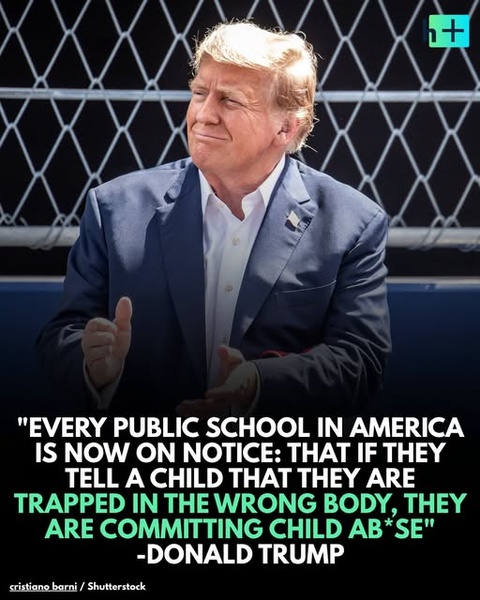
A viral graphic circulating online attributes a dramatic warning to President Donald Trump:
“Every public school in America is now on notice: If they tell a child that they are trapped in the wrong body, they are committing child abuse.”
Unlike many viral political graphics, the quotation itself is genuine. Trump made the statement publicly on August 24, 2026, during a White House back-to-school and education event.
But the graphic leaves out an important distinction: Trump was making a policy and legal assertion, not announcing that every school or teacher using gender-affirming language had already been legally found to have committed child abuse.
Trump really did say it
Trump made the statement during remarks in the White House Rose Garden alongside Education Secretary Linda McMahon.
In the preceding portion of his remarks, Trump criticized transgender participation in women's sports and attacked what he described as “transgender insanity” in schools. He then said:
“Every public school in America is now on notice that if they tell a child that they're trapped in the wrong body, they are committing child abuse.”
The White House confirms that Trump held the back-to-school and education-freedom event on August 24.
So, unlike a number of memes that falsely manufacture quotations, this one did not invent Trump's words.
But “child abuse” is not automatically a legal finding
This is the crucial context missing from the graphic.
Trump's statement does not mean that a teacher who tells a student that the student may be transgender has automatically committed a federal crime.
There is already a Trump administration policy campaign targeting school practices involving gender identity, but it operates through specific federal laws and administrative enforcement mechanisms.
For example, the Department of Education has been investigating school districts over allegations that they concealed information concerning students' gender identity or transition from parents. The department says such conduct can violate the Family Educational Rights and Privacy Act (FERPA).
Those are concrete legal claims.
They are different from a blanket federal statute declaring that telling a child they are transgender constitutes child abuse.
The administration has already taken action against school districts
Trump's warning did not come out of nowhere.
In January 2025, Trump issued an executive order titled “Ending Radical Indoctrination in K-12 Schooling.” It directed federal agencies to develop policies aimed at eliminating federal support for what the administration calls “gender ideology” in K-12 schools and protecting parental rights under FERPA and the Protection of Pupil Rights Amendment.
The administration subsequently began using existing federal laws to challenge particular school policies.
In July 2026, the Education Department announced actions against Anne Arundel County Public Schools in Maryland and Ann Arbor Public Schools in Michigan, alleging that the districts improperly withheld information about students from their parents.
In August, the department announced additional actions involving three Kansas districts, saying their policies encouraged schools to conceal information about students' gender identity from parents.
And on August 26 — two days after Trump's Rose Garden remarks — the department issued a new letter reminding federally funded schools of their obligations under FERPA and PPRA, warning that violations can ultimately lead to the loss of federal funding.
So the broader policy crackdown is real.
Trump is also targeting schools through Title IX
The administration's education campaign extends beyond parental-notification disputes.
The Education Department has opened Title IX investigations into school districts over transgender participation in sports and access to sex-separated facilities.
For example, in June it opened investigations involving several Maryland districts, alleging policies allowing boys to participate on girls' athletic teams and access girls' intimate facilities.
The department has likewise investigated Michigan districts over transgender participation in sports and use of locker rooms.
The administration says violations of Title IX can ultimately jeopardize federal funding.
That provides important context for Trump's phrase “on notice.” His administration has already been pursuing federal enforcement against certain school policies.
But the graphic makes the situation sound broader than the law actually is
There is a major difference between:
“The administration is investigating schools for specific violations of FERPA, PPRA or Title IX.”
and:
“Every public school that tells a child they are transgender is committing child abuse.”
The first describes identifiable legal and administrative actions.
The second is Trump's sweeping characterization of the conduct.
The administration's January 2025 executive order itself instructed agencies to act “consistent with applicable law.”
That qualification matters. A presidential statement does not, by itself, rewrite state child-abuse statutes or create a new criminal offense.
What about the medical claim?
The image also implicitly presents Trump's characterization as settled scientific fact.
That is more complicated.
Research on transgender and gender-diverse young people remains contested in important areas, particularly concerning the long-term effects and certainty of evidence surrounding different interventions. A 2025 systematic review of 105 studies concluded that the evidence base is still limited and often of low or very low certainty for many interventions.
At the same time, research does not establish the blanket proposition that acknowledging a child's gender identity is itself “child abuse.” Studies have found that transgender youth experience substantial mental-health disparities, while supportive family environments can be protective.
In other words, there is legitimate debate over how children should be assessed and supported, particularly when medical treatment is involved. But that is not the same as scientifically proving Trump's categorical definition of “child abuse.”
The bigger political fight
The statement is part of a much larger battle over who should control decisions concerning children's gender identity:
- The Trump administration argues that parents should have primary authority and that schools should not conceal gender-related information from them.
- Opponents argue that schools sometimes need to protect vulnerable students and that transgender students should not be stigmatized or forcibly outed.
- Federal agencies are now using FERPA, PPRA and Title IX as tools to pursue policies they believe violate federal law.
- Courts and state governments remain important because education policy is heavily divided between federal, state and local authority.
The administration has therefore moved beyond rhetoric: it has opened investigations, issued compliance directives and threatened federal-funding consequences in specific cases.
But that does not mean Trump's August statement created a nationwide criminal rule making teachers who affirm transgender students guilty of child abuse.
Verdict: TRUE QUOTE — MISLEADING CONTEXT
The viral graphic gets the most important part right: Donald Trump really did say the quoted sentence.
What it leaves out is just as important.
Trump was speaking as part of his administration's broader campaign against transgender-related school policies and its push for parental-notification requirements. His administration has already taken concrete enforcement actions against some districts.
But his statement is not itself a blanket legal determination that every public school affirming a transgender child has committed child abuse.
So the best characterization is:
The quote is authentic. The legal implication suggested by the meme is much broader than what the existing federal enforcement framework establishes.
Comments (0)
Loading comments...
May You Like

Shocking news from Ohio: an unexpected development ahead of Trump's rally

Russian Drone Strikes Kyiv Bridge as German Chancellor Arrives in Ukraine

South Korea–Ukraine Rift Deepens Over North Korean POW Transfer as PURL Draws New Scrutiny