
Trump Warns Zelenskyy to Stop Striking Russian Refineries as Global Diesel Crisis Deepens
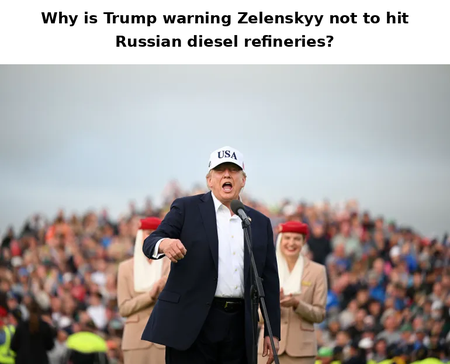
WASHINGTON — September 14, 2026 — President Donald Trump has publicly urged Ukrainian President Volodymyr Zelenskyy to stop targeting Russian diesel infrastructure, arguing that repeated Ukrainian strikes on oil refineries are worsening an already severe global fuel shortage.
Trump made the unusually direct appeal on September 13 while speaking to reporters during his visit to Ireland. He said he had discussed the issue with Zelenskyy and insisted that Ukraine has other targets it can attack without disrupting diesel supplies.
“Mr. Zelenskyy has to do one thing: He has to stop knocking out diesel fuel in Russia.”
Trump's comments come as U.S. diesel prices have climbed above $6 a gallon, reaching a record level and putting additional pressure on transportation, agriculture and consumers.
Why is Trump asking Ukraine to stop?
The immediate concern is the increasingly tight global diesel market.
Ukraine has spent months conducting long-range drone attacks against Russia's oil infrastructure, including refineries and fuel facilities. The campaign is designed to reduce Russia's ability to produce and distribute fuel while simultaneously attacking one of the country's most important sources of revenue for financing the war.
Those strikes have had a measurable impact. Russian fuel production has been disrupted, gasoline shortages have appeared in parts of the country, and Moscow imposed restrictions on diesel exports in an effort to protect domestic supplies.
Trump is now arguing that the consequences are extending far beyond Russia.
Because diesel is essential for trucks, ships, trains, construction equipment and agricultural machinery, disruptions to supplies can quickly translate into higher transportation and food costs.
The president therefore wants Kyiv to avoid actions that could further reduce the amount of Russian diesel reaching international markets.
The timing is particularly sensitive
Trump's warning comes during an unusually difficult period for global energy markets.
The Russia-Ukraine war is not the only factor pushing fuel prices higher. Conflict involving Iran has severely disrupted energy flows through the Middle East, while attacks on regional infrastructure have further reduced available supplies.
Brent crude has risen above $100 a barrel, while U.S. diesel prices have reached unprecedented levels. Analysts warn that prolonged disruptions could keep energy prices elevated and increase inflationary pressure.
Trump, however, has placed particular emphasis on the Russia-Ukraine conflict.
He told reporters that the diesel shortage was being driven by the difficulty of getting Russian fuel onto the world market and argued that Ukrainian attacks were contributing to the problem.
That assessment has become a point of debate among energy analysts, because Middle Eastern disruptions are also playing a major role in the current supply crunch.
Ukraine sees Russian oil infrastructure differently
For Kyiv, Russian refineries are not simply commercial facilities.
Ukraine argues that Russia's oil industry directly supports the war effort by providing fuel for military operations and generating revenues for the Russian government.
Ukrainian forces have therefore increasingly focused on energy infrastructure deep inside Russia as part of a broader strategy to impose economic costs on Moscow.
Kyiv has also faced repeated Russian attacks against its own electricity and energy infrastructure. Ukrainian officials maintain that targeting Russian fuel production is a legitimate part of its defensive campaign.
That creates a difficult dilemma for Washington.
Trump wants the war to end, but he also wants to prevent the conflict from creating an even larger economic shock for Americans.
Russia welcomes Trump's warning
Moscow quickly seized on Trump's comments.
Kremlin spokesman Dmitry Peskov welcomed the U.S. president's appeal, saying Russian diesel facilities should be protected and arguing that attacks on economic infrastructure should stop.
Russia is itself facing significant fuel pressures.
According to Reuters, Moscow has reduced its oil-production forecast to its lowest level in 17 years and revised its expectations for fuel exports in 2026 and 2027 because of the war and damage to energy infrastructure.
The situation demonstrates the unusual consequences of the Ukrainian strategy: attacks designed to weaken Russia militarily are simultaneously reducing fuel supplies from one of the world's major energy producers.
Trump's warning puts Zelenskyy in a difficult position
The message also highlights the increasingly complicated relationship between Trump and Zelenskyy.
Washington remains an important source of support for Ukraine, but Trump has repeatedly pushed Kyiv to accept constraints that he believes could accelerate an end to the war.
His latest demand effectively asks Ukraine to limit one of its most consequential long-range military campaigns at precisely the moment when Russia continues attacking Ukrainian cities and infrastructure.
Trump, however, did not call for Ukraine to stop attacking Russian military targets altogether.
Instead, he specifically drew a line around diesel and refinery infrastructure, saying Ukraine could continue striking other targets.
That distinction could become important in any future negotiations between Washington and Kyiv.
Is this really about Russia — or U.S. fuel prices?
There is another political dimension to Trump's intervention.
American consumers are facing sharply higher fuel costs, while the November midterm elections are approaching.
Diesel is particularly important because it powers much of the country's freight and agricultural economy. Higher diesel prices increase the cost of transporting goods and operating farm machinery, potentially feeding into broader inflation.
The U.S. national average diesel price recently surpassed $6 per gallon, compared with roughly $3.71 a year earlier, according to AAA data cited by Al Jazeera.
For the Trump administration, keeping energy costs under control is therefore both an economic and political priority.
A new pressure point in the Ukraine war
Trump's intervention could create another major disagreement between Washington and Kyiv.
Ukraine wants to maintain pressure on Russia's ability to finance and sustain its military campaign. Trump wants to prevent the conflict from further destabilizing global energy markets.
Both objectives are understandable, but they point in different directions.
The Kremlin's positive reaction also illustrates the broader geopolitical significance of Trump's statement: a U.S. demand that Ukraine reduce attacks on Russian energy infrastructure could indirectly give Moscow some breathing room at a moment when its fuel system is under intense pressure.
For Zelenskyy, the question will be whether the strategic value of continuing refinery attacks outweighs the diplomatic cost of ignoring Trump's warning.
The bottom line
Trump's message is not simply a defense of Russian refineries. It reflects a much broader concern about a global diesel shortage that has already pushed American prices to record levels.
Ukraine's attacks are clearly disrupting Russian fuel production, but they are occurring alongside major disruptions in the Middle East. The result is an increasingly fragile global energy market in which every additional refinery outage can have consequences far beyond the battlefield.
For Zelenskyy, Trump's warning creates a difficult choice: continue striking Russian energy infrastructure to weaken Moscow's war machine, or limit those attacks to help ease a global fuel crisis that is increasingly becoming a problem for the United States and its allies.
And with diesel prices already above $6 a gallon, Trump is making clear that he wants Kyiv to choose the latter.
Comments (0)
Loading comments...
May You Like

Shocking news from Ohio: an unexpected development ahead of Trump's rally


gfnhgmnghnmfgnbvvvvvvvvv












