
Trump’s 100% Tariff Threat Against Canada Meets Carney’s Energy Warning
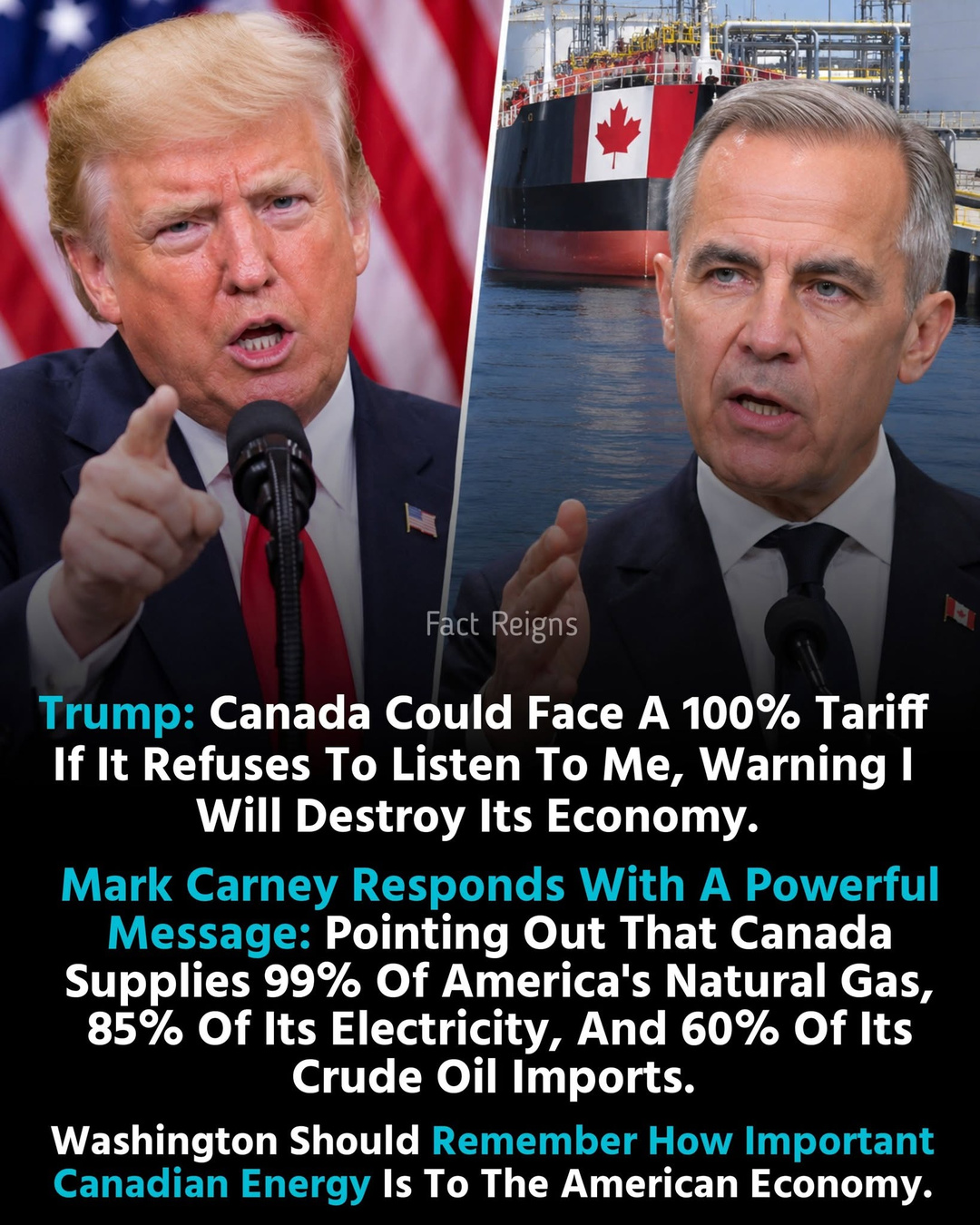
Trump’s 100% Tariff Threat Against Canada Meets Carney’s Energy Warning: Why Washington Cannot Ignore Its Northern Neighbor
November 7, 2026 | U.S. Politics | Canada–U.S. Trade Relations
The relationship between the United States and Canada has entered a period of extraordinary tension, as trade disputes increasingly threaten one of the world's most important economic partnerships.
President Donald Trump threatened to impose a 100% tariff on Canadian imports on January 24, warning Ottawa against strengthening its economic relationship with China.
In a Truth Social post, Trump accused Canada of potentially becoming a gateway for Chinese products entering the American market and threatened severe economic consequences.
His warning followed Canadian Prime Minister Mark Carney's visit to Beijing, where the two countries announced an agreement addressing several longstanding trade disputes.
The agreement included Canadian plans to admit up to 49,000 Chinese electric vehicles annually at reduced tariff rates, while China would lower tariffs on Canadian agricultural exports.
Trump argued that the arrangement could allow Chinese manufacturers to bypass American trade restrictions by using Canada as an intermediary for goods entering the United States.
Carney rejected Trump's characterization, emphasizing that Canada was not negotiating a comprehensive free-trade agreement with China and remained committed to protecting its economic sovereignty.
The Canadian leader had already challenged Trump's suggestion that Canada depended entirely on American support, declaring that his country thrived because of its own people and national values.
But Carney's strongest economic argument came later, during a May 28 address at the Economic Club of New York.
He highlighted Canada's importance to American energy security, arguing that the two countries were economically interconnected and that American industries depended heavily on Canadian resources.
According to Carney, Canada supplied approximately 99% of American natural gas imports, 85% of electricity imports, and 60% of crude oil imports.
His message was straightforward: imposing additional trade barriers against Canada could create economic problems for American businesses and consumers, not simply damage the Canadian economy.
The figures illustrate how deeply integrated the two countries have become through pipelines, electricity transmission networks, industrial supply chains, and cross-border energy infrastructure.
However, the percentages require context. They describe Canada's share of American imports in the period cited by Carney, not Canada's share of total American energy consumption.
More recent official Canadian Energy Regulator figures show that Canada supplied 63.4% of US crude oil imports, nearly 100% of natural gas imports, and 81.3% of electricity imports in 2025.
This confirms Canada's strategic importance while showing that the exact percentages vary depending on the reporting year and measurement method.
Oil is particularly important because Canadian crude supplies many American refineries, especially facilities in the Midwest that are configured to process heavier grades of imported petroleum.
Natural gas exports also support electricity generation, industrial production, and residential heating across several American states, making disruptions potentially costly.
Electricity trade is smaller in overall energy terms, but Canadian hydroelectric exports provide valuable supplies to neighboring American regions during periods of high demand.
The political dispute therefore extends beyond tariffs. It raises questions about continental energy security, economic independence, manufacturing competitiveness, and the future of North American trade cooperation.
Meanwhile, the United States and Canada have continued negotiating despite their disagreements. On November 3, Trump said Washington was close to reaching a trade agreement with Ottawa.
Carney confirmed that discussions had advanced but emphasized that an agreement had not yet been finalized.
As the two governments approach the review of their continental trade agreement, both sides face pressure to protect domestic industries without damaging a deeply interconnected economic relationship.
For Trump, the challenge is using tariffs as negotiating leverage without increasing costs for American manufacturers and households.
For Carney, the challenge is diversifying Canada's international partnerships while preserving access to its largest export market.
Ultimately, the dispute demonstrates that economic pressure between neighboring countries can create consequences on both sides of the border. Canada's energy resources give Ottawa significant negotiating leverage, even as its economy remains closely connected to the United States.
Comments (0)
Loading comments...
May You Like

TOLEDO I-75 TRUCK CRASH — POTENTIAL BRIDGE COLLAPSE AND MILLIONS IN DAMAGE!

TRUMP CALLS GDP FIGURE “FAKE” AFTER GOVERNMENT’S SCHEDULED REVISION

KUWAIT DRONE ATTACK SPARKS TENSION BETWEEN ISRAEL, THE U.S AND IRAN

Latest Posts







Popular Posts




