
Trump’s 2012 Gas Price Attack Resurfaces as Fuel Costs Rise Again
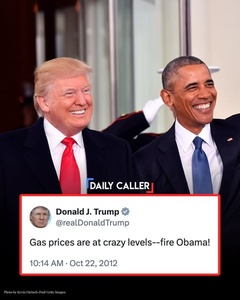
An old Donald Trump post criticizing Barack Obama over gasoline prices has resurfaced as American consumers face renewed pressure from higher fuel costs and continuing disruptions in global energy markets.
On October 22, 2012, Trump wrote on Twitter, “Gas prices are at crazy levels—fire Obama!” The post was published while Obama was president and weeks before that year’s election.
At the time, the national average price for regular gasoline was about $3.69 per gallon, according to FactCheck.org, making fuel costs a prominent political issue during the presidential campaign.
Trump repeatedly criticized Obama over gasoline prices during 2012, arguing publicly that the administration should take stronger action to protect Americans from rising costs at the pump.
The resurfaced post has attracted renewed attention because fuel prices have again become a major economic concern in 2026, with gasoline and diesel costs rising amid international energy disruptions.
Reuters reported on September 30 that high gasoline prices were hurting consumer confidence, while the administration considered additional measures to address energy costs facing American households.
Diesel prices have faced particularly severe pressure, with Reuters reporting that the national diesel price recently reached a record $6.53 per gallon amid disruptions affecting international energy markets.
Current fuel prices are influenced by numerous factors, including crude-oil supply, refinery capacity, geopolitical conflicts, transportation disruptions and global demand, making presidential responsibility difficult to isolate.
Energy analysts have previously emphasized that presidents have limited direct control over gasoline prices because crude oil is traded in global markets and responds to international developments.
That distinction was already evident in 2012, when the Obama administration argued that Middle Eastern instability was a major factor behind higher gasoline prices.
Obama said in March 2012 that instability in the Middle East was contributing to higher prices, while also promoting greater domestic energy production and alternative energy development.
Trump nevertheless continued making gasoline prices a central part of his criticism, including another October 2012 message accusing Obama of failing to protect Americans from expensive fuel.
The political debate has continued long after the Obama administration, with both parties frequently pointing to gasoline prices when discussing economic conditions and presidential energy policies.
In 2026, geopolitical developments have again become an important factor, with Reuters reporting that the Iran conflict and disruptions around the Strait of Hormuz have contributed to energy-market uncertainty.
Trump has recently argued that energy prices will fall after the conflict with Iran ends, while his administration has explored measures including possible restrictions on diesel exports.
The resurfacing of the 2012 post has therefore created a historical comparison between Trump’s earlier criticism of Obama and the fuel-price challenges confronting his administration today.
The comparison does not by itself establish that current gasoline prices are caused by Trump, just as the 2012 tweet did not establish that Obama directly controlled prices.
Instead, the episode illustrates how gasoline costs have repeatedly become politically important whenever Americans experience noticeable increases at the pump.
As fuel prices remain closely watched by consumers, businesses and financial markets, Trump’s decade-old statement continues circulating online, connecting a past political argument with a new period of energy-market pressure.
The resurfaced post ultimately highlights the enduring political sensitivity of gasoline prices and the difficulty presidents face when global energy conditions directly affect household expenses across the United States.
Comments (0)
Loading comments...
May You Like


South Korea–Ukraine Rift Deepens Over North Korean POW Transfer as PURL Draws New Scrutiny
Jack Smith Defends His Integrity as Trump Investigations Face Renewed Political Firestorm













