
Trump’s 6-Year House, 12-Year Senate Term-Limit Plan Returns to Spotlight
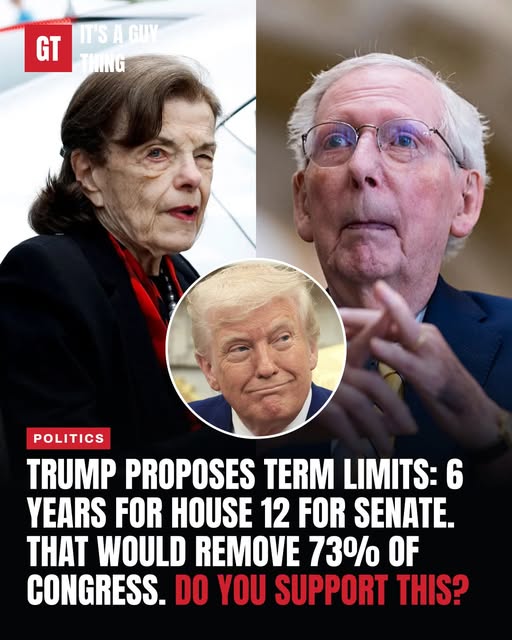
Donald Trump’s proposal for congressional term limits is circulating again, but the image presents an older policy position as though it were necessarily a new 2026 initiative.
Trump first publicly specified the plan in October 2016, when he called for a constitutional amendment limiting House members to six years and senators to twelve years.
Under the proposal, House members could serve three two-year terms, while senators could serve two six-year terms before becoming ineligible for another congressional term under the proposed amendment.
The proposal would not take effect through a presidential order. Congressional term limits require changing the Constitution, placing the issue within the amendment process established by Article V.
Article V allows Congress to propose an amendment with two-thirds support in both chambers, followed by ratification from three-fourths of the states nationwide through legislatures or conventions.
Alternatively, two-thirds of state legislatures can apply for a convention to propose amendments, although that convention method has never been used to propose an amendment.
The Supreme Court has also ruled that individual states cannot impose additional qualifications for congressional candidates, meaning national term limits require constitutional authority through amendment.
The Supreme Court reached that conclusion in United States Term Limits v. Thornton, a 1995 case involving Arkansas restrictions on congressional candidates who had already served specified terms.
That constitutional framework means Trump could advocate term limits and encourage Congress or states to pursue an amendment, but he could not impose congressional limits unilaterally.


The image’s claim that the proposal would remove 73 percent of Congress requires additional context because that percentage comes from a historical congressional membership analysis.
Quorum’s 2026 analysis notes that 73 percent of representatives in the 115th Congress had already served three or more terms by the end of that Congress.
That historical figure does not mean 73 percent of today’s Congress would automatically leave office if identical limits were adopted, because implementation rules and current tenure differ.
Whether existing members would be affected would depend on the exact constitutional amendment, including whether its restrictions applied prospectively or counted service already completed by lawmakers.
Historical congressional proposals have used different approaches, with some versions applying limits prospectively while others considered how previous service should affect eligibility under new constitutional rules.
Supporters of congressional term limits have argued that limits could increase turnover, encourage new candidates and reduce advantages associated with long congressional careers and seniority.
Critics have raised different concerns, including the possibility that term limits could remove experienced lawmakers and shift influence toward unelected staff, lobbyists or executive officials.


These competing arguments have appeared in congressional research and historical debates for decades, showing that the policy question extends beyond Trump’s individual proposal and campaign.
Term limits also differ from the ordinary electoral process because voters currently can repeatedly reelect House members and senators without a federal statutory limit on congressional tenure.
At present, the six-year House and twelve-year Senate limits remain a proposed constitutional change rather than a rule governing federal congressional elections or eligibility today.
The image therefore accurately reflects Trump’s longstanding term-limit position, but its 73 percent figure should not be interpreted as a verified forecast of immediate congressional turnover.


Comments (0)
Loading comments...
May You Like

South Korea–Ukraine Rift Deepens Over North Korean POW Transfer as PURL Draws New Scrutiny

gfnhgmnghnmfgnbvvvvvvvvv

Shocking news from Ohio: an unexpected development ahead of Trump's rally












