
Trump’s 95% Approval Claim: What the Polling Actually Shows
Trump’s 95% Approval Claim: What the Polling Actually Shows
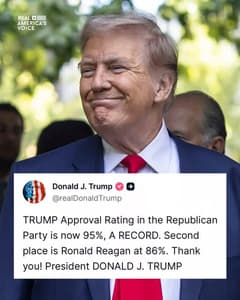
A fact-checked report on the September 18 social media post and the polling behind it
1. The Post That Sparked the Debate
Trump’s message, archived from his Truth Social account, declared that his Republican approval rating had reached 95%, describing it as a record and placing Reagan second at 86%. The post did not name the polling organization or provide a link to the underlying survey.
That missing information matters because approval ratings depend on the wording of the question, who was surveyed, and when the survey was conducted.
2. The 95% Figure Has a More Limited Explanation
The August 14–17 Economist/YouGov poll offers one plausible context for the number: it found that 95% of MAGA supporters approved of Trump’s job performance. But the same survey reported 80% approval among Republicans overall. The groups are not interchangeable, because MAGA supporters include some people who do not identify as Republicans.
This means a 95% figure can appear in a real poll without demonstrating that 95% of the entire Republican Party approves of Trump.
3. A September Poll Showed a Different Picture
A Reuters/Ipsos survey conducted September 17–20 found that 73% of Republicans approved of Trump’s overall job performance, down from 86% in January 2026. His approval among all American adults was 32% in that survey.
These results do not necessarily contradict the August YouGov poll: they were conducted by different organizations at different times, using different survey samples. They do show why a polling claim needs a clear source and date before it can be treated as a record.
4. What About the Ronald Reagan Comparison?
Trump’s post described Reagan’s 86% as the second-highest Republican approval rating. But without a cited historical dataset, survey question, or measurement period, that comparison cannot be independently verified from the post alone.
Historical comparisons are especially sensitive to methodology. A poll measuring approval among Republicans today may not be directly comparable with one conducted decades ago, particularly if the questions, party identification criteria or survey methods differ.
5. Trump’s Support Within the Republican Party
The available surveys indicate that Trump has maintained substantial support among Republican voters, especially among those who identify with the MAGA movement. The August YouGov survey also found a notable gap between MAGA and non-MAGA Republicans: 95% approval among MAGA supporters versus 59% among Republicans who did not identify as MAGA.
That difference provides a more informative picture than a single headline number. It suggests that the political label used to define the group being surveyed can significantly affect the result.
6. Overall Approval Is a Different Measure
Approval among Republicans is not the same as approval among the American public as a whole. In the September Reuters/Ipsos poll, Trump’s approval was 73% among Republicans but 32% among all adults.
A president can retain strong support among members of his own party while receiving a much lower rating nationally. Both measures are useful, but they answer different questions.
7. Why the Claim Matters Ahead of the Midterms
The post appeared as the United States approached the November 3, 2026, midterm elections. In its October 26 poll, Reuters/Ipsos reported that Trump’s overall approval had risen to 32%, while registered voters preferred Democratic congressional candidates over Republicans by 47% to 36% on the generic ballot.
These figures provide broader political context, but a national congressional ballot does not directly measure support for Trump among Republicans. Nor does it determine the outcome of individual races.
8. How to Evaluate a Political Poll
Before accepting a claim of a record approval rating, readers should look for four basic details:
-
The pollster: Which organization conducted the survey?
The population: Republicans, MAGA supporters, registered voters or all adults?
The field dates: When were respondents interviewed?
The methodology: How many people participated, and how was the sample weighted?
Without these details, a percentage may be repeated widely while its meaning remains unclear.
9. The Bottom Line
Trump did publish the 95% claim, but the image does not establish that his approval among all Republicans had reached a historic record or that Reagan’s figure was definitively second-highest.
The strongest conclusion supported by the sources is narrower: one August 2026 poll found 95% approval among MAGA supporters, while other surveys measured lower approval among Republicans overall. The Reagan comparison remains unverified without its underlying source.
For an accurate account, the key is not whether one percentage sounds impressive, but whether the survey actually measures the population and historical comparison being claimed.
Comments (0)
Loading comments...
May You Like

EAST COAST DISASTER—179 THOUSANDS OF HOMES AT RISK, CAUSING $50 BILLION IN DAMAGE!

FLORIDA AIRBNB NIGHTMARE — 50 TEENS, 7 SHOOTING VICTIMS LINKED TO “SHOTS AT THE DOOR”!











Popular Posts




