
Trump’s Alleged Iowa Rally “Glitch” Fuels Online Speculation—but a Strange Sound Is Not Evidence of Cognitive Decline
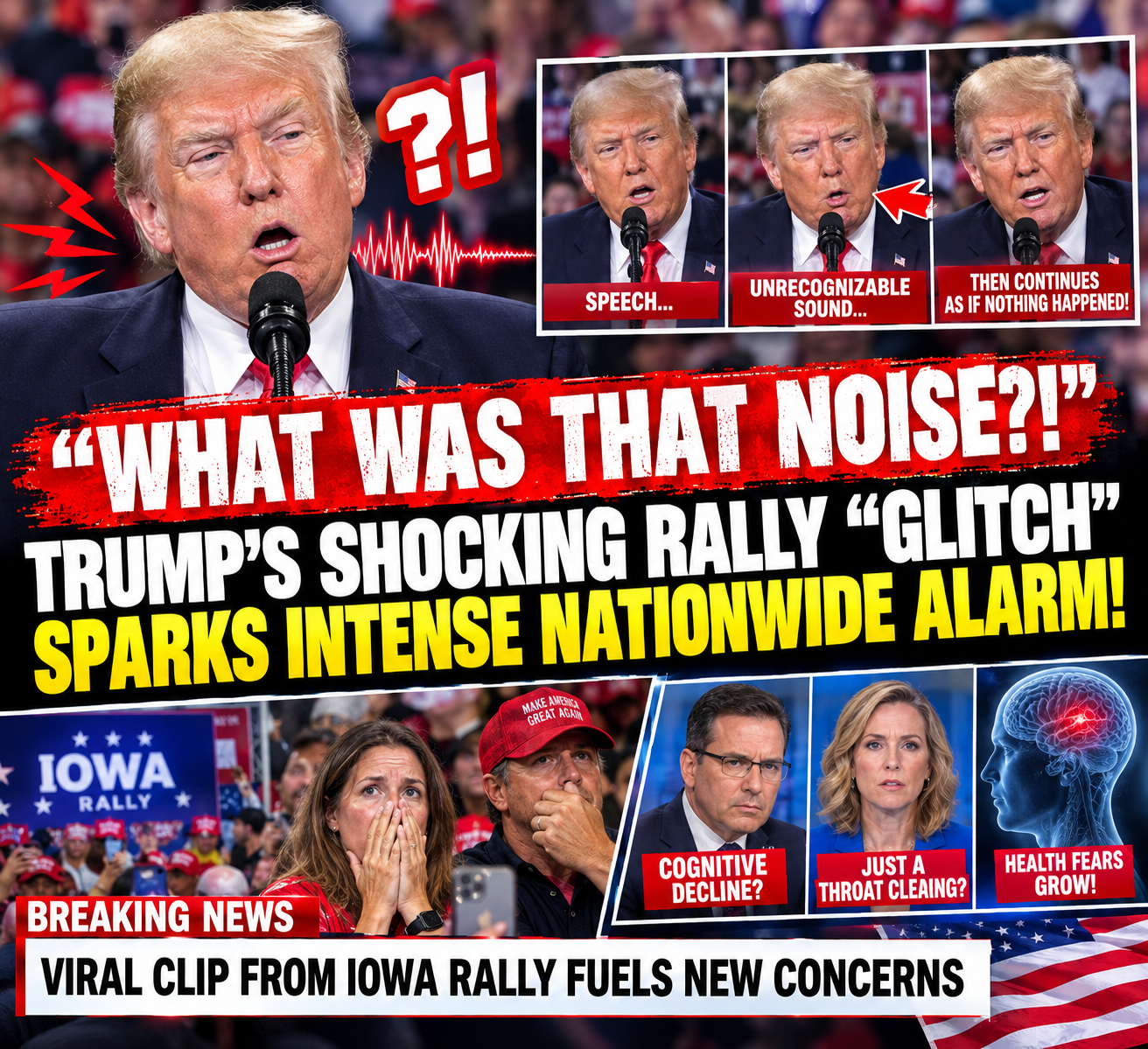
A dramatic social-media graphic alleging that President Donald Trump made an unusual, unintelligible sound during a campaign rally in Iowa has renewed a familiar debate about how moments from political speeches are interpreted, circulated and used to raise questions about a president’s health.
The image portrays Trump speaking into a microphone, accompanied by a sequence of close-up photographs labeled as a speech interruption, an unrecognizable sound and an immediate return to normal delivery. It also features concerned-looking spectators, television commentators and an illustration of a human brain, suggesting that the alleged incident may have medical significance.
But the graphic itself provides no unedited video, exact rally date, original recording or independently documented medical assessment. Without those details, its central allegation—that Trump experienced a significant neurological or cognitive episode—cannot be treated as established fact.
The distinction is important. An unusual sound during a public speech may attract attention and prompt questions, but the sound alone cannot establish why it occurred. A momentary change in speech could have several explanations, including ordinary vocal strain, a cough, throat clearing, microphone distortion or a technical problem. Determining whether a particular incident had any medical significance would require considerably more evidence.
The viral presentation nevertheless illustrates how quickly a brief or ambiguous moment can be transformed into a much larger political narrative, particularly during an election season when presidential appearances are scrutinized for signs of weakness, strength or inconsistency.
The unusual moment, however, was not entirely invented. Reporting published on October 23 and 24 confirms that short video clips from two separate Trump campaign appearances—one in South Carolina on October 21 and another in Iowa on October 22—circulated widely after viewers noticed unexpected vocal sounds during his remarks.
The Iowa incident occurred during a rally in Sioux City, where Trump was campaigning ahead of the November 3 midterm elections. While discussing control of the U.S. Senate, he appeared to interrupt his sentence with a prolonged, difficult-to-interpret sound before moving to a different subject.
Journalist Aaron Rupar shared an excerpt of the speech on social media. In the clip, Trump begins warning against what he describes as communist control of the Senate, makes a sound that online viewers transcribed in different ways, and then pivots to discussing a Michigan political figure.


The Iowa footage was not the only clip attracting attention. At a South Carolina campaign event the previous day, Trump was discussing his decision to appoint former Governor Nikki Haley as U.S. ambassador to the United Nations. During the sentence, he made an audible guttural sound, then resumed explaining that he had wanted Henry McMaster to become governor.
The South Carolina incident can be checked against a longer recording of the rally published by C-SPAN, providing a stronger basis for confirming that the sound occurred. The footage does not, however, establish its medical cause.
The clips quickly became material for political commentary and late-night television. Jimmy Fallon replayed the South Carolina moment on The Tonight Show, joking that it resembled several different involuntary sounds happening simultaneously. Online reactions ranged from amusement to expressions of concern.
Some commentators interpreted the moments as evidence of declining health, while others suggested more ordinary explanations. Neither interpretation was substantiated by a clinical evaluation made available to the public.

The health speculation was amplified by the president's age. Trump, who turned 80 in June 2026, is the oldest person to serve as U.S. president. Questions about presidential health have become an enduring feature of American political debate, particularly following the intense scrutiny directed at former President Joe Biden during his final years in office.
Age alone, however, does not establish a medical condition. Nor can a diagnosis of dementia, a neurological disorder or cognitive impairment be responsibly inferred from a few seconds of speech.
Reports about the Iowa rally noted that Trump appeared tired to some observers and that several social-media users highlighted his facial expressions and verbal stumbles. Those observations are not equivalent to medical findings. The White House has maintained that the president is in good health, and reporting on the viral clips did not identify a medical professional who had examined Trump and established a diagnosis related to the incidents.
The president's previously disclosed health information also needs to be considered separately. In July 2025, the White House announced that Trump had been diagnosed with chronic venous insufficiency after experiencing swelling in his lower legs. Officials described it as a common vascular condition among older adults. That diagnosis does not explain the rally sounds and should not be presented as evidence of a neurological problem.
The viral graphic's brain illustration and suggestion of cognitive deterioration therefore go beyond what the available evidence supports. It is legitimate to report that Trump made unusual sounds, that the videos attracted attention and that critics questioned their significance. It is not legitimate to convert those reactions into an established medical conclusion.
There is also an important distinction between the two recorded events. The South Carolina clip involved Trump speaking about Haley and McMaster. The Iowa clip involved his comments about the Senate and a Michigan political figure. Combining the incidents into a single sequence can create a misleading impression about their timing, frequency and context.
The broader political backdrop helps explain why the videos received attention. Trump was undertaking a demanding campaign schedule as Republicans worked to defend their congressional position before the November 3 elections. His rallies addressed immigration, the economy, national security and Democratic candidates, while his remarks frequently generated separate controversies that competed with the campaign's policy messages for attention.
The Iowa appearance also drew headlines over Trump's defense of a controversial campaign advertisement involving Ohio Republican Vivek Ramaswamy. That dispute was a substantive campaign issue separate from the viral vocal clip, but it demonstrated how several controversies could emerge from the same political event.
For journalists and voters, the challenge is to distinguish what the cameras captured from what viewers believe those images or sounds might mean. The footage documents brief, unusual vocal interruptions. It does not document a medical emergency, an onstage collapse or a confirmed episode of cognitive impairment.
The immediate reaction inside the venues also appears to have been less dramatic than the social-media response. Trump continued speaking after the interruptions, and the available reports do not describe either rally being halted because of the sounds.


That contrast illustrates a broader feature of modern political communication. A few seconds extracted from a lengthy speech can become the defining image of an event for millions of online viewers, even when those attending the event experienced it as one moment within a much longer address.
Short clips can serve an important accountability function when they reveal something newsworthy. But edited footage, slowed playback, exaggerated captions and medical imagery can also encourage conclusions that the original material does not support.
The public has a legitimate interest in the health and ability of any sitting president to perform the duties of office. Meaningful reporting on that subject depends on documented medical disclosures, reliable observations, verified recordings and appropriately qualified professional assessments—not on speculative diagnoses circulated through partisan social-media accounts.
The October 21 and 22 rally clips have become another example of that tension. The sounds were sufficiently unusual to attract news coverage and public discussion. Their underlying cause remains unknown.
As the midterm campaign approaches its final days, the footage is likely to remain part of the political conversation. Whether it has any lasting electoral significance cannot be determined from social-media reaction alone.
For now, the most defensible conclusion is also the most precise: Trump made brief, unusual vocal sounds during two campaign appearances, continued speaking afterward, and prompted a wave of online commentary. Claims that the incidents prove cognitive decline or a serious neurological condition remain unverified.
Comments (0)
Loading comments...
May You Like

WWE BRONSON REED DEAD AT 38, STIMULANTS DETECTED, $11M INSURANCE PAYOUT FROZEN!

EAST COAST STORM CRISIS—5 MILLION AT RISK OF BLACKOUTS, WATER, AND HEATING FAILURES!

COASTAL DISASTER — 112 KM/H WINDS, SEAWATER FLOODING, 79,000 NEW JERSEY HOMES AT RISK!








Popular Posts




