
Trump’s Bold Iran War Statement
Trump’s Bold Iran War Statement Raises a Major Question: Who Really Controls When the Conflict Ends?
President Donald Trump has once again placed the United States' confrontation with Iran at the center of international attention following a widely circulated TMZ headline suggesting that he believes the war will end whenever he decides it should. The statement has generated questions about American military strategy, presidential authority and the uncertain future of a conflict with potentially far-reaching consequences for the Middle East.
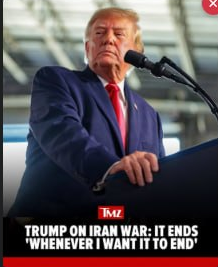
The image features Trump standing at a podium alongside the headline, “TRUMP ON IRAN WAR: IT ENDS ‘WHENEVER I WANT IT TO END’.” Although the graphic attributes the statement to the president, it does not identify the original interview date or provide the complete exchange. That missing context matters because a short headline cannot fully explain what Trump meant, which military developments he was discussing or whether his comments referred to a specific stage of the conflict.
The wording nevertheless reflects a familiar feature of Trump's foreign policy communication: the use of direct, emphatic language to project confidence and bargaining power. Throughout his political career, Trump has frequently argued that decisive American leadership can change the behavior of rival governments and create opportunities for negotiations. His critics, however, have questioned whether strong public declarations can oversimplify conflicts involving multiple countries and competing strategic interests.
The dispute between Washington and Tehran has deep historical roots. Since the Iranian Revolution of 1979, relations have been shaped by diplomatic confrontations, economic sanctions, regional military tensions and disagreements over Iran's nuclear program. Successive American administrations have struggled to balance efforts to deter Iranian military activities with the risk that confrontation could develop into a broader regional war.

Trump's approach to Iran has long emphasized economic pressure and military deterrence. During his first presidency, the United States withdrew from the 2015 nuclear agreement, formally known as the Joint Comprehensive Plan of Action, and reimposed extensive sanctions on Tehran. The administration argued that the agreement did not sufficiently address Iran's missile capabilities and regional activities, while supporters of the deal warned that withdrawal could make nuclear diplomacy more difficult.
The president's position has also been influenced by concerns about Iran's relationships with armed groups across the Middle East. American officials have repeatedly accused Tehran of providing financial, military and political support to organizations that operate in Lebanon, Iraq, Syria and Yemen. Iranian leaders have defended aspects of their regional involvement while rejecting the United States' broader characterization of their policies.
Any direct military confrontation between the United States and Iran would involve considerably more than decisions made in Washington. Iranian military capabilities, the security interests of neighboring countries, international shipping routes and the responses of American allies could all affect the course of events. These factors make predictions about the duration of a conflict inherently uncertain.
The Strait of Hormuz is one of the most important strategic locations in any discussion of Iran. Situated between Iran and Oman, the narrow waterway connects the Persian Gulf with international shipping routes and serves as a major passage for global energy supplies. A serious disruption to commercial shipping in the region could affect oil prices, transportation costs and economic conditions far beyond the Middle East.
Military analysts also emphasize that ending active combat is not necessarily the same as resolving the underlying political dispute. A ceasefire may halt immediate attacks, but lasting stability generally requires agreements about security arrangements, future military activities and mechanisms for preventing renewed confrontation. Without such arrangements, even a temporary reduction in violence can leave the principal causes of conflict unresolved.
Trump's reported assertion that the conflict could end whenever he wants raises a broader constitutional question about the president's control over military operations. As commander in chief, the president has substantial authority over the armed forces. However, Congress possesses important constitutional powers involving declarations of war, military funding and oversight of executive actions.
The relationship between presidential authority and congressional war powers has been debated for decades. Presidents from both major political parties have authorized military operations without formal declarations of war, often citing national security responsibilities and existing legal authorities. Critics of expansive executive power argue that major or prolonged military campaigns should receive stronger congressional authorization and scrutiny.

Even when an American president directs military operations, the practical outcome depends on developments beyond any single leader's control. Intelligence assessments, operational conditions, adversary decisions, diplomatic negotiations and the actions of allied governments can all influence whether fighting continues or stops. Public statements of confidence may be intended to strengthen a negotiating position, but they cannot guarantee a particular result.
Iranian leaders face their own strategic calculations. Decisions about military retaliation, negotiations or de-escalation can be influenced by domestic political pressures, economic conditions, military capabilities and the positions of regional partners. These factors can complicate attempts to establish a mutually acceptable path toward ending hostilities.
The possibility of a broader regional confrontation remains a major concern whenever tensions between Washington and Tehran intensify. Countries throughout the Middle East maintain different security relationships with the United States and Iran, and their governments have strong interests in avoiding instability that could threaten civilian populations, energy infrastructure and trade.
Israel's security concerns are another important part of the regional picture. Israeli leaders have repeatedly described Iran's nuclear ambitions and support for armed groups as major threats. Iranian officials, meanwhile, have criticized Israeli military policies and rejected demands that they abandon what they describe as legitimate national security interests.
These opposing positions help explain why negotiations involving Iran are often complicated. Diplomatic progress may require addressing several interconnected questions, including nuclear activities, sanctions, regional security guarantees and the activities of armed organizations. Agreement on one issue does not necessarily produce agreement on the others.
The humanitarian consequences of military escalation are equally significant. Civilian populations can face displacement, interruptions to healthcare, damage to infrastructure and economic hardship during sustained hostilities. International humanitarian law requires parties to armed conflicts to distinguish between civilians and combatants and to observe applicable protections for civilian life.

Economic consequences can extend well beyond the immediate conflict zone. International energy markets are particularly sensitive to the possibility of disruptions in the Persian Gulf, while shipping companies and insurers may respond to increased security risks by changing routes or raising costs. Such developments can eventually affect businesses and consumers around the world.
For American voters, the Iran issue also raises questions about national priorities. Supporters of a forceful approach argue that military deterrence can prevent attacks against American personnel and discourage hostile actions. Opponents of expanded military involvement warn about the possibility of a prolonged conflict, the financial costs of military operations and the risks to service members.
Public opinion about foreign policy often changes as circumstances develop. Initial support for a military action can weaken if casualties rise, objectives become unclear or the operation lasts longer than anticipated. Conversely, voters may support decisive action when they believe an immediate threat to national security requires a response.
Trump's public communication style can influence how these debates unfold. Short, confident statements are easily shared through television clips and social media, but they can leave important questions unanswered. Understanding the significance of any presidential remark requires examining the complete statement alongside the administration's actual decisions and the evolving security situation.
Diplomatic efforts remain an important consideration regardless of the intensity of political rhetoric. Negotiations can involve direct talks, intermediaries or multilateral discussions with other governments. The success of those efforts depends on whether the parties can identify acceptable terms and establish sufficient confidence that commitments will be honored.
The timing of the quotation is now clearer. Trump used the wording in a March 11 interview with Axios, when he argued that American and Israeli strikes had severely weakened Iran's military capabilities. His statement was subsequently repeated in coverage of the conflict, including renewed campaign reporting in late October.
The broader situation has changed considerably since the original interview. The conflict has continued for months, with reports of mounting financial costs, disruptions to energy markets and warnings that additional military operations could follow the November 3 elections. These developments demonstrate why the ability to stop American strikes should not be confused with the ability to guarantee a lasting end to the war.
Trump has continued to defend the decision to use military force, arguing that preventing Iran from acquiring nuclear weapons is a fundamental American security objective. Critics have questioned the duration, costs and strategic consequences of the campaign, particularly as the conflict has become an issue in the midterm elections.
The central uncertainty remains whether military pressure can produce a durable diplomatic settlement. A decision by Washington to suspend operations could reduce immediate fighting, but a lasting resolution would also depend on Iran's response, regional security arrangements and the willingness of the parties to negotiate.
Trump's statement may project confidence, but the course of the conflict illustrates a more complicated reality: a president can make decisions about American military involvement, yet ending a regional war requires outcomes that no single leader can fully control.
Comments (0)
Loading comments...
May You Like
A MAJOR BREAKTHROUGH MAY BE WITHIN REACH — BUT IRAN'S NEXT MOVE COULD CHANGE EVERYTHING
A TERRIFYING NEW DEVELOPMENT JUST PUT TRUMP UNDER PRESSURE

Latest Posts

Popular Posts
Danica Patrick Accuses Democrats
Nov 2, 2026
JD Vance’s Election Day
Nov 2, 2026