
Trump’s Congressional Proposal
Trump’s Congressional Term-Limits Proposal Could Reshape Capitol Hill, but the Viral Graphic Needs Context
U.S. Politics | November 3, 2026
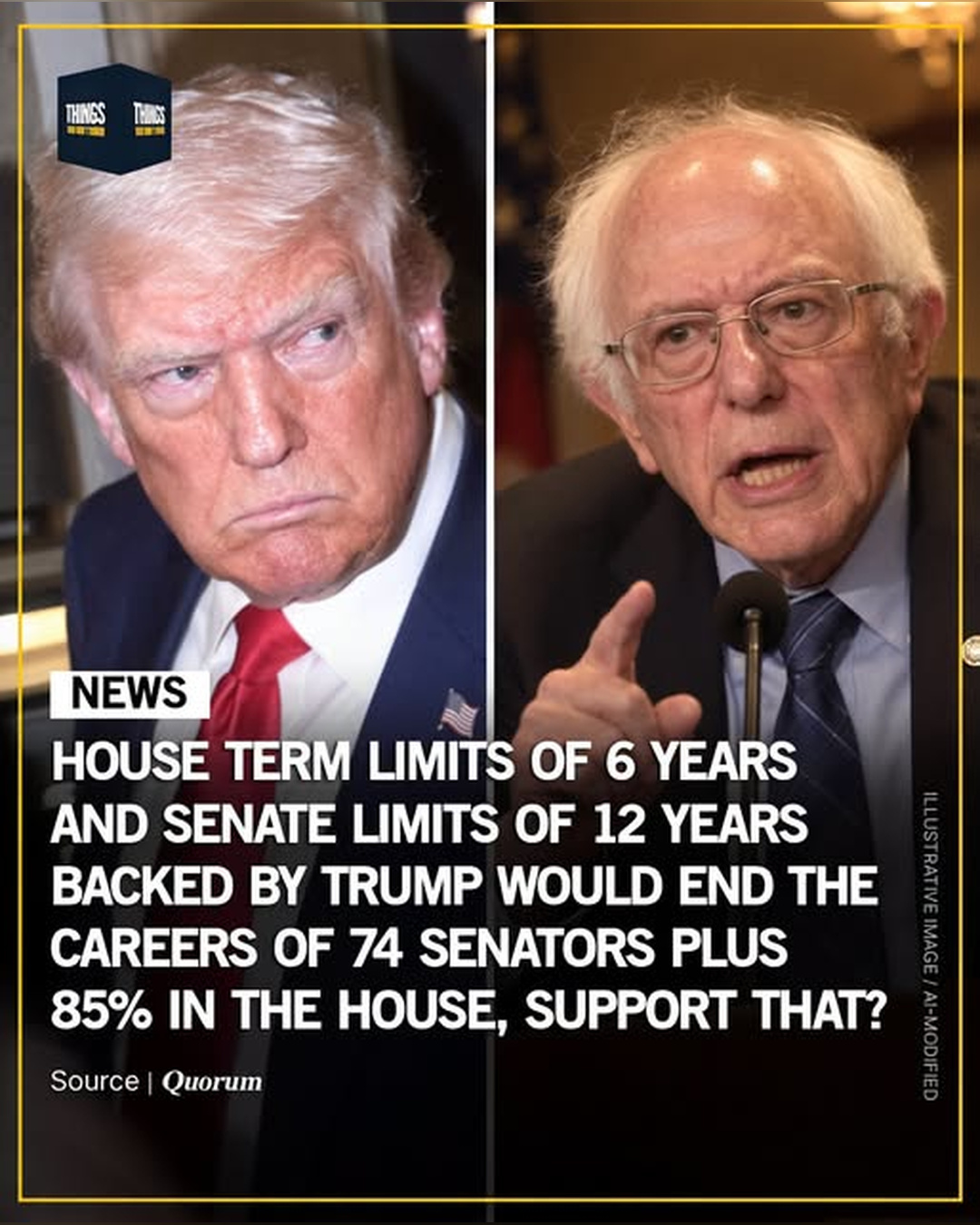
A viral graphic featuring Donald Trump and Bernie Sanders claims that a proposal to limit House members to six years and senators to 12 years would end the careers of 74 senators and 85 percent of House members.
The figures are based on an analysis by Quorum, but the graphic leaves out a crucial distinction: the numbers describe lawmakers’ accumulated service, not an enacted policy or an automatic mass removal from Congress.
What Trump actually proposed
Trump has supported congressional term limits since his 2016 presidential campaign. His proposal called for a maximum of three two-year terms in the House, amounting to six years, and two six-year terms in the Senate, amounting to 12 years.
The idea was presented as part of his “Drain the Swamp” message, promising to challenge entrenched political power and reduce the influence of long-serving lawmakers in Washington.
The proposal is not a new constitutional rule. Members of the House can currently be reelected without a federal term limit, and senators can likewise serve indefinitely if voters continue returning them to office.
Where the 85% and 74 figures come from
Quorum’s March 2026 analysis examined the membership of the 119th Congress against Trump’s proposed limits. It found that 368 representatives—about 85 percent of the House—had already served at least three terms.
Under a strict application of the proposed six-year cap, those representatives would exceed the proposed limit. The analysis also counted 74 senators who had served at least two terms, meaning they had reached or passed the proposed 12-year ceiling.
The Senate figure includes lawmakers who have completed two terms as well as those who have served longer. Quorum reported that 49 senators had served three terms or more, illustrating how much experience is concentrated among long-serving members.
These figures are a snapshot of congressional tenure, not a prediction that exactly 442 lawmakers would immediately lose their seats. The outcome would depend on the final amendment’s wording, especially its transition rules.
Why the proposal has not become law
Changing congressional eligibility rules would require a constitutional amendment. Under Article V, an amendment can be proposed by a two-thirds vote in both chambers of Congress, or through a convention called by two-thirds of state legislatures. It must then be ratified by three-fourths of the states.
The Supreme Court also ruled in U.S. Term Limits, Inc. v. Thornton (1995) that states cannot impose additional qualifications or term limits on members of Congress. A state-by-state workaround is therefore not available.
There have been congressional efforts to advance the idea. House Joint Resolution 5, introduced in January 2025, proposed limiting representatives to six terms and senators to two terms.
Importantly, that resolution included a provision exempting individuals who served in Congress before the 118th Congress. It had not passed either chamber, meaning it was still only a proposal—not an enforceable limit.
That transition provision demonstrates why the graphic’s prediction needs qualification. If an amendment protects previous service, many lawmakers who appear to exceed the proposed limits might not be forced out immediately.
The political debate
Supporters argue that term limits could bring new perspectives into Congress, reduce the advantages of incumbency, and prevent political offices from becoming lifelong careers.
They also contend that frequent turnover could make lawmakers more responsive to voters rather than to powerful political networks, established donors, and Washington lobbying interests.
Critics counter that elections already give Americans the power to remove representatives. They warn that strict limits could eliminate experienced lawmakers and transfer influence to unelected lobbyists, congressional staff, and executive-branch officials.
Another concern is institutional knowledge. Legislators who have spent years working on complex issues such as national security, taxation, healthcare, and foreign policy may possess expertise that newcomers need time to develop.
The debate also raises a question about democratic choice: should voters lose the option of reelecting a representative simply because that person has served for a specified number of years?
Trump’s proposal therefore represents more than a personnel change. It raises fundamental questions about political accountability, experience, institutional power, and the relationship between elected officials and the electorate.
For now, congressional term limits remain a political proposal rather than federal law. The 85 percent and 74 figures illustrate the potential scale of change under a strict application of the proposal, but they do not establish that those lawmakers would automatically lose their positions.
The central fact is that Trump has long advocated six-year House limits and 12-year Senate limits. Whether such a plan could become law—and which sitting lawmakers it would affect—depends on the constitutional amendment process and the final text adopted.
Comments (0)
Loading comments...
May You Like

THANKSGIVING NIGHTMARE: OVER 1M BLACKOUTS, NEARLY 2M WATER ALERTS!


TRUMP NAMES PICKAXE TARGET AS NETANYAHU PUSHES FOR MORE IRAN STRIKES

Latest Posts









Popular Posts




