Trump’s Congressional Term-Limit Plan Resurfaces — 6 Years in House, 12
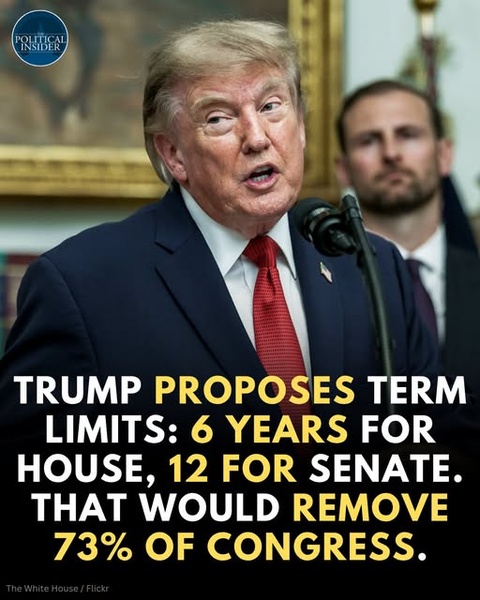
WASHINGTON — A proposal long associated with President Donald Trump to impose strict term limits on members of Congress is circulating again, with a viral graphic claiming that the plan would force 73% of Congress out of office.
The proposal itself is real — but the viral presentation makes it sound like Trump could simply impose the limits himself and immediately remove most lawmakers.
He cannot.
Trump has previously proposed a constitutional amendment limiting House members to three terms, or six years, and senators to two terms, or 12 years. He first made the proposal during his 2016 presidential campaign, describing it as part of his effort to “drain the swamp.”
The biggest obstacle is that congressional term limits would require a constitutional amendment, meaning the president cannot establish them through an executive order or ordinary federal legislation.
Trump’s Six-Year, 12-Year Formula
Trump's proposal is straightforward on paper.
Under the plan:
- House members would be limited to three two-year terms, or six years.
- Senators would be limited to two six-year terms, or 12 years.
- The restriction would apply to members of Congress rather than the presidency.
Trump explicitly called for a constitutional amendment when he introduced the idea in 2016.
The proposal has continued to appear in Republican term-limit campaigns and congressional resolutions. A 2023 House constitutional-amendment proposal, for example, also called for three House terms and two Senate terms. That measure was defeated in the House Judiciary Committee.
So the basic numbers shown in the viral graphic — six years for the House and 12 for the Senate — are grounded in Trump's longstanding proposal.
The claim that this automatically means 73% of Congress would disappear immediately, however, is much more complicated.
Would 73% of Congress Really Be Removed?
Not necessarily.
An analysis published by Quorum in March 2026 estimated that if Trump's proposed limits were applied to the current Congress under a strict interpretation, 368 House members — about 85% of the House — and 74 senators would be ineligible to continue serving.
That would amount to an extraordinary turnover.
But that calculation is not the same thing as saying 73% of Congress would automatically be removed from office.
The real impact would depend heavily on the final constitutional-amendment language, including whether previous congressional service counted toward the limit and whether the restrictions applied retroactively to sitting lawmakers.
Some proposed amendments have included provisions that would change how prior service is treated.
As a result, the 73% figure should not be presented as an established prediction of what would happen immediately.
Trump Cannot Impose Term Limits by Himself
This is perhaps the most important fact missing from the viral graphic.
The president has no unilateral power to impose congressional term limits.
Under Article V of the Constitution, an amendment can be proposed after approval by two-thirds of both the House and Senate, or through the alternative convention process involving two-thirds of state legislatures.
The amendment would then have to be ratified by three-fourths of the states — currently 38 states.
The Constitution also does not give the president a formal role in proposing constitutional amendments.
That makes congressional term limits dramatically more difficult to enact than a presidential executive order.
Why Congress Has Never Adopted Federal Term Limits
The idea of congressional term limits has enormous popular appeal, particularly among voters frustrated with politicians who remain in Washington for decades.
But support among voters has repeatedly failed to translate into the two-thirds congressional majority required for a constitutional amendment.
A 2023 proposal limiting House members to six years and senators to 12 years was rejected by the House Judiciary Committee, receiving 17 votes in favor and 19 against.
The issue therefore presents Congress with an unusual political dilemma: lawmakers would effectively be voting on rules that could eventually prevent themselves and their colleagues from remaining in office.
The Supreme Court Has Already Settled One Part of the Debate
There is another important constitutional barrier.
States cannot simply decide on their own to impose term limits on members of Congress.
In U.S. Term Limits, Inc. v. Thornton, the Supreme Court ruled in 1995 that states cannot add qualifications for congressional service beyond those contained in the Constitution.
The Court specifically rejected an Arkansas system that attempted to prevent congressional candidates from appearing on the ballot after serving a certain number of terms.
Congress.gov's Constitution Annotated explains that changing the qualifications for congressional membership therefore requires a constitutional amendment rather than individual state laws.
That leaves national constitutional amendment as the central legal pathway.
Supporters See Term Limits as an Anti-Corruption Measure
Supporters argue that term limits would fundamentally change Washington.
Their argument is that lawmakers who spend decades in Congress can become increasingly dependent on political networks, donors, lobbyists and institutional interests.
Limiting congressional careers, they say, could bring new representatives into Washington, reduce entrenched political power and make lawmakers more accountable to voters.
The idea has historically attracted support from both conservatives and some progressives, although the political arguments surrounding it have changed over time.
Trump has presented his version primarily as part of his broader campaign against what he calls the Washington establishment.
Critics Warn of Losing Congressional Experience
Opponents see the issue differently.
They argue that forcing experienced lawmakers out of office could weaken Congress by eliminating institutional knowledge and giving unelected staff, lobbyists and executive-branch officials more influence.
A rapidly rotating Congress could also make it harder for lawmakers to understand complicated areas such as national security, taxation, financial regulation and foreign policy.
There is another potential consequence: term limits could strengthen the executive branch.
If presidents and executive agencies retain experienced officials while Congress continuously replaces its members, critics argue that the legislative branch could become less capable of overseeing the administration.
That concern is particularly significant during periods of intense executive action and partisan conflict.
The Political Timing Is Significant
The renewed attention comes as Trump and congressional Republicans enter the final stretch before the November 2026 midterm elections.
Republicans currently hold narrow congressional majorities, while Trump is campaigning aggressively to keep the House and Senate under GOP control. Reuters reported that Trump has made congressional races a central focus of his midterm strategy despite weak approval ratings.
Trump and the Republican Party are also holding an unprecedented national midterm convention in Dallas this week, placing the president at the center of the party's congressional campaign.
That makes any renewed discussion of “draining the swamp” politically significant.
But a term-limit amendment would require cooperation far beyond the president's own political coalition.
What the Viral Graphic Gets Right — and Wrong
The image's central message contains a real Trump proposal, but it presents several important details too simplistically.
Confirmed
- Trump has proposed congressional term limits.
- His longstanding proposal calls for six years maximum in the House.
- It calls for 12 years maximum in the Senate.
- Trump has said the change would require a constitutional amendment.
Needs qualification
- The claim that 73% of Congress would be removed immediately is not an established fact.
- The percentage depends on how an eventual amendment treats previous service.
- Current analyses using different assumptions produce different estimates of potential turnover.
- Trump cannot impose congressional term limits by himself.
- Any successful proposal would have to survive the extremely difficult Article V amendment process.
A Potential Political Earthquake — If It Ever Becomes Law
If Congress and the states eventually approved a strict six-year House and 12-year Senate limit, the American political system could experience one of the largest turnovers in congressional history.
But that remains a constitutional proposal, not a new law.
The immediate question is therefore not whether 73% of Congress is about to disappear.
It is whether Trump — or anyone else — can persuade Congress and enough states to fundamentally rewrite the rules governing how long America's legislators can remain in power.
For now, the answer remains uncertain.
The term-limit proposal is real. The six-year and 12-year figures are real. But the claim that Trump has just proposed removing 73% of Congress is misleading without explaining the constitutional process and the assumptions behind that percentage.
Comments (0)
Loading comments...
May You Like

South Korea–Ukraine Rift Deepens Over North Korean POW Transfer as PURL Draws New Scrutiny

Barack Obama Draws Attention With New Literary Podcast

OBAMA STUNS ON INSTAGRAM: MESSAGE MARKING 34-YEAR MILESTONE SPARKS A BUZZ