
Trump’s Death Penalty Push Targets Illegal Immigrants Convicted of Capital Crimes and Those Who Kill Law Enforcement Officers
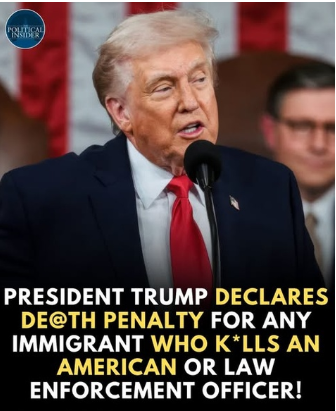
WASHINGTON — President Donald Trump has made the death penalty a central part of his administration’s tougher approach to violent crime and immigration, directing the Justice Department to pursue capital punishment in certain federal cases involving illegally present immigrants and the killing of law-enforcement officers.
The policy stems from an executive order Trump signed on January 20, 2025, titled “Restoring the Death Penalty and Protecting Public Safety.” The order instructs the attorney general to pursue the death penalty for federal capital crimes involving the murder of a law-enforcement officer and for capital crimes committed by an alien who is illegally present in the United States, where federal jurisdiction and applicable law allow it.
The wording in the viral graphic — which says Trump declared the death penalty for “any immigrant who kills an American or law enforcement officer” — is therefore broader than the actual legal language of the executive order. The order does not establish an automatic death sentence for every immigrant who kills an American.
Trump Orders DOJ to Seek Capital Punishment
Trump's 2025 executive order instructed the attorney general to pursue the death penalty for federal crimes of sufficient severity and specifically directed prosecutors to seek capital punishment, where legally permitted, in cases involving the murder of a law-enforcement officer or a capital crime committed by an illegally present immigrant.
The order also called on the Justice Department to encourage state attorneys general and prosecutors to bring state capital charges in qualifying cases.
The administration has presented the policy as part of a broader effort to strengthen public safety and deter what it describes as the most serious violent crimes.
Justice Department Moves to Strengthen Death Penalty Enforcement
The policy has continued into Trump's second year in office.
In April 2026, the Justice Department announced a series of measures designed to strengthen federal death-penalty enforcement. The department said it had restored procedures for carrying out lawful capital sentences and expanded the federal execution protocol to include methods such as the firing squad in addition to lethal injection.
Acting Attorney General Todd Blanche said the department intended to pursue the ultimate punishment against what the administration considers the most dangerous offenders, including those who kill law-enforcement officers.
The Justice Department's actions represent a significant shift from the more limited use of federal capital punishment during the Biden administration.
The Death Penalty Is Not Automatic
Despite the dramatic wording circulating online, Trump's order does not mean that every undocumented immigrant convicted of killing an American will automatically receive a death sentence.
Capital punishment is governed by federal and state law, and prosecutors must establish that a case qualifies for the death penalty. Depending on the circumstances, jurisdiction and applicable statutes, a case may be prosecuted federally or at the state level.
The executive order itself also states that its provisions must be implemented consistently with applicable law.
That distinction is important because the graphic's wording — “death penalty for any immigrant who kills an American or law enforcement officer” — can give the impression that the president has created a blanket automatic punishment.
Part of a Much Broader Immigration Crackdown
The death-penalty policy is one component of Trump's broader immigration agenda.
On his first day back in office in January 2025, Trump signed a series of executive orders aimed at increasing immigration enforcement, expanding removals and strengthening cooperation between federal, state and local authorities. Reuters reported at the time that the administration was pursuing a sweeping crackdown on illegal immigration and increased deportation efforts.
The administration has also instructed federal agencies to prioritize violent criminal offenders and strengthen immigration enforcement operations.
That broader campaign has continued throughout 2026, including a major expansion of immigration enforcement resources.
Immigration Enforcement Has Become Increasingly Controversial
Trump's aggressive immigration policies have also generated intense legal and political controversy.
In July 2026, federal immigration officers were involved in several deadly shootings. In Houston, ICE identified Lorenzo Salgado Araujo as an undocumented Mexican immigrant and said he attempted to ram an ICE vehicle and run over an officer. The case prompted an investigation by federal and other law-enforcement agencies.
A separate fatal shooting occurred in Biddeford, Maine, days later, when an ICE officer shot and killed a motorist during an immigration operation. The incident triggered further scrutiny of the administration's enforcement tactics.
These incidents have intensified the national debate over how far immigration officers should go in enforcing federal immigration laws and how the government should respond to violent confrontations.
What the Graphic Gets Right — and What It Leaves Out
The graphic is based on a real Trump policy, but its wording simplifies the legal situation.
What is accurate:
- Trump signed an executive order directing the Justice Department to pursue the death penalty in qualifying federal capital cases involving the murder of law-enforcement officers.
- The order also specifically targets capital crimes committed by immigrants who are illegally present in the United States.
- The Justice Department has taken additional steps in 2026 to strengthen federal death-penalty enforcement.
What needs clarification:
- The policy does not impose an automatic death sentence on every immigrant who kills an American.
- The death penalty applies only where the underlying crime qualifies as a capital offense and where the relevant legal and jurisdictional requirements are satisfied.
- The policy was established by an executive order in January 2025, rather than being a brand-new declaration made in response to a single 2026 incident.
Comments (0)
Loading comments...
May You Like
Jack Smith Defends His Integrity as Trump Investigations Face Renewed Political Firestorm

South Korea–Ukraine Rift Deepens Over North Korean POW Transfer as PURL Draws New Scrutiny














