Trump’s $5,000 “Dividend” Hits a Major Roadblock as Speaker Says Congress Must Approve It
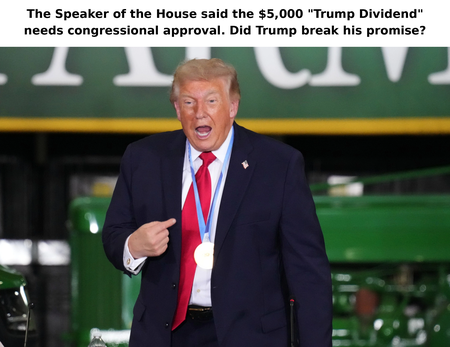
WASHINGTON — September 14, 2026 — President Donald Trump’s headline-grabbing proposal to give every American adult a $5,000 “Trump Dividend” has run into its first major political obstacle after House Speaker Mike Johnson said Congress would need to approve the payments.
The announcement has raised a new question surrounding Trump's promise: Can the president actually deliver the checks if Republicans retain control of Congress after the November midterm elections?
The answer is far from certain.
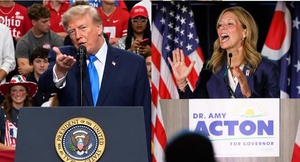
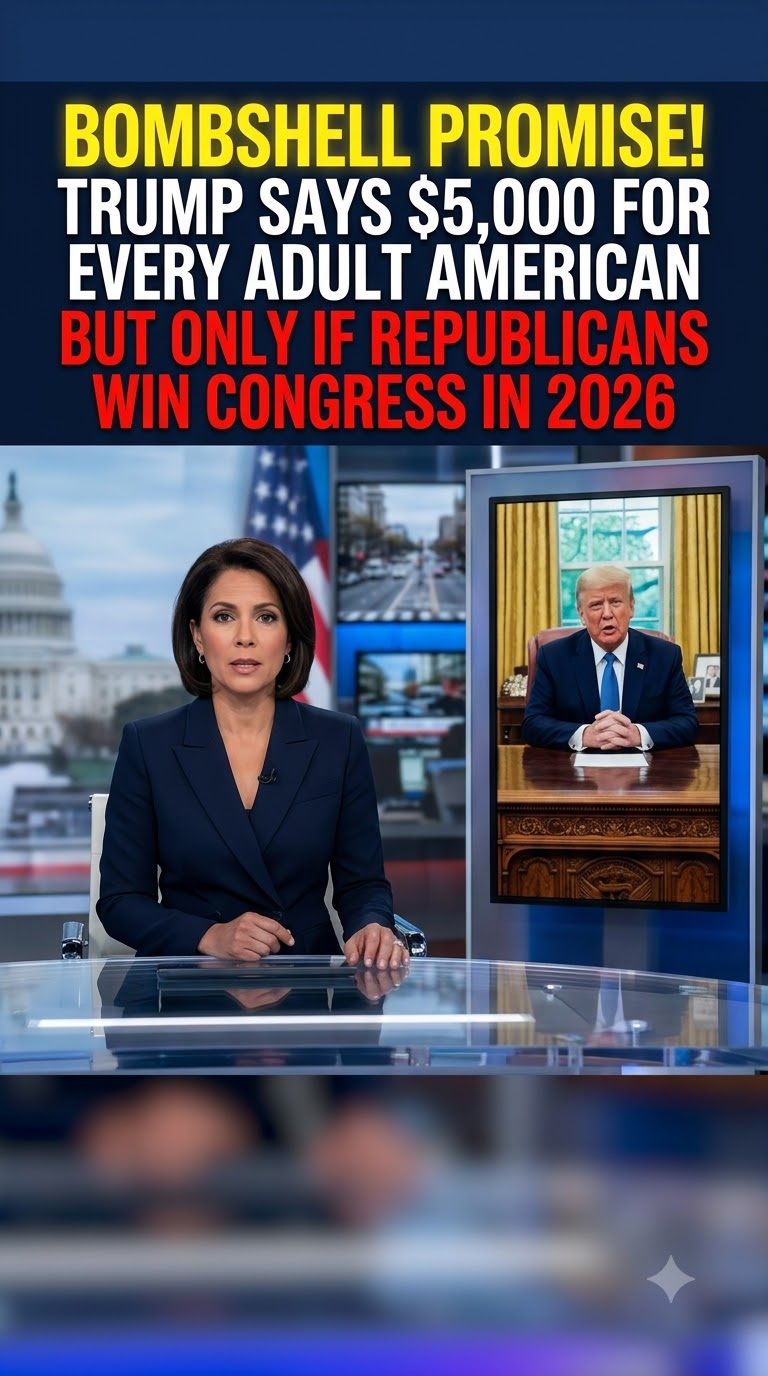
Trump unveiled the proposal at the Republican Party’s midterm convention in Dallas on September 9, promising a $5,000 payment to every adult U.S. citizen if Republicans maintain control of both the House and Senate. The White House subsequently promoted the proposal as a dividend made possible by the strength of the U.S. economy.
But there is an important problem: the federal government cannot simply spend more than $1 trillion without legal authorization.
Speaker Johnson delivers a reality check
House Speaker Mike Johnson addressed the issue Sunday, saying he assumes Congress would have to act before the payments could be made.
“I would assume, yes, he’d need Congress to act,” Johnson said when asked whether lawmakers would have to authorize Trump's proposed checks. He nevertheless expressed support for working toward the proposal, while acknowledging that the details still need to be worked out.
That statement directly complicates Trump's own description of the plan.
Just days earlier, Trump told CBS News Texas that he did not think congressional approval would be necessary, although he added that Congress would approve the payments if needed. He did not explain what legal mechanism could allow the administration to distribute more than $1 trillion without congressional authorization.
The disagreement matters because Congress controls federal spending.
How much would the “Trump Dividend” cost?
The proposed payment could become one of the largest direct-cash programs in American history.
An estimated $1.3 trillion to $1.35 trillion could be required if every eligible adult received $5,000. The exact cost would depend on eligibility rules, including whether higher-income Americans are excluded. Vice President JD Vance has indicated that wealthy Americans would not necessarily qualify.
That price tag is enormous even compared with the federal government's current fiscal position.
Critics argue that distributing such a large amount of money could increase the deficit and potentially add to inflationary pressure. Supporters, however, argue that the payments could be financed through increased government revenue, particularly revenue generated by Trump's tariffs.
The White House has presented the proposal as a reward for Americans benefiting from Trump's economic policies.
Trump says Americans would “win” with Republicans
Trump's announcement was explicitly tied to the midterm elections.
At the Republican convention, he said that if Republicans win both chambers of Congress, he would issue the $5,000 dividend to every adult citizen. In effect, the proposal makes Republican control of Congress a condition for receiving the payment.
Trump has rejected the characterization that the payment is simply an election incentive.
When questioned about the proposal, he argued that the money would be a reward for Americans who had endured what he described as years of poor economic policies under President Joe Biden.
The political implications, however, are obvious.
The promise arrives just weeks before Americans vote in the 2026 midterm elections, making the proposal one of the most striking economic pledges of the campaign.
Does this mean Trump has broken his promise?
Not yet.
Trump has made a conditional promise, rather than announced an existing payment program with a fixed distribution date.
His stated condition is that Republicans must maintain control of the House and Senate. Congress would then presumably need to pass legislation authorizing the money.
That means the current dispute is less about Trump already breaking the promise and more about whether the promise is legally and financially achievable.
ABC News noted that the proposal faces significant political and financial hurdles and that there is currently no indication Congress would necessarily approve it.
The situation is therefore substantially different from a government program that has already been funded and scheduled for distribution.
The funding question remains unanswered
Trump has pointed to the government's growing revenue and tariff collections as part of the justification for the proposal.
But analysts have questioned whether tariff revenue alone could cover the enormous cost.
The estimated $1.3 trillion price tag is several times larger than the tariff revenue available in some estimates, meaning the government could need to find additional funding or borrow the money.
That creates another political problem.
Republicans have traditionally emphasized reducing government spending and controlling the national debt. Critics argue that borrowing more than $1 trillion to finance direct payments could contradict those fiscal priorities.
The United States already carries roughly $40 trillion in national debt, making the financing of a new trillion-dollar program especially contentious.
Inflation could become another obstacle
There is also an economic question beyond whether Congress approves the checks.
If hundreds of millions of adults suddenly receive thousands of dollars, consumer spending could increase sharply.
Economists have warned that injecting such a large amount of purchasing power into the economy could push prices higher if businesses cannot increase supply quickly enough. The proposal could therefore undermine some of the economic gains Trump says his administration has achieved.
That creates a difficult balancing act.
Trump would need to demonstrate that the dividend provides meaningful financial relief without simultaneously worsening inflation, government borrowing and interest-rate pressures.
A familiar pattern?
The proposal is also attracting attention because Trump has floated other large-scale cash-payment ideas that never became reality.
In 2025, he promoted the idea of $2,000 tariff-rebate checks, while a separate proposal involving so-called “DOGE dividends” envisioned payments of up to $5,000.
Neither program ultimately produced checks for Americans.
That history is now being cited by critics questioning whether the latest promise will fare differently.
Trump supporters, meanwhile, argue that this proposal is different because it is being presented alongside a Republican congressional strategy and could be legislated if the party retains control of Capitol Hill.
The November election could determine what happens next
The most important factor may ultimately be political rather than economic.
If Republicans retain both chambers, Johnson has already indicated that he is willing to consider legislation implementing Trump's plan.
But that does not guarantee passage.
Republican lawmakers would still have to agree on eligibility, funding, the size of the payments and the legal mechanism for distributing the money. Democrats would almost certainly oppose the proposal, while some Republicans could also object because of its potential impact on the deficit and national debt.
If Democrats gain control of either chamber, the proposal would face a much steeper uphill battle.
The bottom line
The $5,000 Trump Dividend is not dead — but it is far from guaranteed.
Trump has promised the payment if Republicans maintain control of Congress, while Speaker Mike Johnson has now acknowledged that congressional action would be necessary. That means the president cannot simply order the Treasury to distribute the money on his own.
The estimated $1.3 trillion-plus cost, questions about funding, inflation risks and the upcoming midterm elections all make the proposal one of the most consequential economic promises of the 2026 campaign.
So, did Trump break his promise? Not yet. But the promise has encountered a major reality check: before Americans can receive a $5,000 dividend, Congress will likely have to say yes.
Comments (0)
Loading comments...
May You Like

Russian Drone Strikes Kyiv Bridge as German Chancellor Arrives in Ukraine
Shocking news from Ohio: an unexpected development ahead of Trump's rally