Trump’s “Final Warning” to Canada: Deal or Tariffs? What the Latest Trade Fight Actually Means
Verdict: MISLEADING — THE TRADE THREAT IS REAL, BUT “FINAL WARNING” AND “DEAL OR TARIFFS” OVERSIMPLIFY A MUCH LARGER TRADE CONFRONTATION
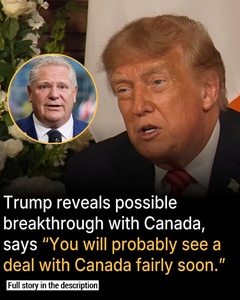
A dramatic viral graphic claims that Donald Trump has issued a “final warning” to Canada, suggesting Ottawa now faces a simple choice: make a deal or face punishing tariffs.
There is a real and rapidly escalating U.S.-Canada trade dispute behind the graphic. But the wording makes the situation sound like a brand-new ultimatum when the Trump administration has already imposed 50% tariffs on a range of Canadian goods, Canada has retaliated, and Washington has moved toward outright import bans on selected Canadian products.
The latest developments are even broader: Trump has now threatened additional economic measures in response to Canada's effort to deepen ties with the European Union.
Trump really has threatened to cut off trade with Canada
The most important part of the viral claim has a factual basis.
On September 4, Trump told reporters that the United States could simply stop trading with Canada and Mexico, arguing that doing so could save the United States tens of billions of dollars. He said that if the U.S. did not trade with Canada, it could save roughly $60 billion to $90 billion a year.
That was not, however, a formal announcement that the United States was immediately ending all trade with Canada.
It was a threat and negotiating position, rather than an enacted blanket trade embargo.
That distinction matters.
The trade war has already escalated far beyond ordinary tariff negotiations
The situation has moved considerably since the original tariff disputes.
In August, the Trump administration imposed 50% tariffs on about $27.6 billion worth of Canadian goods under Section 338. Canada responded with matching tariffs on U.S. products.
Canada's Finance Department said the retaliatory measures cover products including steel, dairy, appliances, agricultural equipment, pulp and paper, plastics and electronics.
The result is no longer merely a disagreement over the terms of a future trade agreement.
It is an active tariff confrontation.
Reuters reported that the dispute is already affecting businesses and political calculations in northern U.S. states, particularly because of the deeply integrated economies along the Canadian border.
Washington has gone beyond tariffs
One of the biggest developments missing from the viral graphic is that the Trump administration has already begun moving from tariffs toward specific import bans.
On September 8, Trump issued proclamations excluding certain Canadian products from entering the United States beginning September 29.
Those measures cover selected products involving:
- automobiles and auto-related goods;
- alcoholic beverages;
- dairy products.
The White House says the restrictions respond to what it describes as discriminatory Canadian trade practices.
The White House also issued a September 16 memorandum directing federal agencies to identify Canadian-origin products that could be removed or made unavailable for purchase through parts of the U.S. government's procurement system.
So the graphic's implication that tariffs are merely a future possibility is already outdated.
Canada has not simply backed down
Prime Minister Mark Carney's government has taken its own countermeasures.
Beginning September 8, Canada imposed new tariffs ranging from 15% to 50% on approximately C$27.6 billion worth of U.S. imports, matching U.S. Section 338 tariffs dollar-for-dollar in targeted sectors.
Carney has also been emphasizing a strategy of reducing Canada's dependence on the American market.
In a September 8 national address, he acknowledged that diversifying away from the United States would carry economic costs but argued that Canada needed to become more resilient so that no country could hold it economically hostage.
At the same time, Carney has said Canada remains willing to negotiate a fair trade agreement with Washington. On September 10, he said he had spoken with Trump in recent days and that Canada remained ready for a mutually beneficial deal.
That makes the viral graphic's “deal or tariffs” framing particularly incomplete: negotiations and retaliation are occurring simultaneously.
Where Ontario Premier Doug Ford fits in
The graphic also prominently features a Canadian political figure associated with the dispute.
Ontario Premier Doug Ford has become one of Trump's most vocal Canadian critics during the trade confrontation.
Ford has argued that the tariffs threaten both Canadian and American workers because the two economies are deeply integrated, particularly in automobiles.
In August, Ford said Canada was prepared to consider measures including electricity and critical-mineral restrictions if the conflict worsened.
He also told CBS that he hoped the United States and Canada could eventually reach an agreement, while saying that “no deal is better than a bad deal.”
By September, however, Ford's rhetoric had become substantially more confrontational. He said he hoped Republicans would lose control of Congress in the U.S. midterms and urged Americans to hold Trump accountable for the trade dispute.
Those comments were political criticism, not evidence that Canada had received a new formal “final warning.”
Then came Trump's latest Canada-EU threat
The situation became even more complicated this week.
On September 16, European Commission President Ursula von der Leyen proposed giving Canada a new associate-member relationship with the European Union.
The proposal is part of Canada's broader effort to strengthen economic and strategic relationships outside the United States.
Trump responded by warning that if European leaders pursued the relationship with what he considered hostile intentions, the United States could impose “very heavy tariffs” on Europe or stop trading with Europe in certain areas.
Trump also called Canada a “terrible trade partner” and described the prospect of closer Canada-EU integration as “laughable.”
That is significant because it shows how the dispute has expanded beyond a bilateral tariff fight.
Canada is increasingly looking toward Europe, while Washington is warning that deeper Canadian-European integration could itself provoke a U.S. response.


Is Canada actually facing a “final warning”?
Not in the formal sense suggested by the graphic.
There has been no verified presidential proclamation saying, in effect, Canada has one last chance to sign a deal or the United States will immediately terminate all trade.
Instead, there have been multiple escalating threats and actions:
- U.S. tariffs on Canadian products.
- Canadian retaliatory tariffs.
- U.S. restrictions and planned import bans on selected Canadian products.
- Restrictions targeting Canadian access to some U.S. government procurement.
- Continued disputes over automobiles, dairy and other sectors.
- Trump's broader threat that the U.S. could stop trading with deficit countries.
- Trump's latest threat concerning Canada's possible closer relationship with the EU.
The underlying confrontation is therefore real, but “final warning” is headline language rather than the name of an official U.S. policy.
What the viral graphic gets right — and wrong
What is supported
- Trump has threatened major additional trade restrictions against Canada.
- The United States has imposed 50% tariffs on selected Canadian goods.
- Canada has retaliated with tariffs of up to 50%.
- Washington has moved toward import bans affecting selected Canadian products.
- Canada is seeking greater economic diversification, including stronger ties with Europe.
- Doug Ford has publicly criticized Trump's trade policy and advocated a tough Canadian response.
What's misleading
- “Final warning” — there is no formal policy carrying that title.
- “Deal or tariffs” — tariffs have already been imposed; this is not simply a future choice.
- The graphic makes it appear that Trump just issued a single new ultimatum to Canada, when the confrontation has developed over months.
- It understates Canada's own retaliatory measures and diversification strategy.
- It suggests that a trade agreement is necessarily imminent; as of September 18, negotiations remain unsettled.
The bigger picture
The U.S.-Canada relationship is now dealing with something substantially larger than a disagreement over individual tariff rates.
For decades, the two countries built highly integrated supply chains in automobiles, energy, agriculture and manufacturing. AP notes that this integration makes prolonged trade restrictions potentially costly to businesses and workers on both sides of the border.
The current dispute is consequently producing two parallel strategies.
Washington is using tariffs, import restrictions and procurement policy to pressure Canada to change its trade practices.
Ottawa is retaliating while simultaneously trying to reduce Canada's dependence on the U.S. market.
And Canada's proposed closer relationship with Europe has now become part of the dispute itself.
That is why the latest headline should not be reduced to “Trump's final warning.” The more accurate description is an escalating U.S.-Canada trade confrontation in which both governments are using tariffs and market access as negotiating leverage while Canada seeks alternative international partnerships.
Bottom line
The viral graphic is based on a real and increasingly serious trade dispute, but its “final warning” framing is exaggerated.
Trump has genuinely threatened to restrict or even halt some trade, and his administration has already imposed 50% tariffs and moved toward targeted import bans. Canada has retaliated rather than simply accepting Washington's terms.
But there is no verified blanket ultimatum saying Canada must immediately choose between a deal and total trade cutoff.
As of September 18, 2026, the more consequential development is that the dispute is expanding: Washington is tightening restrictions on Canadian goods while Ottawa is retaliating and deepening its economic relationship with Europe.
Verdict: MISLEADING — REAL TRADE ESCALATION, BUT THE “FINAL WARNING” AND “DEAL OR TARIFFS” LANGUAGE OVERSIMPLIFIES WHAT IS ACTUALLY HAPPENING.
Comments (0)
Loading comments...
May You Like
Shocking news from Ohio: an unexpected development ahead of Trump's rally

Jack Smith Defends His Integrity as Trump Investigations Face Renewed Political Firestorm