
Trump’s Halloween Rally in Salina Was Canceled. What We Know—and What We Don’t
Trump’s Halloween Rally in Salina Was Canceled. What We Know—and What We Don’t
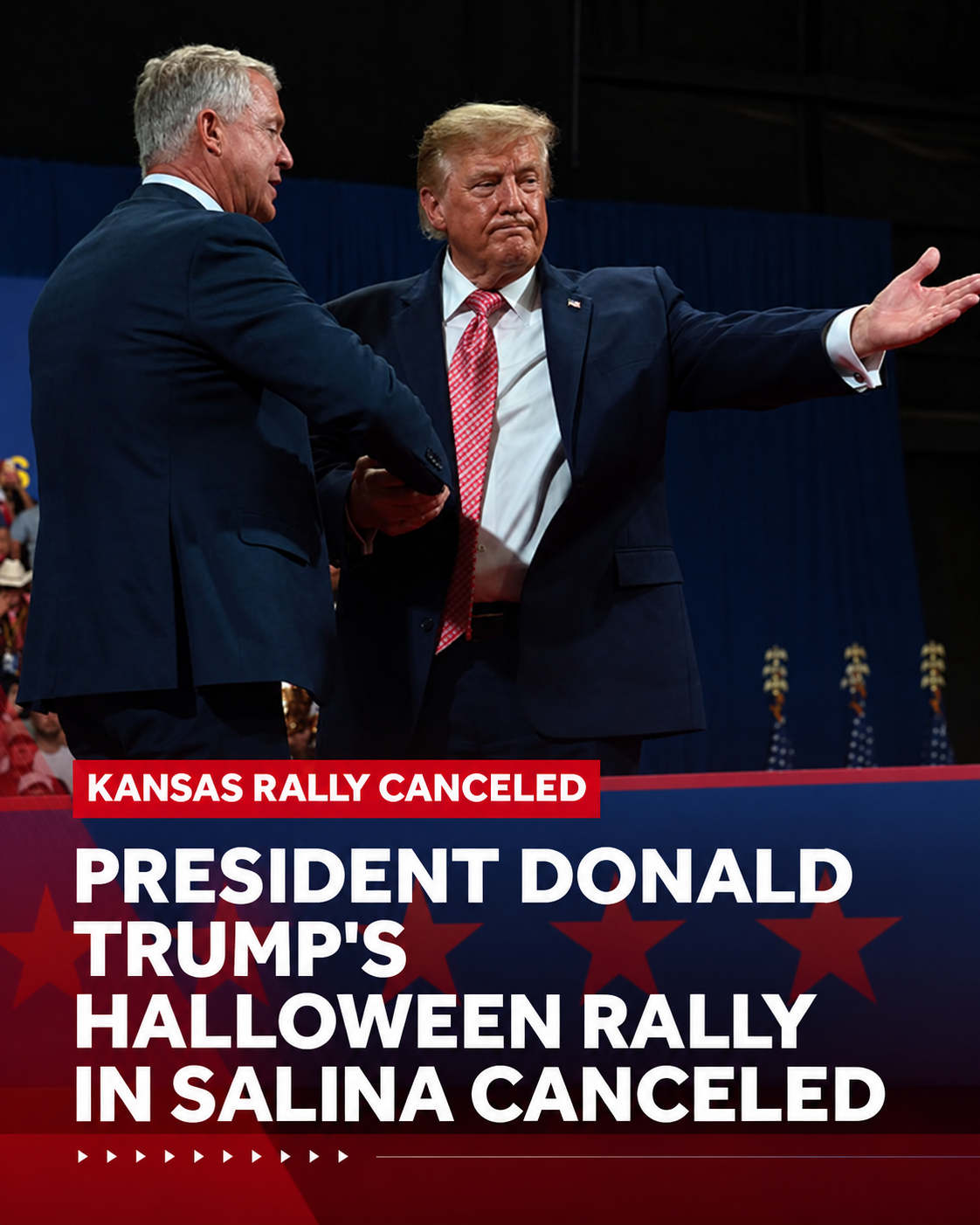


The political graphic announcing that Donald Trump’s Halloween rally in Salina, Kansas, has been canceled is based on a real development. Local news organizations reported on October 29 that the planned October 31 event at Salina Regional Airport was called off. The cancellation is confirmed, but the graphic does not establish why it happened or what it means for the wider political contest.
The event was planned as a campaign appearance supporting Republican U.S. Senator Roger Marshall, who is facing Democratic challenger Adam Hamilton in a closely watched race. The rally was scheduled for Hangar 509 at Salina Regional Airport, with doors expected to open in the morning and Trump’s remarks planned for around noon.
The Salina Airport Authority confirmed the visit was canceled, and Kansas media outlets reported confirmation from Republican Party officials. Some reports cited scheduling conflicts or changes in the president’s schedule. At the time of publication, officials had not provided a detailed public account that resolved every question about the decision.
That distinction matters. A canceled event is a verifiable fact; an explanation for the cancellation may remain incomplete. Without a fuller statement or documentary evidence, it would be premature to claim the rally was canceled because of poor turnout, security concerns, internal campaign trouble, or a particular political calculation.
The timing made the event politically significant. The rally was planned in the final stretch before the November 3, 2026, midterm elections, when both parties were trying to mobilize voters and draw attention to competitive races. A presidential appearance can generate news coverage, help a candidate reach supporters, and signal that national party leaders consider a contest important.
Kansas is often described as a reliably Republican state, but that does not mean every race is uncompetitive. Marshall’s contest with Hamilton had attracted national attention, and both parties were investing in efforts to persuade voters. Turnout, candidate quality, and national political conditions can make a race competitive even in a state with a long-term partisan lean.
Trump had already visited the Kansas area earlier in October to support Marshall. Vice President JD Vance had also appeared in the state during the campaign period. Those visits suggest Republican leaders considered the Senate contest important enough to warrant national attention, regardless of whether a particular rally ultimately went ahead.
The cancellation may affect campaign logistics, but it does not by itself tell us how voters will respond. Campaigns also use advertising, phone calls, canvassing, local events, fundraising, and remote appearances. Organizers may try to replace an in-person event with a tele-rally or another format, but any replacement plan should be confirmed rather than assumed.
An in-person rally offers a candidate a large stage and a visible show of enthusiasm. It also requires transportation, crowd management, venue preparation, staff time, and security. A remote event can reach supporters in multiple places with less travel, but may not create the same local spectacle or interaction with attendees.
The graphic’s headline uses the cancellation as its news hook, while the image of Trump gesturing onstage supplies a familiar campaign atmosphere. However, a photograph does not necessarily depict the event being discussed. Unless a reliable caption establishes date and location, the image should be treated as illustrative rather than proof of what happened in Salina.
That is a recurring challenge with viral political graphics. They often combine a current headline with an older photograph, a bold banner, and a simplified interpretation. The result can be visually persuasive even when context is missing. Readers should check the date, venue, source, and wording of underlying reports before drawing conclusions from the design alone.
The strongest local reports agreed on the central point: the Salina rally was canceled. Broadcasters cited the airport authority and Kansas Republican officials, while regional public radio also reported that airport officials had received word that the president’s Saturday activities were off. Agreement among independent local sources strengthens confidence in the basic fact.
Reports differed in how much detail they could provide about the reason. Some cited scheduling conflicts; others said the president’s schedule would not allow the trip to proceed. These explanations are broadly compatible, but they do not fully explain how the decision was made or whether alternatives were considered. The responsible conclusion is that the public explanation remained limited.
The cancellation should not be mistaken for evidence that Trump abandoned campaigning altogether. News coverage described other campaign appearances and a broader effort to support Republican candidates before the midterms. A canceled stop can reflect competing demands on a candidate’s time and does not automatically signal a retreat from the state or the race being supported.
For Marshall’s campaign, the practical question is whether the absence of a presidential rally changes voter engagement in the final days. Trump’s presence could have attracted supporters and media attention, but the effect of a single event is difficult to isolate. Turnout, local organization, candidate favorability, economic concerns, and the broader political climate are also likely to matter.
For voters, the immediate takeaway is simple: anyone planning to attend should rely on updated notices from the campaign, the airport, or local authorities rather than an older event listing. Event pages can remain online after a cancellation, and search results may still show the original schedule. An old listing is not proof that an event remains scheduled.
The episode illustrates the difference between campaign optics and electoral evidence. A packed rally can demonstrate enthusiasm among attendees, but it cannot by itself predict an election. Likewise, a canceled rally may attract attention without demonstrating that a candidate has lost support. Election outcomes are determined by votes, not by the visual drama of campaign events.
It is also worth resisting partisan explanations that outrun the evidence. Supporters may describe the change as a sensible scheduling decision, while opponents may portray it as a sign of weakness. Either interpretation may serve a political purpose, but neither should be treated as established fact without supporting information from credible sources.
The most defensible account is therefore narrow but meaningful: Trump’s planned Halloween visit to Salina was canceled, local officials and Republican representatives confirmed the change, and reports pointed to scheduling issues while leaving some details unresolved. The event was intended to support Marshall ahead of a competitive Senate race, but its electoral consequences are not yet known.
In a fast-moving campaign, facts and interpretations can quickly blur together. This case is a reminder to distinguish what has been confirmed from what remains uncertain. The cancellation is news; the motive and political impact require more evidence. Until officials provide further detail or the election offers a clearer measure of voter response, claims that the episode proves a larger political collapse should be treated as commentary rather than fact.
Comments (0)
Loading comments...
May You Like

WWE BRONSON REED—INSPIRED—SUDDEN COLLAPSE, MYSTERIOUS STIMULANTS, DEAD AT 38!


1,000+ MILITARY FAMILY RECORDS BREACHED, 200+ MILITARY SITES AT RISK!









Popular Posts




