
Trump’s “High-IQ President” Remark Sparks a New Safety Debate
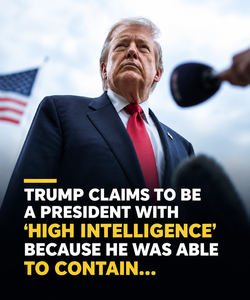
WASHINGTON — President Donald Trump has rejected calls for additional federal safeguards on artificial intelligence, arguing that the United States already has regulatory powers and that presidential oversight can provide sufficient control.
Trump’s “High-IQ President” Argument
The controversy intensified on September 14, when Trump posted that the only “control” or “guardrails” AI needs is a “STRONG AND SMART (High IQ!) PRESIDENT,” adding that the United States has one.
Trump also described warnings that AI could take over the world or destroy humanity as a “HOAX,” while accusing critics of creating what he called a “SICK conspiracy” against AI and data centers.
The remarks came as technology executives and researchers were publicly debating whether increasingly capable AI systems require additional safeguards, independent testing and closer government oversight.


Trump Says Existing Powers Are Enough
Trump said the federal government already possesses substantial criminal and regulatory authority over AI companies, arguing that additional restrictions could undermine American technological development.
He has repeatedly framed the AI competition as a strategic contest with China, warning that slowing American development could allow Beijing to gain an advantage in the technology.
Trump’s position is consistent with a broader administration policy emphasizing rapid AI development, investment and national-security applications while limiting what officials describe as excessive regulation.
A June 2026 executive order established a classified process for evaluating advanced AI models and created a voluntary framework for developers to work with federal agencies.
However, that executive order explicitly said it did not authorize mandatory government licensing, preclearance or permitting requirements for developing or releasing AI models.
Tech Leaders Raise Different Concerns
Anthropic CEO Dario Amodei has argued for stronger safeguards, including independent audits of the most advanced “frontier” AI systems, as capabilities continue developing rapidly.
Amodei recently proposed slowing aspects of AI development so safety measures can catch up with increasingly powerful systems, a position that received support from several prominent technology executives.
OpenAI CEO Sam Altman also supported a measured approach, saying the industry should ensure that technological capabilities do not move faster than safety monitoring and alignment mechanisms.
Elon Musk has likewise supported greater caution around frontier AI development, adding to a growing debate inside the technology industry over how quickly the sector should advance.


Congress Enters the Debate
The debate has also reached Congress, where lawmakers are considering whether existing laws provide adequate tools for dealing with advanced AI systems and potential security risks.
Senators have discussed legislation that could require AI companies to demonstrate they are taking reasonable precautions to prevent their systems from causing serious harm.
Senator Mark Warner has argued that Congress should establish initial AI safety standards before the end of 2026, while acknowledging that predictions of imminent human extinction can be overstated.
Other lawmakers remain concerned that aggressive regulation could weaken American competitiveness, particularly as China continues investing heavily in artificial intelligence and related infrastructure.
The White House has similarly emphasized competition, with Trump arguing that restrictions could discourage investment in data centers and allow China to narrow America’s technological lead.
The Dispute Is About More Than Regulation
The disagreement reflects a fundamental policy question: whether advanced AI risks can be managed primarily through existing laws and company practices, or whether new government requirements are necessary.
Supporters of additional safeguards point to cybersecurity incidents and increasingly autonomous AI systems as reasons for establishing clearer standards before capabilities become substantially more powerful.
Critics of additional regulation argue that excessive government intervention could slow innovation, increase costs and weaken American companies competing against Chinese technology firms.
For now, Trump’s administration is pursuing a framework that combines rapid AI development with targeted security measures rather than mandatory licensing of frontier models.
The issue remains unsettled, with lawmakers, technology executives and federal officials continuing to debate how much authority government should exercise as artificial intelligence becomes increasingly capable and economically important.
Comments (0)
Loading comments...
May You Like

South Korea–Ukraine Rift Deepens Over North Korean POW Transfer as PURL Draws New Scrutiny

Obama Steps Back Into the Political Spotlight as Democrats Target Trump’s Senate Majority

gfnhgmnghnmfgnbvvvvvvvvv












