
TRUMP'S IRAN BLOCKADE
Trump's Iran Promise Before the Midterms Raises a Bigger Question: What Happens After the Vote?
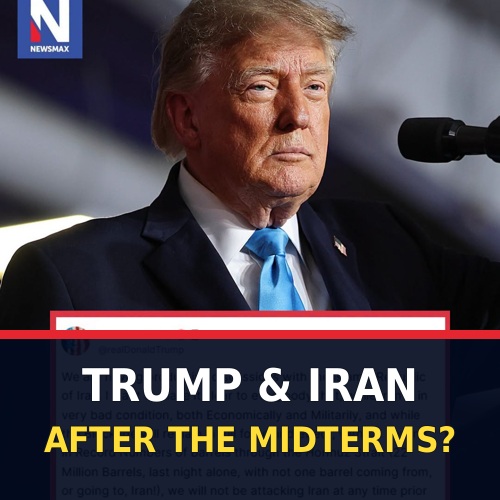
President Donald Trump's announcement that the United States would not launch new attacks on Iran before the November 3 midterm elections placed an unusually explicit political deadline on one of Washington's most consequential foreign-policy decisions.
In an October 8 statement, Trump said American and Iranian representatives were engaged in productive discussions. Yet he also emphasized that the U.S. blockade remained in force and reiterated his refusal to allow Iran to acquire a nuclear weapon.
That combination of diplomatic language and military pressure reflected the central contradiction facing the administration: Washington wanted to keep negotiations open while retaining substantial leverage over Tehran.
The timing mattered. Voters were preparing to decide control of Congress, with war, inflation, fuel costs and broader economic uncertainty featuring prominently in the campaign. Trump's pledge made the relationship between domestic politics and the Iran conflict impossible to ignore.
The statement followed months of fighting that began with U.S. and Israeli strikes in February 2026. Iran retaliated, and the confrontation disrupted shipping and energy markets across a region crucial to the global economy.
One of the most consequential flashpoints was the Strait of Hormuz, the narrow waterway connecting the Persian Gulf to international markets. Interruptions to traffic there can affect energy prices far from the Middle East.
Trump claimed that 22 million barrels of oil had moved through the strait in a single night, with none originating in or destined for Iran. That was his assertion, not an independently verified traffic count presented in the statement.
For companies moving crude oil, the stakes are immediate. Shipping interruptions raise insurance and transportation costs, while uncertainty about future access influences prices even when vessels continue to pass through.
American households experience the consequences differently. Higher fuel prices affect commuting, deliveries and household budgets, creating a link between foreign-policy decisions and everyday economic frustrations.
Those pressures were also politically significant. Polling in October showed substantial public dissatisfaction with the administration's handling of the Iran war, including concerns among some Republican voters.
The promise of no new attacks before Election Day did not amount to a peace agreement. Trump continued to describe Iran in severe economic and military terms and made clear that the blockade would remain in effect.
Tehran, meanwhile, has consistently disputed Western characterizations of its nuclear program and has rejected demands it views as infringements on sovereignty. Negotiations have been complicated by competing security guarantees and questions about uranium enrichment.
The president's statement offered no detailed roadmap for settling those disputes. It established a temporary limit on new U.S. strikes, but did not define what military options Washington might consider after November 3.
That uncertainty created a difficult problem for diplomats. A time-limited pledge can give negotiators breathing room, but it can also encourage each side to delay difficult concessions while waiting to see whether the political environment changes.
Military planners faced a different calculation. U.S. forces still needed to protect personnel, ships and regional partners, even as the administration publicly ruled out new attacks for a specified period.
The distinction between a commitment not to initiate fresh strikes and a broader ceasefire is important. Defensive operations, force protection and enforcement of existing policies are separate questions from launching a new offensive campaign.
The administration's critics questioned whether the election calendar was shaping its military posture. Supporters argued that maintaining pressure while pursuing talks was a pragmatic way to avoid unnecessary escalation.
Neither interpretation alone resolves the larger issue. The credibility of American policy depends on the content of negotiations, the behavior of forces in the region and the ability of both governments to make verifiable commitments.
After the midterm vote, the central questions remain whether Washington and Tehran can turn talks into enforceable arrangements, whether maritime traffic can stabilize and whether both sides can avoid another major escalation.
Trump's October declaration is therefore best understood as a politically timed promise, not proof that the crisis has ended or that another attack has already been ordered. Its significance lies in what the statement temporarily ruled out—and what it left unresolved.
Comments (0)
Loading comments...
May You Like

CAIRO INFERNO — CAR CARRYING SENIOR U.S. OFFICIAL SLAMS INTO FUEL TANKER, 31 DEAD, 21 INJURED!

BANGCHAK REFINERY IN THAILAND SHUT DOWN, U.S. OIL PRICES JUMP 10%!

TOLEDO I-75 TRUCK CRASH — POTENTIAL BRIDGE COLLAPSE AND MILLIONS IN DAMAGE!

Latest Posts








Popular Posts



