
Trump’s “Lake America” Move Pushes Canada Closer to Europe — But How Far Can Ottawa Pivot?
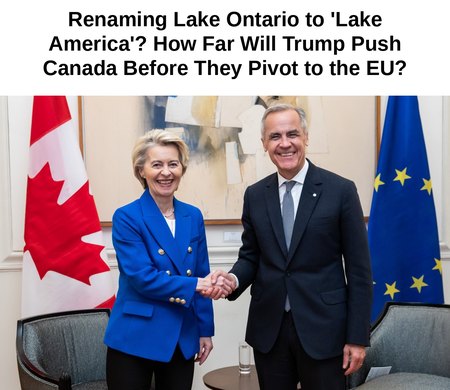
President Donald Trump’s decision to rename Lake Ontario “Lake America” for U.S. federal purposes has become another symbol of the rapidly deteriorating relationship between Washington and Ottawa.
But the dispute over a Great Lakes name is now unfolding alongside something potentially more consequential: Canada is actively deepening its economic, security and political relationship with the European Union.
Canadian Prime Minister Mark Carney is in Europe this week seeking closer ties with Brussels, while European Commission President Ursula von der Leyen has proposed making Canada the European Union’s first “associate member.” The proposal would expand cooperation in areas including defense, energy, technology and critical minerals without making Canada a full EU member.
The timing is difficult to ignore. Canada’s trade relationship with the United States has been strained by tariffs, failed negotiations and increasingly sharp political rhetoric.
Yet Ottawa’s European strategy is not simply about replacing America with Europe. Canada remains deeply integrated with the U.S. economy, and Carney has continued to leave the door open to future negotiations with Washington.


Trump’s Lake Ontario Order Became a New Flashpoint
Trump signed an executive order on August 27 directing U.S. federal agencies to use “Lake America” instead of Lake Ontario in federal maps, documents and databases.
The order does not have the power to force Canada to adopt the new name. Canadian officials immediately rejected the change, with Carney saying the lake would remain Lake Ontario in Canadian usage.
Carney pointed out that the name has more than 400 years of history and predates both Canadian Confederation and the Declaration of Independence.
The dispute quickly moved beyond political statements.
Google Maps began displaying “Lake America” for users in the United States, while Canadian users continued to see Lake Ontario. Google said its maps use official government sources, explaining the different naming conventions.
Ontario officials have also continued to use the historic name.
So, despite the dramatic headline, Trump has not literally changed the name of the lake for the entire world. He has changed how the U.S. federal government refers to it.
The Bigger Change Is Happening in Canada’s Foreign Policy
While the lake dispute dominated headlines, Ottawa was simultaneously pursuing a much broader strategy.
On August 22, Carney said Canada needed to diversify its trading relationships because the traditional stability of the U.S.-Canada economic relationship had changed.
He said Canada had already signed more than 20 trade and security agreements across five continents and intended to expand access to markets beyond the United States. He specifically identified the European Union as a priority for a deeper economic and security partnership.
That strategy is now moving from rhetoric toward concrete negotiations.
Carney traveled to Strasbourg on September 15-17 to address the European Parliament, attend von der Leyen’s State of the Union address and meet European lawmakers about trade, investment and security cooperation.
The timing gives the European relationship a new prominence just weeks after Washington and Ottawa failed to reach a new trade agreement.
Von der Leyen Offers Canada an Unusual New Relationship
The most significant development came from Brussels.
During her September 16 State of the Union address, von der Leyen proposed that Canada become the EU’s first associate member.
The concept is not the same as full EU membership.
Instead, it would create a new framework for closer cooperation in areas such as:
- Defense
- Energy
- Technology
- Artificial intelligence
- Critical minerals
- Security
- Trade
- Strategic supply chains
The proposal reflects the growing overlap between Canadian and European interests, particularly as both sides seek greater economic and security resilience.
Carney has welcomed closer European cooperation and has described Canada and Europe as partners with shared interests.
But the proposal is still at an early stage.
There is no established EU treaty category for exactly the kind of “associate membership” being discussed, meaning the legal and institutional details would have to be worked out.
Canada Is Already Moving Closer to the EU on Defense
The relationship is not starting from zero.
Canada officially joined the EU's Security Action for Europe (SAFE) initiative in February 2026, becoming the first non-European country to participate.
The program is part of the EU’s broader effort to expand defense production and readiness.
Canada’s government says participation allows Canadian defense companies to compete for European contracts and strengthens cooperation between Canadian and European industries.
The two sides also signed a Security and Defence Partnership in 2025.
At a June meeting, Carney, von der Leyen and European Council President António Costa discussed cooperation involving critical minerals, energy, secure supply chains and digital technology.
That means the current push is an expansion of an existing relationship rather than a sudden diplomatic pivot created entirely by Trump's policies.
Trade With Europe Still Has a Major Complication
There is, however, a significant obstacle.
Canada and the EU already have a trade agreement known as the Comprehensive Economic and Trade Agreement, or CETA.
The agreement has been provisionally applied since 2017, but it has not yet been fully ratified by every EU member state.
Recent reporting says only 17 of the EU's 27 member states have completed ratification. Concerns include agricultural market access and domestic regulatory issues.
That creates an unusual situation.
Canada is now asking Europe for deeper economic integration while an existing trade agreement has still not completed the full ratification process.
Carney is therefore pushing European governments to make better use of the framework that already exists while exploring additional areas of cooperation.
Europe Cannot Simply Replace the United States
This is perhaps the most important context missing from the viral narrative.
Canada and the United States remain extraordinarily interconnected.
Energy, automobiles, manufacturing, agriculture and other industries rely heavily on cross-border trade and integrated supply chains.
The EU is Canada's second-largest trading partner for goods and services, with approximately C$178 billion in bilateral trade in 2025, according to the Canadian government.
The EU is also Canada's second-largest source of foreign direct investment after the United States.
That means a stronger relationship with Europe could diversify Canada's economy, but it does not immediately eliminate Canada's dependence on the American market.
Carney himself has not described the strategy as permanently abandoning Washington.
Instead, his government has framed it as building additional options.
Canada Is Looking Beyond Europe, Too
The European push is part of a wider diversification strategy.
Carney said Canada intends to deepen trade relationships with countries and regions including ASEAN and India, alongside existing relationships across the Middle East and elsewhere.
The Canadian government says its businesses now have tariff-free access to roughly 1.5 billion consumers through existing agreements and intends to expand that reach further.
That suggests Ottawa's long-term strategy is not simply:
United States → European Union
Instead, it is closer to:
United States + Europe + Asia + Middle East + other global markets.
The goal is to make Canada's economy less dependent on any single trading partner.
Why Trump’s Tariff Fight Matters
The acceleration of Canada's diversification strategy comes after the collapse of another round of U.S.-Canada trade negotiations.
Carney said Canada had spent more than a year trying to negotiate a comprehensive agreement with Washington but concluded that the conditions being demanded did not provide a satisfactory basis for a deal.
The trade conflict has included tariffs and retaliatory measures on both sides.
Canada has imposed counter-tariffs on U.S. goods, while the Trump administration has continued to use tariffs as a major component of its trade policy toward Canada.
The lake-renaming controversy emerged during the same period, giving the economic conflict a highly visible cultural and political dimension.
Canada’s European Pivot Has Limits
European officials have expressed interest in stronger ties with Canada, but that does not mean Brussels is preparing to replace Washington as Ottawa's main economic partner.
The Financial Times reported that some EU diplomats are skeptical about Carney's proposal for a broad “unique alliance” and believe the more immediate priority should be implementing existing agreements such as CETA.
There are also differences over agriculture, telecommunications and regulatory standards.
And Europe itself has its own economic and geopolitical constraints.
So even if Canada and the EU deepen their relationship considerably, creating a substitute for the U.S. market would be a much larger undertaking.
The October Canada-EU Summit Could Be a Turning Point
The next major test will come in Montreal on October 29-30, when Canada hosts the next Canada-EU Summit.
By then, Ottawa and Brussels could have a clearer idea of what the proposed associate relationship would actually involve.
Potential areas include:
Defense: expanding Canadian participation in European defense procurement.
Critical minerals: strengthening supply chains for resources important to batteries, advanced manufacturing and defense.
Energy: expanding cooperation on LNG, nuclear energy and clean technologies.
Digital technology: deeper collaboration on artificial intelligence, cybersecurity and digital infrastructure.
Trade: accelerating implementation of CETA and potentially negotiating additional arrangements.
These areas are considerably more consequential than the dispute over the name of a lake.
What the Viral Image Gets Right — and What It Leaves Out
The image asks:
“Renaming Lake Ontario to ‘Lake America’? How Far Will Trump Push Canada Before They Pivot to the EU?”
What is accurate:
✓ Trump did order U.S. federal agencies to use “Lake America.”
The executive order was signed on August 27.
✓ Canada rejected the change.
Carney has continued to call it Lake Ontario.
✓ Canada is actively strengthening ties with Europe.
Carney is currently in Europe pursuing deeper cooperation in trade, investment and security.
✓ The EU is discussing an unprecedented new relationship with Canada.
Von der Leyen has proposed Canada become the bloc's first associate member.
What needs context:
The lake dispute did not itself cause Canada to turn toward Europe.
Ottawa had already been expanding Canada-EU cooperation before Trump's August naming order. Canada joined SAFE in February, and Carney had been working with European leaders throughout 2026 on defense, energy, critical minerals and technology.
Likewise, Canada is not applying to become a full member of the European Union.
The current proposal is for an unprecedented form of associate membership, and its legal structure and scope have yet to be determined.
And despite the worsening relationship, Canada remains deeply connected to the U.S. economy.
How Far Will Canada Actually Go?
The answer is still developing.
Canada has clearly signaled that it wants more economic and strategic options beyond Washington. Europe has responded with proposals for deeper cooperation, including defense and a possible new associate status.
But replacing the United States is not the stated objective and would not be economically simple.
The more immediate strategy appears to be diversification rather than separation.
Canada wants stronger links with Europe, India, ASEAN and other markets while maintaining the possibility of renewed engagement with Washington when conditions permit.
For now, the lake dispute is the most visible symbol of the deterioration in U.S.-Canada relations.
But the more consequential story is happening behind the maps and headlines.
Canada is building a broader network of economic and security partnerships — and Europe is increasingly becoming one of the central pieces of that strategy.
Whether that eventually develops into the “unique alliance” Carney has proposed, or remains a collection of sector-by-sector agreements, will become clearer at the Canada-EU summit in Montreal this October.
Suggested SEO Setup
SEO Title:
Trump’s “Lake America” Move Pushes Canada Closer to EU — What Happens Next?
Alternative Headline:
Trump Renames Lake Ontario. Canada Turns to Europe for a New Strategic Partnership
Meta Description:
Trump’s Lake America order comes as Canada deepens ties with the EU. Here’s how far Mark Carney’s European strategy could go and why Europe cannot easily replace the U.S.
Slug:trump-lake-america-canada-eu-europe-carney
Category:
International News / U.S. Politics / Canada / Europe
Tags:
Donald Trump, Mark Carney, Canada, European Union, Ursula von der Leyen, Lake Ontario, Lake America, Canada EU, U.S.-Canada Relations, Trade War, CETA, NATO, Defense
Comments (0)
Loading comments...
May You Like

gfnhgmnghnmfgnbvvvvvvvvv

Barack Obama Draws Attention With New Literary Podcast













