
TRUMP'S LATEST UKRAINE OFFER MAY ONLY TEMPT PUTIN TO STEP UP HIS WAR
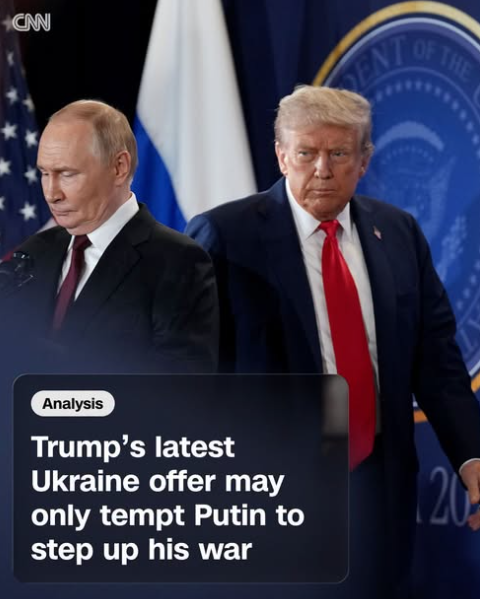
TRUMP'S LATEST UKRAINE OFFER MAY ONLY TEMPT PUTIN TO STEP UP HIS WAR — IS WASHINGTON MAKING A DANGEROUS MISTAKE?
President Donald Trump's latest proposal concerning the war in Ukraine is raising difficult questions about the future of the conflict and the strategy Washington is pursuing toward Moscow.
The central concern is whether Trump's approach could give Russian President Vladimir Putin an incentive to continue his military campaign rather than negotiate a lasting peace.
For Ukraine, the stakes are enormous. Any agreement that rewards territorial gains made through military force could affect not only the country's future, but also the security calculations of America's European allies.
TRUMP'S NEW SECURITY PROPOSAL LEAVES UKRAINE WITH MORE QUESTIONS THAN ANSWERS

On November 5, Trump met privately with Russian envoy Kirill Dmitriev, a senior representative of the Kremlin.
Following the meeting, Trump suggested that a broad agreement could emerge to end the war — potentially involving not just Ukraine but the entire European continent.
The following day, he described the idea as a major European security agreement, but offered few concrete details about what it would contain.
The proposal has attracted attention because it could reshape Europe's security arrangements. Yet without clear commitments, it remains difficult to determine what Russia, Ukraine and European governments would actually be expected to accept.
ZELENSKYY WARNS THAT THE PROPOSAL COULD BE DANGEROUS

Ukrainian President Volodymyr Zelenskyy has expressed concern about the emerging framework.
Speaking to CNN on November 6, Zelenskyy said he did not know many details of the proposal and warned that an agreement between Russia and Europe could be dangerous.
His position is that negotiations must first address the war itself, with credible security guarantees established afterward.
For Kyiv, the central concern is straightforward: Ukraine cannot accept an arrangement that leaves it vulnerable to another Russian invasion once a ceasefire takes effect.
Zelenskyy's warning highlights a fundamental disagreement over the sequence and conditions of any potential peace settlement.
WHY PUTIN COULD BENEFIT FROM A WEAK PEACE AGREEMENT

The greatest concern surrounding Trump's approach is whether Moscow could secure concessions without making meaningful compromises of its own.
Russia continues to demand control over Ukrainian territory it claims to have annexed, including areas its forces do not fully occupy. Moscow has also demanded restrictions on Ukraine's military and its ambitions to join NATO.
Ukraine rejects those demands, arguing that territorial concessions could reward the invasion and encourage further aggression.
The Associated Press has reported that the two sides remain far apart on territory and security guarantees, while Russian missile and drone attacks have continued despite renewed diplomatic efforts.
This is why critics worry that an agreement focused primarily on stopping the immediate fighting could give Russia time to regroup and prepare for future military pressure. That is a concern about the possible consequences, not proof that Putin has already decided to restart the war.
TRUMP'S ECONOMIC DEAL WITH RUSSIA ADDS TO THE CONTROVERSY

Trump's latest peace initiative follows another controversial development: an agreement for Russian diesel supplies to reach US and global markets.
The deal, announced in October, was presented by Trump as a way to ease fuel prices for American consumers.
But Ukrainian President Zelenskyy criticized the arrangement, arguing that it could provide Moscow with additional revenue while its military campaign continues.
Reuters also reported that US envoys had discussed the diesel arrangement as a possible way to encourage Russia to return to negotiations.
Critics argue that offering economic benefits before Russia makes substantial concessions could weaken Washington's leverage. Supporters of engagement may counter that economic incentives can help bring negotiations forward.
The unresolved question is whether such incentives will produce genuine Russian compromises.
EUROPE IS PREPARING FOR A FUTURE WITHOUT CLEAR SECURITY GUARANTEES

European governments are also confronting the consequences of any potential agreement.
Britain and France are preparing military exercises in Poland involving approximately 2,800 troops from 10 European countries. The exercises are intended to prepare for a possible postwar mission supporting Ukraine.
However, such a mission would only be deployed after a ceasefire, and major questions remain about its mandate, military protection and the level of American support.
Russia has warned that foreign troops in Ukraine would be considered legitimate targets.
These complications demonstrate why European leaders are demanding more than a general promise of peace. They need a workable security arrangement capable of deterring renewed aggression.
A CRUCIAL ROUND OF TALKS IS APPROACHING

The next major diplomatic test is expected on November 10–11 in Abu Dhabi, where American officials plan to mediate discussions involving Russia and Ukraine.
US envoy Steve Witkoff has said the agenda will include:
-
Postwar security agreements.
De-escalation measures.
Humanitarian arrangements.
Steps toward ending the war.
American negotiators have also held discussions with European representatives about Ukraine's security guarantees and the continent's broader security framework.
However, the fundamental disagreements remain unresolved. Ukraine wants credible protection against another invasion, while Russia continues to demand territorial and military concessions.
The upcoming discussions could clarify whether Trump's new proposal has a realistic path forward or whether the sides remain too far apart.
THE BOTTOM LINE
Trump is promoting a broader European security agreement after meeting Putin's envoy, but the proposal still lacks important details.
Zelenskyy has warned that the framework could be dangerous, while Russia continues to demand territorial and military concessions that Ukraine rejects.
The central issue is not simply whether Trump can bring both sides to the negotiating table. It is whether any agreement will prevent another invasion rather than give Russia an opportunity to strengthen its position.
Could Trump's latest peace offer actually encourage Putin to demand more — and leave Ukraine facing another war in the future?
Based on reporting available November 7, 2026. The suggestion that the proposal could encourage further Russian aggression is a concern raised by critics and Ukrainian officials, not an established outcome.
Comments (0)
Loading comments...
May You Like


NYC EMERGENCY—MILLIONS FACE EVACUATION RISKS, MACY'S GIANT BALLOONS REMOVED FOR SAFETY!

CAIRO INFERNO — CAR CARRYING SENIOR U.S. OFFICIAL SLAMS INTO FUEL TANKER, 31 DEAD, 21 INJURED!
Latest Posts








Popular Posts




