
Trump’s Medicaid Funding Rule for Transgender Youth: What Changed?
Trump’s Medicaid Funding Rule for Transgender Youth: What Changed?
The new federal policy restricts Medicaid and CHIP funding for specified treatments for minors—but it does not make all gender-affirming care illegal nationwide.
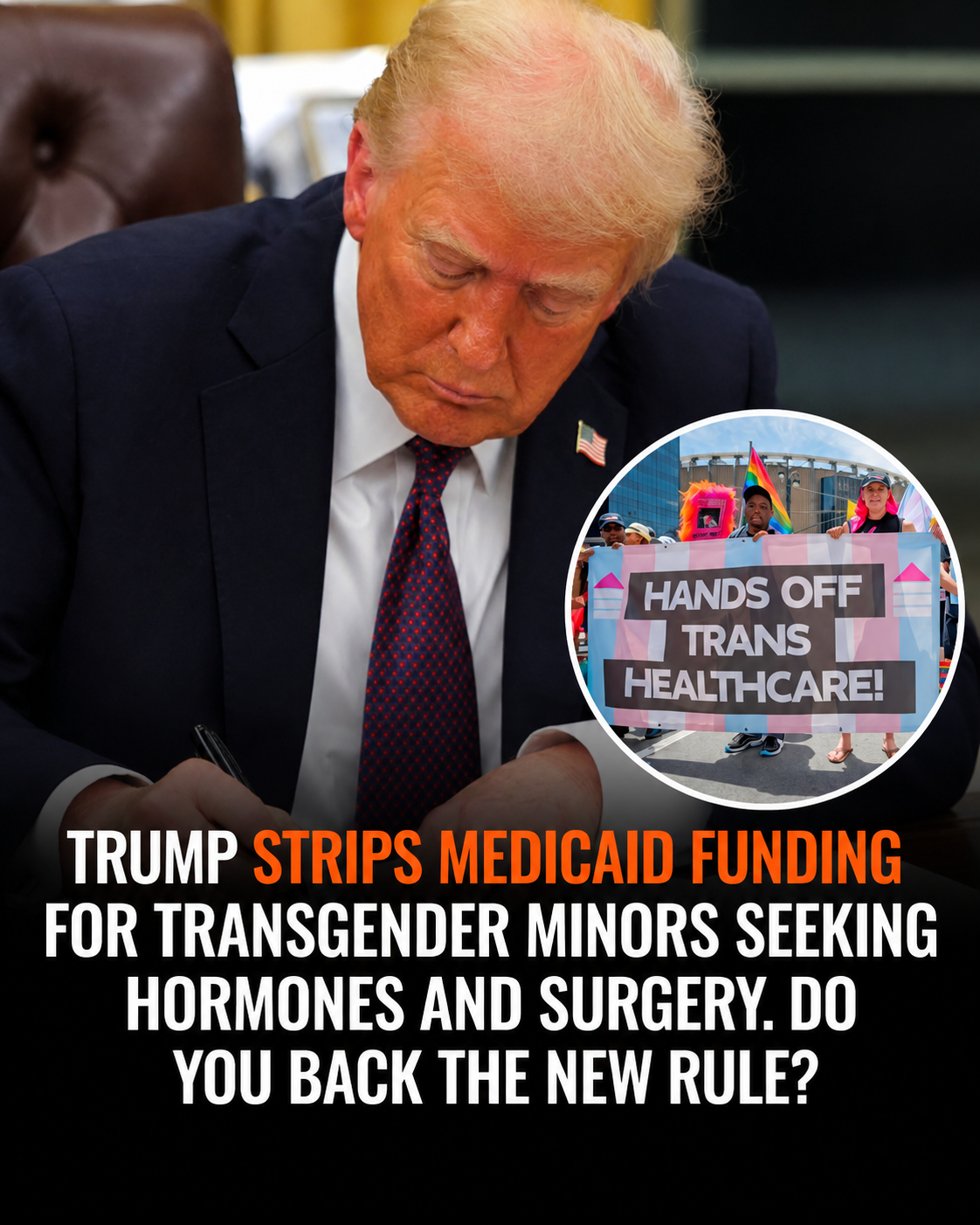
The Trump administration’s new restriction on federal Medicaid and Children’s Health Insurance Program funding for certain gender-affirming treatments for minors has become another flashpoint in the national debate over transgender healthcare. The rule took effect on October 13, 2026, after the administration finalized it in August. Its consequences will depend on the program, the treatment involved, state policy, and the outcome of ongoing lawsuits.
The graphic accompanying this article frames the change as Trump “stripping Medicaid funding” for transgender minors seeking hormones and surgery, then asks readers whether they support the rule. The underlying policy is real, but the headline needs an important qualification: the federal rule restricts federal Medicaid and CHIP dollars for specified treatments. It does not, by itself, make every form of gender-affirming care illegal nationwide.
The Centers for Medicare & Medicaid Services, part of the Department of Health and Human Services, issued the final rule in August. The government describes the covered interventions using the term “sex-rejecting procedures,” a politically and ideologically charged label that differs from the terminology commonly used by many clinicians and LGBTQ+ advocates. The rule applies to specified pharmaceutical and surgical interventions when provided to treat gender dysphoria in young people.
Under the rule, federal Medicaid funding cannot be used for the specified interventions for beneficiaries under 18. A parallel restriction applies to CHIP beneficiaries under 19. These age limits matter: the policy is not simply a blanket statement about every transgender person, every treatment, or every insurance arrangement.
The rule also distinguishes treatment purposes. Some medications discussed in the political debate can be prescribed for other medical conditions, including conditions unrelated to gender dysphoria. The federal restriction focuses on their use for the purposes defined in the rule; it should not be described as banning the medications themselves in all circumstances.
For young people already receiving certain hormone therapies, the rule provides a limited federal funding transition period of up to six months after the effective date. That is not an indefinite guarantee of continued coverage. Families and providers may need to seek guidance from their state Medicaid agency or health plan about how the transition applies to an individual case.

The rule does not eliminate Medicaid or CHIP coverage for mental-health services. The administration says eligible children will continue to have access to covered mental-health care, while critics argue that separating mental-health support from other aspects of care may not address the needs of every patient or family.
The administration’s stated rationale is that these interventions may carry serious or irreversible risks and that the evidence does not meet the standard it believes should govern public funding for minors. HHS has pointed to international reviews and changing approaches in some other countries. Those are the administration’s arguments for the rule, not a substitute for examining the quality, limits, and interpretation of the underlying medical evidence.
Opponents of the rule argue that medical decisions should be made through individualized assessment involving patients, parents or guardians, and qualified healthcare professionals. They say a categorical funding restriction can limit access even in states where care remains lawful and where clinicians consider a particular treatment medically appropriate. For families with limited incomes, losing federal reimbursement may be a substantial practical barrier.
The distinction between legality and affordability is central. The federal rule conditions access to federal program funding; it does not itself prohibit parents from seeking care through private insurance, out-of-pocket payment, or state-only funding where those options are legally and practically available. In reality, those alternatives may be inaccessible to many families, which is why the funding change can have effects beyond the formal text of the rule.
Medicaid is jointly financed by the federal government and the states, while CHIP also relies on federal-state arrangements. When federal matching funds become unavailable for a category of service, states that want to continue coverage may face difficult budget decisions. Whether a state uses its own funds, changes its coverage policy, or takes another approach can affect what patients experience on the ground.
A coalition of 21 states and the District of Columbia, joined by Pennsylvania’s governor, sued the administration in federal court in Massachusetts in September. The states argue that federal health officials exceeded their statutory authority and imposed a restriction that conflicts with the way Medicaid and CHIP have historically been administered. These are allegations in ongoing litigation, not a final judicial determination.

A separate case brought by New Hampshire families also challenges the rule. The families argue that it unlawfully limits treatment for transgender adolescents enrolled in Medicaid. As of late October, the case remained active, with a hearing on a request for a preliminary injunction scheduled for October 30. The existence of a lawsuit does not automatically suspend a rule; courts must issue appropriate relief for enforcement to be blocked.
The legal disputes raise broader questions about the balance of power between federal agencies and states. One issue is whether CMS has authority under existing federal statutes to make the funding restriction in this form. Another is how federal conditions on health-program funding interact with states’ responsibilities to administer programs and make coverage decisions under applicable law.
Supporters of the rule may view it as a responsible limit on the use of public money for interventions they consider insufficiently supported or potentially harmful for minors. Critics may view the same measure as federal interference with clinical decision-making that places additional burdens on families already navigating a complex healthcare system. A careful assessment should accurately represent both positions without presenting either side’s claims as settled fact.
The debate is also often distorted by treating all gender-affirming care as if it were one intervention. Care can include counselling and mental-health support, social support, medication, and, in some cases, surgery. These interventions differ in purpose, evidence, eligibility, reversibility, and clinical circumstances. The new federal funding rule covers specified interventions rather than every service that might be part of a young person’s care.
Surgery for minors is uncommon compared with other forms of care, according to reporting on the policy, but the rule’s practical reach is not limited to surgery. Hormone therapy and puberty-suppressing medication are also among the interventions addressed when used for gender dysphoria. That is why a headline focused only on surgery would miss a significant part of the policy’s effect.

The political question in the graphic—whether readers support the new rule—cannot be answered by a slogan alone. Voters may weigh public spending, parental authority, medical evidence, protection of minors, equal treatment, and state autonomy differently. They may also distinguish between opposing a particular treatment, opposing federal payment for it, and supporting a nationwide legal prohibition; those are not identical positions.
For families who may be affected, the most useful next step is to obtain case-specific information rather than rely on a social-media graphic. State Medicaid agencies, CHIP administrators, health plans, and treating clinicians can explain current coverage, transition arrangements, and lawful alternatives. Because court proceedings may change the policy’s status or scope, families should also check for updates from official agencies and reliable reporting.
The clearest conclusion is that the Trump administration has put a consequential federal funding restriction into effect, while legal challenges continue. The graphic captures a genuine and contentious policy shift, but “strips Medicaid funding” is most accurate when understood as a restriction on federal Medicaid and CHIP funds for specified treatments—not as proof that all transgender healthcare for minors is illegal or that every state must stop paying with its own money. The final impact will be shaped by litigation, state responses, and how the rule is implemented.
Comments (0)
Loading comments...
May You Like

WWE BRONSON REED DEAD AT 38, STIMULANTS DETECTED, $10M INSURANCE PAYOUT FROZEN!


WWE BRONSON REED—STAR COLLAPSES AT COMPANY EVENT, FATAL DRUG REACTION SUSPECTED!
MINNESOTA EMERGENCY — HOUSE EXPLOSION PUTS 2 HUNDRED FAMILIES AT RISK OF FIRE AND WINTER EVACUATION!











Popular Posts


