
Trump’s New Green Card “Public Charge” Rule Takes Effect as DHS Estimate Points to 950,000 Forgoing Benefits
WASHINGTON — Sept. 18, 2026 — A major change to the U.S. immigration system takes effect Friday as the Trump administration restores a broader “public charge” test that allows immigration officers to consider a wider range of government benefits when evaluating some applications for permanent residency.
The change does not mean that 950,000 immigrants will automatically lose or be denied green cards. The 950,000 figure is a Department of Homeland Security estimate of people who could choose to disenroll from or avoid enrolling in public assistance because of the policy’s potential consequences.
The rule has already triggered lawsuits from more than 20 states, the District of Columbia, and several major cities. Supporters of the policy say it restores the principle that immigrants seeking permanent status should be financially self-sufficient. Opponents argue that the broader standard could discourage families from using benefits for which they are legally eligible.


What Is the New “Public Charge” Rule?
The term public charge has been part of U.S. immigration law for generations. Under federal law, certain people seeking admission to the United States or adjustment to lawful permanent resident status can be found inadmissible if immigration authorities determine they are likely to become primarily dependent on the government for support.
The Trump administration's new policy rescinds a 2022 regulation adopted during the Biden administration and gives immigration officers broader authority to evaluate an applicant's circumstances on a case-by-case basis.
Officers can consider factors including an applicant's:
- Age
- Health
- Family circumstances
- Assets and financial resources
- Education and skills
- Potential use of certain means-tested public benefits
The expanded approach can bring programs such as Medicaid, SNAP food assistance and housing assistance into the assessment, depending on the circumstances of the case.
That represents a significant departure from the narrower framework adopted in 2022.
The 950,000 Figure Does Not Mean 950,000 Green Cards Are at Risk
One of the most important distinctions surrounding the policy has been blurred in some online descriptions.
The DHS estimate of approximately 950,000 people refers to a potential “chilling effect”: people in immigrant households who could decide not to enroll in, or to withdraw from, public benefit programs because they fear that using those programs could affect an immigration application.
It is therefore inaccurate to interpret the figure as meaning that 950,000 immigrants are being automatically rejected for permanent residency.
The number is also substantially larger than the estimated number of people who would actually undergo a formal public-charge review each year. DHS previously estimated roughly 588,000 adjustment-of-status applicants annually would be subject to the review, while noting that the potential behavioral effect could extend much further into immigrant households.
That distinction is central to understanding the headline circulating online.
Why Could Families Be Affected?
The policy has raised particular concerns about mixed-status households, where some family members are U.S. citizens or otherwise legally eligible for public assistance while another family member is seeking permanent residency.
For example, a family could include:
- A parent applying for a green card;
- A U.S.-citizen child;
- Another family member already holding lawful status; and
- Household members receiving means-tested benefits.
The fact that a family member receives benefits does not automatically mean the applicant will be denied.
USCIS officials have said benefits received by family members are not automatically treated as benefits received by the applicant themselves. However, officials may consider household circumstances when evaluating an applicant's overall financial situation.
That distinction has nevertheless contributed to uncertainty among immigrant families and advocacy organizations.
New York Attorney General Letitia James and other opponents of the policy argue that families could respond by abandoning programs they are legally entitled to receive.


Medicaid, Food Assistance and Housing Are at the Center of the Dispute
Under the Biden-era framework, the categories of benefits considered in public-charge determinations were significantly narrower.
The Trump administration's new approach restores broader consideration of means-tested benefits.
That can include programs such as:
SNAP: The federal food assistance program commonly known as food stamps.
Medicaid: Government-funded health coverage for eligible low-income individuals and families.
Housing assistance: Certain means-tested housing programs.
Other forms of assistance may also become relevant depending on the individual circumstances and the applicable immigration guidance.
The policy is not simply a rule saying that receiving one of these benefits automatically disqualifies someone from a green card. Instead, the benefits can become part of the broader assessment immigration officers make when determining whether an applicant is likely to become a public charge.
Trump Administration: Immigrants Should Be Able to Support Themselves
The administration has defended the policy as a restoration of the principle that immigrants seeking permanent residence should be capable of supporting themselves rather than relying primarily on government assistance.
USCIS Director Joseph B. Edlow said the administration was restoring what it described as the “basic principle” that immigrants should be able to support themselves while protecting public resources.
The official DHS rule similarly says the 2022 regulation was too restrictive and prevented officers from considering all relevant facts when evaluating public-charge determinations.
The administration's position is therefore that the new framework is not intended to punish ordinary use of government programs but to provide immigration officers with a broader picture of an applicant's ability to remain financially self-sufficient.
States and Cities Are Fighting the Rule in Federal Court
The controversy moved quickly into the courts.
On Sept. 14, a coalition led by New York, California and Illinois, joined by additional states and the District of Columbia, filed a lawsuit seeking to block the policy.
A separate lawsuit was brought by New York City and other local governments, including Chicago, San Francisco, Seattle and Santa Clara County.
The lawsuits argue that the administration exceeded its legal authority and that the policy could discourage people from receiving assistance to which they are legally entitled.
The states also argue that reduced participation could have consequences for state health-care systems, food programs and local governments.
New York officials have specifically argued that the policy could create uncertainty because families may not know which benefits could ultimately affect an immigration case.
The administration disputes those arguments and has defended the rule as consistent with federal immigration law.
Why the Rule Is Being Compared With Trump’s First Term
This is not the first time the Trump administration has attempted to broaden the public-charge standard.
During Trump's first term, DHS adopted a 2019 rule that expanded the types of public benefits that could be considered. The policy became the subject of extensive litigation.
The Biden administration subsequently stopped defending the rule and replaced it with the narrower 2022 framework.
The 2026 policy now reverses that change.
The new rule therefore represents a return to a broader approach that has already been at the center of major immigration-policy battles.
The 2019 Experience Shows Why the “Chilling Effect” Matters
The administration's critics are not focused only on actual green-card denials.
They are also concerned about what families might do before an immigration officer ever reviews their case.
During the earlier Trump-era policy, immigrant advocacy organizations reported reductions in participation in public-assistance programs among immigrant families.
A 2023 Urban Institute study cited by food-policy researchers found that one in six adults in immigrant families with children reported avoiding federal benefits because of concerns about immigration consequences after the earlier public-charge policy was announced.
The concern is particularly significant in households where U.S.-citizen children are eligible for benefits even though their parents may have unresolved immigration matters.
In such cases, opponents say, fear surrounding immigration status could influence decisions about children's health coverage, food assistance or other services.
What About Children Who Are U.S. Citizens?
A key point is that the rule does not eliminate U.S. citizens' eligibility for public benefits.
A U.S.-citizen child remains a citizen and can remain legally eligible for programs for which the child qualifies.
The issue is whether a noncitizen parent might become reluctant to enroll the child in those programs because of concerns about the parent's own immigration application.
That distinction has become a major part of the legal and political dispute.
New York officials have argued that the policy could effectively discourage families from accessing benefits even when those benefits are being received by U.S.-citizen children.
Not Everyone Is Subject to the Rule
The new framework does not apply identically to every immigrant.
Certain categories are exempt under federal law or have special protections.
These include various humanitarian categories, including refugees and people granted asylum, along with certain other protected groups. Afghan nationals working on behalf of the U.S. government are among the categories identified in reporting on the policy.
The exact application depends on the person's immigration category and the type of application being filed.
That means families should not assume that the general rule applies to every immigration case in the same way.
How Many People Will Actually Be Denied?
This remains an important unanswered question.
Historical data indicate that formal public-charge denials have been relatively uncommon compared with the enormous number of people potentially affected by the broader policy environment.
CBS News reported that between fiscal years 2020 and 2024, DHS recorded between 41 and 95 public-charge denials of adjustment-of-status applications annually. During the period when the 2019 Trump rule was applied, DHS identified only a small number of cases in which the broader public-charge analysis resulted in denials or notices of intent to deny, and those cases were later reopened or rescinded.
Those historical numbers do not predict what will happen under the new 2026 framework.
But they demonstrate why the 950,000 estimate should not be interpreted as a forecast of green-card denials.
The number represents a potential behavioral response to the policy, not a projected number of people who will lose permanent residency.
Why the New Policy Is Taking Effect Now
The final rule was issued in July after the administration moved to rescind the Biden-era regulation.
The government allowed a transition period before the new framework became operational.
USCIS announced that the new policy would take effect on Sept. 18, 2026, with applications submitted on or after the effective date subject to the revised framework.
That makes Friday a significant date for immigration applicants, attorneys and community organizations.
The legal challenges, however, mean the policy's future could still depend on federal court decisions.
What Happens to the Lawsuits?
The lawsuits filed by states and cities seek to prevent the administration from implementing the new approach.
Their legal arguments include claims that DHS exceeded its statutory authority and violated the Administrative Procedure Act.
The administration maintains that federal immigration law already gives the government authority to make public-charge determinations and that the new regulation restores a framework consistent with that authority.
The courts will therefore have to address questions that go beyond the practical effects on individual families, including the scope of DHS's authority and the legality of the regulatory change.
What the Viral Image Gets Right — and What It Leaves Out
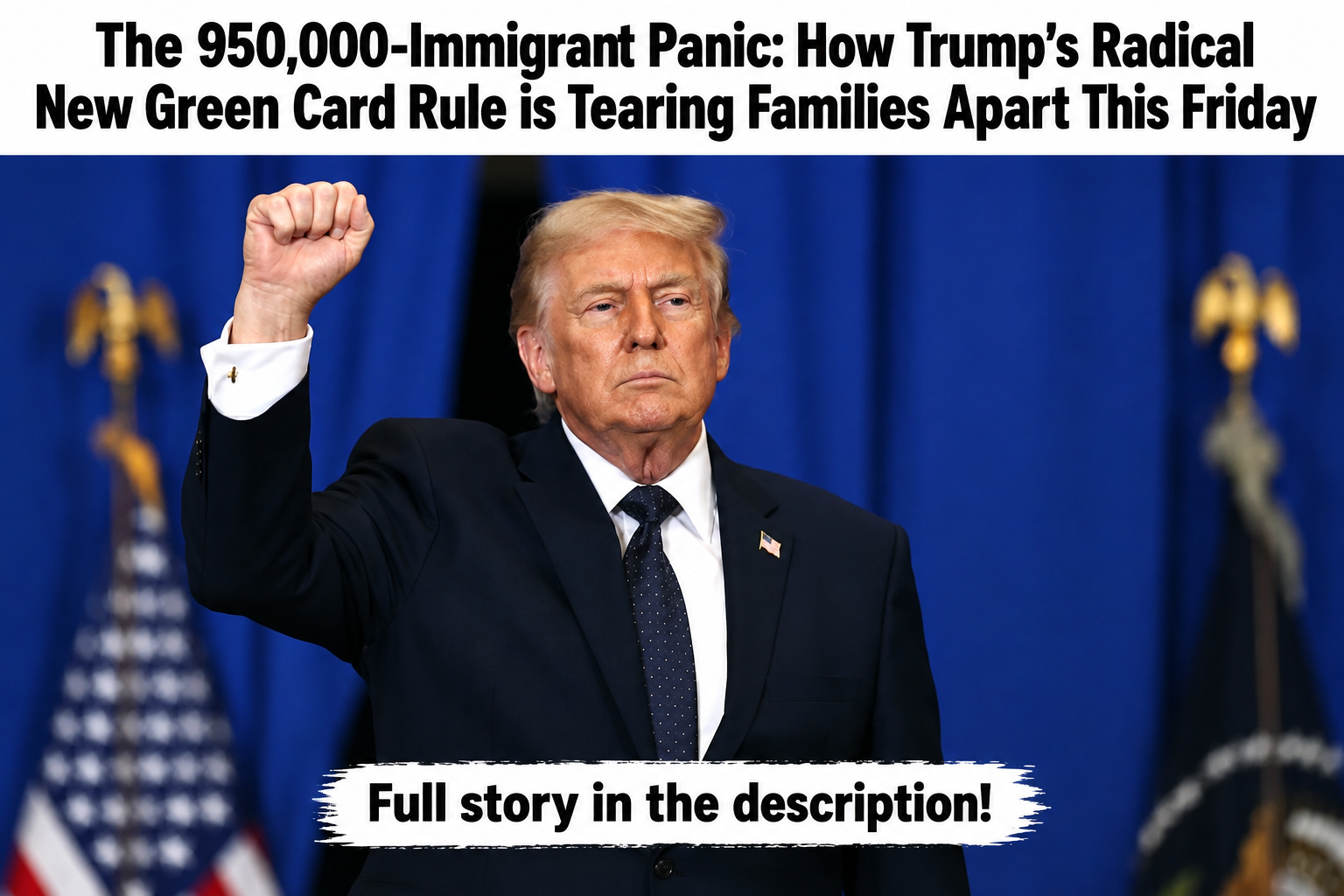
The image accompanying this story describes the policy as a “950,000-Immigrant Panic” and says the rule is “tearing families apart.”
Those phrases are highly charged descriptions rather than neutral descriptions of what the government has actually announced.
There is a real 950,000 figure connected to the policy, but it refers to DHS's estimate that about 950,000 people could disenroll from or decline to enroll in public benefits because of the rule's chilling effect.
The image does not establish that:
- 950,000 people are being denied green cards;
- 950,000 immigrants are being deported;
- receiving Medicaid automatically causes a green-card denial;
- receiving SNAP automatically makes someone inadmissible; or
- every immigrant family will be affected in the same way.
What the policy actually does is give immigration officers broader discretion to consider public benefits and an applicant's overall circumstances when making certain immigration determinations.
The practical effect will depend on how USCIS officers apply the framework, how courts rule on the challenges and how applicants and their families respond.
The Bigger Issue: Immigration Policy Meets the Social Safety Net
The dispute illustrates a broader tension in U.S. immigration policy.
The Trump administration is emphasizing self-sufficiency and limiting government dependence as part of its approach to legal immigration.
Opponents are emphasizing the potential consequences for health care access, food security and mixed-status families, particularly when U.S.-citizen children are involved.
Both sides are therefore focused on different parts of the same system: the federal government's authority to determine who can obtain permanent immigration status, and the ability of eligible residents to access public programs.
The significance of the Sept. 18 change may ultimately depend not only on how many green-card applications are affected, but also on how many families alter their behavior because they fear that seeking assistance could complicate their immigration status.
For now, one number has become the symbol of that uncertainty: 950,000.
But the number is an estimate of potential benefit disenrollment or avoidance — not a prediction that 950,000 immigrants will lose or be denied green cards.
Comments (0)
Loading comments...
May You Like
TRUMP HIT WITH 26 ARTICLES OF IMPEACHMENT

OBAMA STEPS BACK INTO THE POLITICAL SPOTLIGHT















