Trump’s PACT Act Makes Certain Severe Animal Cruelty a Federal Crime
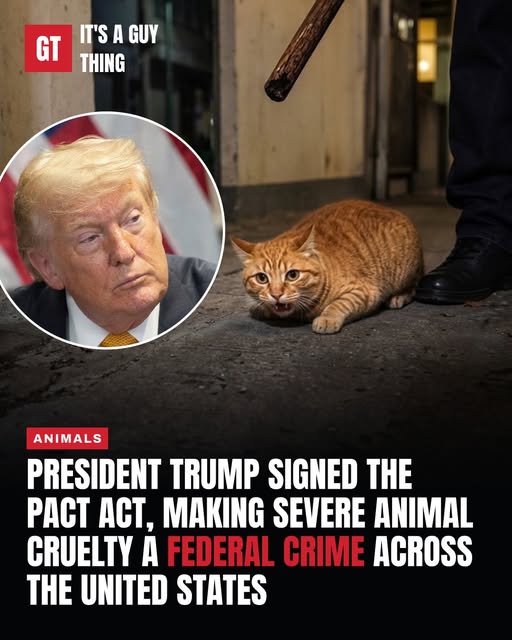
WASHINGTON — President Donald Trump signed the Preventing Animal Cruelty and Torture Act, known as the PACT Act, in 2019, creating federal criminal penalties for specific forms of serious animal abuse.
The law was approved by Congress before Trump signed it on November 25, 2019. It amended federal criminal law concerning animal crushing and certain animal-crush videos.
Despite the dramatic wording frequently used online, the PACT Act does not make every act of severe animal cruelty a federal offense throughout the United States.
Instead, the statute targets specific conduct, including intentionally engaging in animal crushing and knowingly creating or distributing animal-crush videos under circumstances covered by federal law.
The federal statute applies when prohibited conduct occurs in or affects interstate or foreign commerce, or within certain federal maritime and territorial jurisdictions specified by Congress.
Violations can result in fines, imprisonment of up to seven years, or both, giving federal prosecutors a significant criminal enforcement tool in qualifying animal cruelty cases.
When Trump signed the legislation, he called it an important measure and said animal cruelty should have been addressed by federal law much earlier.
The legislation followed years of congressional efforts to strengthen federal protections against particularly extreme forms of animal abuse that could cross state or national boundaries.


Since the law took effect, federal prosecutors have continued using the PACT Act as part of broader efforts to investigate and prosecute serious animal abuse cases.
In September 2025, the U.S. Attorney’s Office for the Central District of California announced an Animal Abuse Task Force specifically focused on prosecuting violations of the federal PACT Act.
The task force brings together federal prosecutors, the FBI, the Agriculture Department’s inspector general, local prosecutors, police departments, animal-control officials, and other law-enforcement agencies.
The California task force operates across seven counties, including Los Angeles, Orange, Riverside, San Bernardino, San Luis Obispo, Santa Barbara, and Ventura, an area containing nearly 20 million residents.
In August 2026, federal authorities announced a $5,000 reward and a dedicated FBI tip line seeking information that could lead to successful prosecutions under the PACT Act.
Officials said useful evidence could include photographs, videos, dates, locations, and descriptions of suspected animal abuse, giving investigators specific information to evaluate potential federal violations.


The renewed federal enforcement effort demonstrates that the PACT Act remains an active legal tool more than six years after Trump signed the legislation into law.
However, state governments continue to handle most animal-cruelty prosecutions because state statutes cover many forms of abuse that do not necessarily fall within federal jurisdiction.
This distinction matters because describing the PACT Act as making all severe animal cruelty a federal crime can create a broader impression than the actual language and jurisdiction of the statute.
The federal government must establish the specific legal elements of a PACT Act offense, while defendants in criminal proceedings remain entitled to due process and the presumption of innocence.


The law also contains exceptions covering certain activities, meaning not every action involving animals automatically falls within the federal prohibition established by the PACT Act.
Ultimately, Trump's 2019 legislation established a federal pathway for prosecuting particular extreme animal-abuse conduct, while recent Justice Department actions show authorities continuing to use that law in qualifying cases.
Sources & References
Comments (0)
Loading comments...
May You Like
Shocking news from Ohio: an unexpected development ahead of Trump's rally

Russian Drone Strikes Kyiv Bridge as German Chancellor Arrives in Ukraine

Russian Drone Strikes Kyiv Bridge as German Chancellor Arrives in Ukraine