Trump's Plan to Redirect $3 Billion from Harvard to Trade Schools: Rhetoric vs. Reality
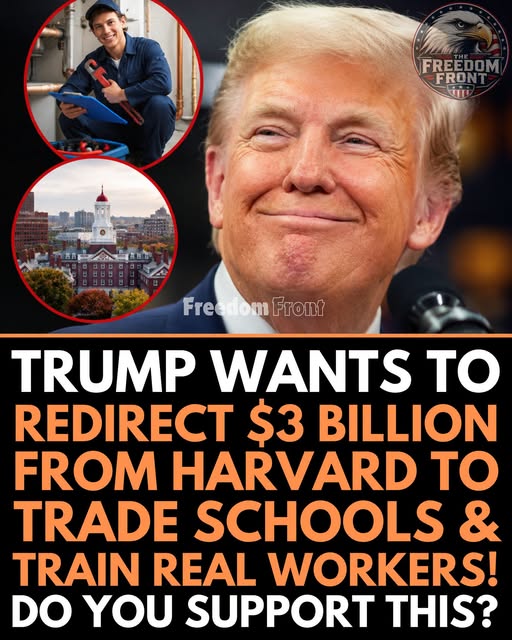
President Donald Trump has repeatedly stated he wants to take $3 billion in federal grants from Harvard University and redirect the money to trade schools across America. The proposal, framed as a blow against "antisemitic" elite institutions and a boost for working-class education, has energized his base. But the actual record reveals a significant contradiction: while Trump talks about supporting trade schools, his own budget proposals have slashed funding for the very programs that train skilled workers.
WASHINGTON – In May 2025, President Donald Trump posted on Truth Social: "I am considering taking Three Billion Dollars of Grant Money away from a very antisemitic Harvard, and giving it to TRADE SCHOOLS all across our land." The statement, which came amid a broader confrontation between the White House and elite universities, immediately went viral .
The proposal has since become a recurring theme in Trump's public comments. In September 2026, he told reporters that negotiations with Harvard were close to a $500 million settlement, with part of the deal including the opening of trade schools operated by the university .
"Linda is finalizing the final details," Trump said in the Oval Office, referring to Education Secretary Linda McMahon. "Harvard will run trade schools and train people for artificial intelligence and other technologies" .
But the reality behind the rhetoric is more complicated.
What the $3 Billion Actually Represents
The $3 billion Trump refers to is not a discretionary fund under his direct control. According to reporting by Samaa TV and other outlets, most of that money is appropriated by Congress for the National Institutes of Health (NIH) to disburse for biomedical research after a lengthy application process by individual scientists — work that is not typically done at trade schools .
Trump's administration froze roughly $3 billion in federal grants to Harvard, prompting the university to sue. Harvard argued that the cuts were an unconstitutional attack on its free speech rights and unlawful .
Whether Trump could legally redirect those funds to trade schools remains an open question. Legal experts have noted that congressionally appropriated research funds cannot simply be reassigned at the president's discretion.
The Rhetoric vs. the Budget
While Trump has positioned himself as a champion of trade schools and vocational education, his administration's budget proposals tell a different story.
According to analysis by New America, Trump's fiscal year 2027 budget request slashes more than $800 million in funding for community colleges — the primary providers of career and workforce education in the United States .
Specifically, the budget proposes:
-
Making community colleges ineligible for grants under the Carl D. Perkins Career and Technical Education Act, a $1.4 billion program that funds equipment, faculty training, and services for low-income students and students with disabilities
Eliminating all funding for the $715 million Adult Education and Family Literacy Act, which supports education and training for people without a high school credential
Eliminating the $65 million Strengthening Community Colleges Training Grant Program at the Department of Labor
Cutting the National Science Foundation budget by 54 percent, making it unlikely that its $74 million Advanced Technological Education program would survive
The Bloomberg editorial board summarized the contradiction bluntly: "Trump Loves Trade Schools. So Why Does He Want to Defund Them?"
The Harvard Settlement: What It Actually Entails
The ongoing negotiations between Harvard and the Trump administration have evolved significantly since the initial $3 billion proposal.
According to multiple reports, the settlement under discussion would involve Harvard paying approximately $500 million to resolve the dispute, with some of that money potentially going to trade school programs .
Trump has described the arrangement as Harvard running trade schools itself. "They wanted to do a convoluted job training concept, but it was turned down in that it was wholly inadequate and would not have been, in our opinion, successful," Trump said in September 2026, suggesting the initial proposal was rejected .
By early 2026, Trump had escalated his demands, saying the administration would seek $1 billion in damages from Harvard and "want nothing further to do, into the future, with Harvard University" .
The Broader Political Context
The proposal to redirect Harvard's funding to trade schools fits into a broader political strategy. As the Harvard Kennedy School's commentary noted, Trump's approach is "a transparent and cynical ploy: pit one segment of the education community against another — rich Harvard versus poor 'trade schools' — and watch the divisions take hold" .
The commentary warned that this strategy "only works if institutions, elite or otherwise, fall for the bait" .
Trump has framed the effort as a matter of national priorities. In his Truth Social post, he argued that "the labor market needs concrete skills, not ideological centers" and that redirecting the money would be "a great and badly needed investment for the US" .
The Bottom Line
| Claim | Reality |
|---|---|
| Trump wants to redirect $3 billion from Harvard to trade schools | He proposed it, but the funds are mostly NIH biomedical research grants not easily redirected |
| The plan would boost vocational education | Trump's own budgets have proposed cutting over $800 million from community college workforce programs |
| Harvard will run trade schools under a settlement | Negotiations have evolved; a $500 million payment is under discussion, but the trade school component remains unclear |
| This is a done deal | No formal policy has been enacted; the proposal remains a negotiating position and political talking point |
Trump's rhetoric about trade schools resonates with voters who feel that elite universities have abandoned working-class Americans. But the gap between his words and his budget proposals raises a fundamental question: Does the president actually support vocational education, or is he using it as a political cudgel against institutions he views as hostile?
The answer, based on the available evidence, appears to be both. The $3 billion Harvard proposal serves as a potent political symbol. But when it comes to actual funding for the trade schools he claims to champion, the record tells a more complicated — and contradictory — story.
Comments (0)
Loading comments...
May You Like

South Korea–Ukraine Rift Deepens Over North Korean POW Transfer as PURL Draws New Scrutiny
TRUMP’S OHIO WARNING UNDER THE SPOTLIGHT
OBAMA STUNS ON INSTAGRAM: MESSAGE MARKING 34-YEAR MILESTONE SPARKS A BUZZ