Trump’s Pressure Campaign and the China-Russia Relationship: Is the “Axis” Actually Getting Stronger?
President Donald Trump’s second-term foreign policy has placed unprecedented pressure on major U.S. rivals and trading partners through tariffs, sanctions, export controls and diplomatic bargaining.
Yet the same period has also produced a paradox.
Washington is simultaneously pressuring China and Russia while maintaining channels for negotiations with both. Beijing and Moscow, meanwhile, continue expanding their strategic cooperation and coordinating positions on issues ranging from trade and energy to Western sanctions.
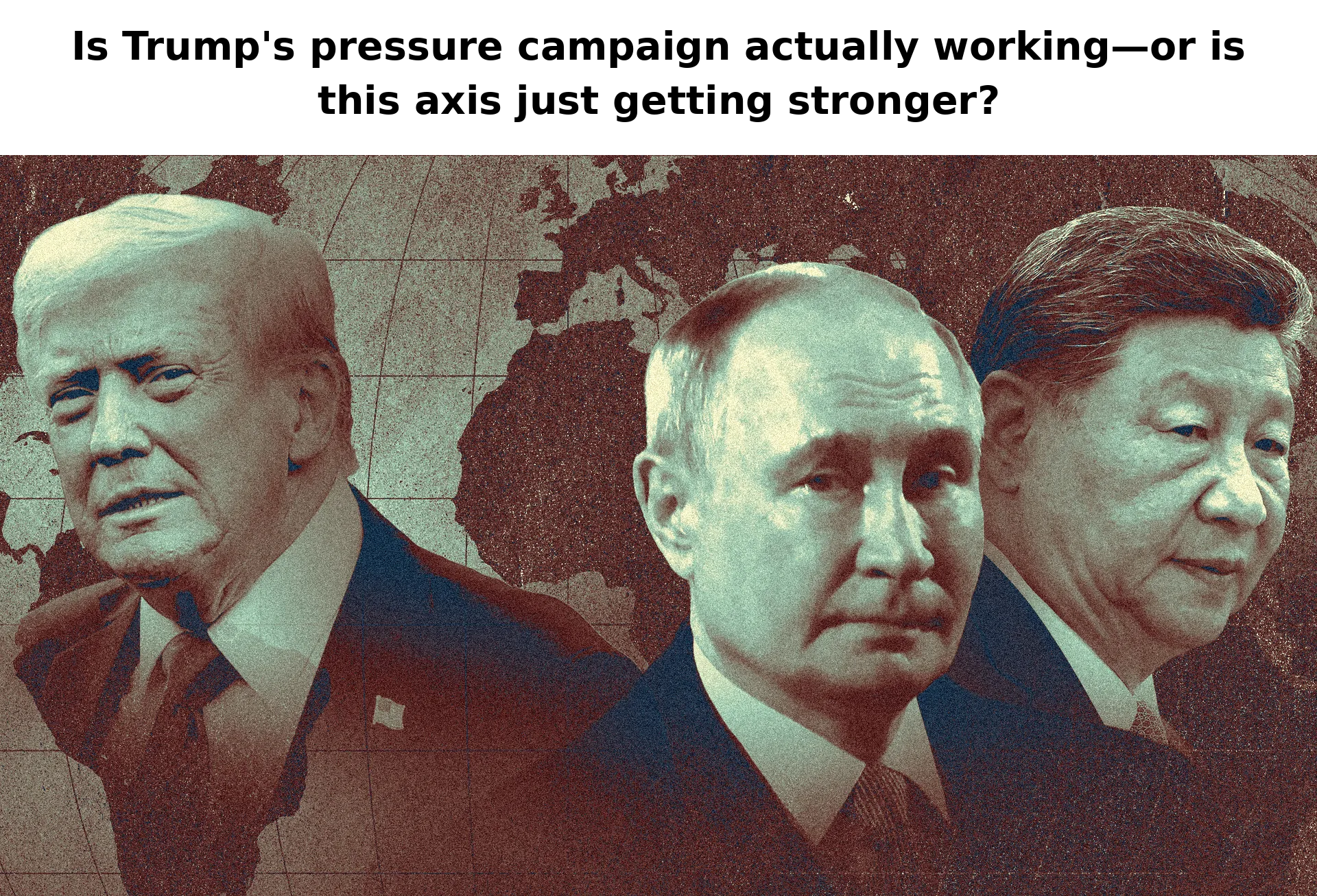
The result is a geopolitical picture that is more complicated than the image's question — “Is Trump’s pressure campaign actually working — or is this axis just getting stronger?”
There is evidence supporting both parts of that question, but the available record does not establish that China and Russia have formed a formal military “axis” against the United States.
What it does show is a durable China-Russia strategic partnership developing while Washington tries to use economic and diplomatic pressure to change the behavior of both countries.


Trump Is Applying Pressure on Both Moscow and Beijing
The clearest evidence of Washington's pressure campaign is economic.
The House of Representatives is currently considering the Lindsey O. Graham Sanctioning Russia and Iran Act of 2026, a sweeping sanctions bill that would increase pressure on Russia's energy and defense sectors.
The legislation would also authorize the president to impose tariffs of up to 100% on countries that continue buying significant amounts of Russian energy, potentially affecting major Russian customers such as China and India.
The Senate previously passed the measure 86-11, and Trump has indicated that he intends to sign it if Congress sends it to him.
That is a significant escalation because the proposed sanctions would not only target Moscow directly.
They could also raise the economic cost for countries that continue maintaining major commercial relationships with Russia.
China would be particularly important because it remains one of Russia's largest economic partners.
But Washington Is Still Negotiating With China
At the same time, Trump is preparing for another meeting with Chinese President Xi Jinping.
Treasury Secretary Scott Bessent said he plans to meet Chinese Vice Premier He Lifeng this weekend, ahead of the scheduled Trump-Xi summit on September 24.
The two governments are reportedly discussing reductions in selected tariffs, including measures involving U.S. energy and agricultural exports and Chinese manufacturing inputs. Bloomberg reported that the discussions could involve roughly $30 billion in reciprocal tariff reductions under an earlier framework.
That creates an important distinction.
Trump's policy toward China is not simply a campaign of permanent economic isolation.
It combines:
Tariffs and trade pressure
Technology restrictions
Financial and sanctions pressure
Negotiations
Potential tariff reductions
High-level presidential diplomacy
The objective appears to be obtaining concessions while preserving the ability to negotiate.
A Singapore-based RSIS analysis published earlier this month similarly concluded that the latest U.S.-China sanctions and countermeasures appeared designed to build leverage ahead of the Trump-Xi summit rather than permanently break economic relations.
China and Russia Are Continuing to Deepen Their Relationship
While Washington is applying pressure, Beijing and Moscow continue to describe their relationship as a strategic partnership.
Russian President Vladimir Putin has repeatedly characterized Xi Jinping as a reliable partner and described Russia-China cooperation as expanding across economic, security and international affairs.
A recent Russia-China joint statement described their relationship as having reached its highest level in history and committed both countries to deeper cooperation in political, security, military, economic and international affairs.
At the same time, the two governments explicitly stated that their relationship is not a formal military-political alliance of the type that existed during the Cold War.
That distinction is important.
Calling China and Russia an “axis” may be useful as shorthand in political commentary, but it should not be confused with a formal alliance treaty committing Beijing and Moscow to fight alongside each other.
Their cooperation is broad, but it has its own limits.
The Economic Connection Is Becoming More Important
China has become increasingly important to Russia's ability to withstand Western economic pressure.
Russia has lost much of its access to Western markets and financial systems since the invasion of Ukraine.
China has remained a major destination for Russian energy exports and a significant source of manufactured goods, technology and industrial inputs.
A September 15 assessment by the Institute for the Study of War said Chinese companies were supplying Russia with materials used in the production of kamikaze drones, while also supplying Iran with air-defense equipment through arrangements designed to bypass sanctions.
The assessment cited internal Russian shipping documents showing that a Chinese state-owned company supplied carbon-fiber-related materials to a sanctioned Russian company involved in drone production.
These allegations are significant, although they represent an analytical assessment rather than a new U.S. government finding establishing that the Chinese government itself authorized every transaction described.
The broader pattern is nevertheless clear: economic links between China and Russia continue to provide both countries with alternatives to Western markets and suppliers.
Russia Is Also Looking to BRICS
The China-Russia relationship does not exist in isolation.
Russia is increasingly using the BRICS framework to promote alternative economic and diplomatic relationships outside the Western-led system.
At the September BRICS summit in New Delhi, Putin argued that the group should develop more practical cooperation in technology, infrastructure, payments and investment.
India and Russia also discussed increasing bilateral trade toward $100 billion by 2030, despite continuing U.S. pressure on countries purchasing Russian oil.
China's Xi Jinping was also present at the summit.
But BRICS itself should not be treated as a unified anti-American alliance.
The group contains countries with very different interests.
India, for example, maintains substantial defense and economic relationships with the United States while simultaneously maintaining close energy and defense ties with Russia.
The September summit itself demonstrated internal disagreements over the Iran war and other geopolitical issues.
Trump's Russia Strategy Is Different From His China Strategy
The image places Trump, Putin and Xi together, but Washington's relationships with Moscow and Beijing are currently operating through different channels.
With Russia, Trump is trying to negotiate an end to the war in Ukraine while maintaining the possibility of increased economic pressure.
The White House confirmed that special envoys Steve Witkoff and Jared Kushner traveled to Moscow on September 5 to meet Putin, then traveled to Kyiv to meet Ukrainian President Volodymyr Zelenskyy.
That diplomacy remains active.
At the same time, Congress is moving toward additional sanctions against Russia.
This produces a two-track strategy:
Diplomacy: negotiate over Ukraine.
Pressure: increase the potential economic cost of Russia's continued war.
Those policies may appear contradictory, but they can operate simultaneously.
The China Track Is Moving Toward a Major Summit
The Trump-Xi meeting scheduled for September 24 could become one of the most consequential diplomatic encounters of the month.
Ahead of the summit, officials are discussing trade, tariffs and economic relations.
The two countries are also preparing for their first formal bilateral talks on AI safety, according to Reuters. The talks are expected to address risks associated with advanced AI systems and possible cooperation between U.S. and Chinese AI researchers.
That is another example of the relationship's complexity.
Washington and Beijing can simultaneously:
- Compete over advanced technology
- Restrict sensitive exports
- Fight over tariffs
- Negotiate agricultural trade
- Discuss AI safety
- Prepare presidential meetings
A complete economic rupture is therefore not what the current evidence shows.
China Has Its Own Reasons for Working With Russia
Beijing's relationship with Moscow also cannot be explained solely as a response to Trump.
China and Russia share several long-term strategic interests.
These include:
Energy: Russia is a major supplier of oil and gas to China.
Military cooperation: Both countries conduct exercises and maintain extensive defense ties.
Diplomacy: Beijing and Moscow frequently coordinate positions at the United Nations and other international institutions.
Alternative financial systems: Both countries have an interest in reducing dependence on Western-controlled financial infrastructure.
Technology and industrial supply chains: Russia increasingly depends on Chinese imports for goods that became harder to obtain from Western countries after sanctions.
But their interests are not identical.
China remains considerably more economically dependent on global trade than Russia and has strong commercial relationships with Europe, the United States and other developed economies.
That gives Beijing incentives to avoid a complete break with the West.
Pressure May Be Producing Negotiations — But That Is Not the Same as Strategic Alignment
One of the most important developments this month is that U.S. pressure has not stopped diplomacy.
In fact, negotiations are occurring on multiple fronts.
The Trump administration is:
Talking to Beijing about tariff reductions.
Preparing for a Trump-Xi summit.
Sending envoys to Moscow.
Discussing a possible Ukraine settlement.
Pushing Congress toward tougher Russia sanctions.
Considering tariffs against countries that continue buying Russian energy.
This suggests that Washington is using pressure partly as a bargaining mechanism.
Whether those tactics ultimately produce the concessions the administration seeks is a separate question.
The available evidence as of September 16 does not establish a final outcome.
But There Are Signs the China-Russia Partnership Is Becoming More Resilient
At the same time, several developments point in the opposite direction.
China continues trading extensively with Russia.
Russia continues to depend on China for important industrial goods and components.
The two countries continue coordinating diplomatically.
Both participate in BRICS.
And both have an interest in reducing their vulnerability to Western sanctions and financial restrictions.
The Institute for the Study of War's September assessment goes further, arguing that Chinese supplies to Russia and Iran are allowing Beijing to gain economic and technological benefits from real-world military conflicts.
That does not prove that Beijing and Moscow are creating a unified military bloc.
But it does show why the relationship has become increasingly relevant to U.S. strategy.
The Biggest Test May Be Whether Pressure Changes Beijing's Calculus
The upcoming Trump-Xi summit provides the clearest near-term test.
If Washington and Beijing reach agreements on tariffs, energy, agriculture or technology, it would demonstrate that economic pressure can coexist with negotiation.
If talks stall and both governments increase tariffs and technology restrictions, the relationship could move in the opposite direction.
Either way, the summit will provide more concrete evidence than the current political imagery.
The same is true for Russia.
If the U.S.-Russia diplomatic track produces a durable Ukraine agreement, Washington's approach toward Moscow could change substantially.
If negotiations fail while sanctions increase, the economic confrontation could deepen.
What the Viral Image Gets Right — and What It Leaves Out
What is supported by current reporting:
✓ Trump is applying substantial economic pressure to Russia.
Congress is considering a major sanctions bill that could also authorize tariffs against countries buying Russian energy.
✓ The United States is applying pressure to China while simultaneously negotiating with Beijing.
Bessent is preparing for talks with China's He Lifeng before the Trump-Xi summit.
✓ China and Russia maintain a deep strategic relationship.
Both governments describe their partnership as historically strong and expanding across multiple sectors.
✓ China-Russia economic and technological ties remain significant.
Recent assessments cite Chinese supplies reaching Russian defense-related industries.
✓ Trump is also maintaining direct diplomatic channels with Putin.
U.S. envoys met Putin in Moscow this month as part of Ukraine peace efforts.
What the image oversimplifies:
⚠ China and Russia are not formally a Cold War-style military alliance.
⚠ Their cooperation does not mean they agree on every issue.
⚠ U.S. pressure has not ended diplomatic engagement with either country.
⚠ The available evidence does not establish that Trump's pressure campaign has either “defeated” or “strengthened” the China-Russia relationship as a whole.
The situation is still developing.
So, Is the “Axis” Getting Stronger?
The most defensible answer from the evidence available on September 16, 2026 is that China-Russia strategic cooperation remains substantial while U.S. pressure has increased — but the two developments should not automatically be treated as cause and effect.
Russia and China have their own longstanding strategic relationship.
Trump's administration is simultaneously attempting to pressure both countries and negotiate with them.
And Beijing and Moscow are responding differently to those pressures according to their own economic and security interests.
The next major milestones are already visible:
September 24: Trump-Xi summit.
Late September: further U.S.-China economic negotiations.
Ongoing: U.S.-Russia diplomacy over Ukraine.
September: congressional action on expanded Russia sanctions.
November: potential Trump-Putin-Xi trilateral diplomacy around the APEC summit, an idea Russia has said it has not ruled out.
Those events will provide a much clearer indication of whether pressure is producing concessions, deeper resistance, or a combination of both.
For now, the international picture is not a simple three-country confrontation.
It is a system of overlapping negotiations, sanctions, trade relationships and strategic partnerships — with Washington, Beijing and Moscow each trying to preserve as much leverage as possible.


Suggested SEO Setup
SEO Title:
Trump’s Pressure Campaign vs. China-Russia Ties: Is the Axis Getting Stronger?
Alternative Headline:
Trump Pressures China and Russia as Beijing and Moscow Deepen Strategic Ties
Meta Description:
Trump is escalating tariffs and sanctions while negotiating with China and Russia. Here’s what the latest moves reveal about the evolving China-Russia partnership.
Slug:trump-pressure-china-russia-axis-2026
Category:
World News / U.S. Politics / China / Russia / International Affairs
Tags:
Donald Trump, Xi Jinping, Vladimir Putin, China, Russia, U.S. Foreign Policy, China-Russia Relations, Russia Sanctions, China Tariffs, Ukraine, Trump Xi Summit, BRICS, Trade War, Geopolitics
Comments (0)
Loading comments...
May You Like
Jack Smith Defends His Integrity as Trump Investigations Face Renewed Political Firestorm